UPDATE:
It’s been about a year since I wrote this post when I made a batch of walnut ink. I’ve been using it regularly and it’s delicious, silky, smooth and rich. It seems to be lightfast, no signs of fading on any of the pieces, although I’ve been careful to use best quality acid-free paper like Fabriano and Saunders.
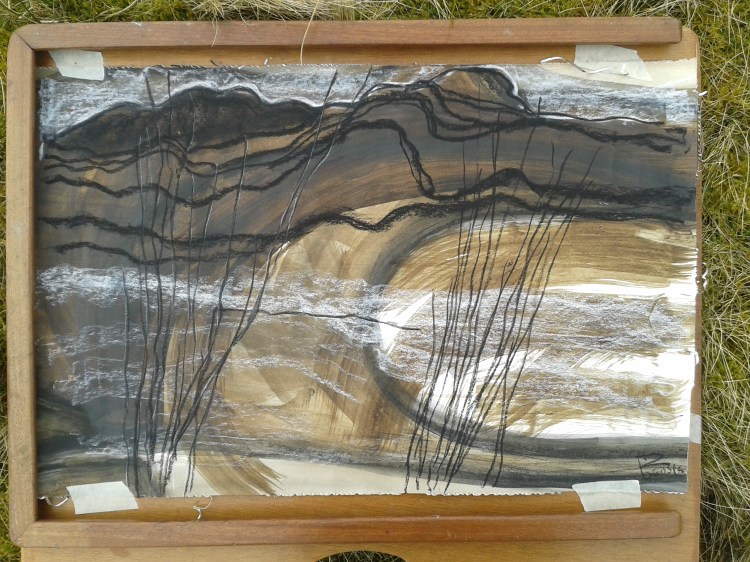
Here’s the most recent drawing, in carbon and white conte crayon overlaid onto a background of walnut ink.
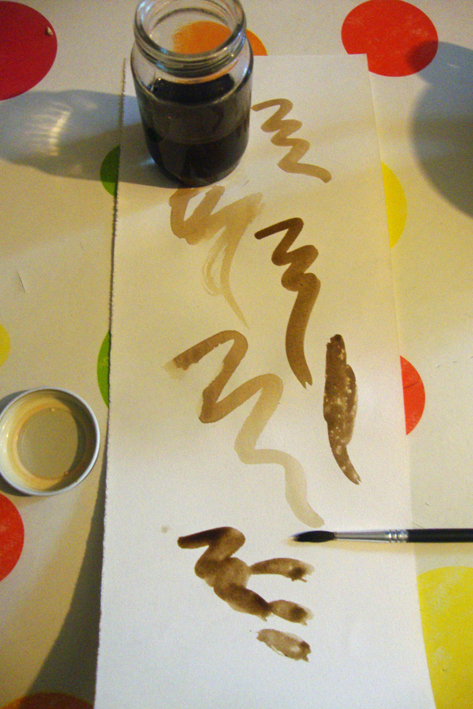
So today I finally finished the walnut ink I started a couple of weeks ago. A friend gave me 4 fresh walnuts (juglans regia) in their husks. I peeled them and left the husks to stand in a basin of water for about a week and a half. They went very black and mushy. I put the basin, covered with tin foil, into a slow cooker with hot water coming up to half way and left it on the lowest setting overnight, letting it cool completely for another day and night.
Then I strained it through a ‘J’ cloth into a large jar and tested its strength on a bit of cartridge paper. It was quite pale so I boiled it on the stove and reduced it, checking occasionally until it was a decent sepia colour. There wasn’t much to bottle, about a quarter of a tea mug. The recipes I’ve looked at online suggest adding up to 20% surgical spirit (rubbing alcohol) as a preservative, but there’s so little that I think I’ll use it up pretty quickly. I’ll do some drawings with it and leave them in the light until this time next year. If they haven’t faded, I’ll see if I can get hold of a larger amount of husks and make some more.
 scribblah
Reblogged this on scribblah and commented:
I’ve updated this post about the time I made some walnut ink
That looks a lot stronger than the imitation walnut ink I have.
I made up a second batch with 40 husks and it made a litre of a very dark sepia, silky ink. It’s delicious to use and virtually free to make. Just find someone with a walnut tree.
what fun! I am impressed that you got even this much ink from 4 husks – doesn’t sound many husks to me. Is it basically a tannin? If so, perhaps you could combine it with a recipe for iron gall ink with the walnuts instead of the oak galls? That dries to a blacker colour with a blueish sheen when you put it on thick. Can’t remember how well it stands up to light, but I think possibly better than the tannin on its own, with the slight issue that it can eat the paper over time!
I’m not sure if it’s a tannin. The husks stain badly and the J cloth I used can’t be washed clean. Some recipes add iron to make the ink black, but I wanted the warm sepia. Everything I’ve read says the ink is lightfast, but I just want to make sure. It certainly gives a lot of ink from very few husks.
Its a lovely warm colour – it will be interesting to see how lightfast it is. So nice to have something so organic!
Everything I’ve read says it’s colourfast, but I won’t do anything for sale with it until I’ve left some test pieces for a year. Just to satisfy myself 🙂
Very interesting. Thank you so much for showing and sharing. Have a happy day! 🙂
Thank you. You’re welcome 🙂
This looks very good! Congratulations.
Thank you. It was fun to do.
Such a lovely sepia color! Thanks for sharing your process, Rosie. I have a batch going now and just tested the color, but like yours, it will need a bit more concentrating. I’ve read the light-fastness is good, but doing your own test is wise.
Thanks, Mary. I’m looking forward to testing it out.