The Hard Stuff.

Drawing of drapery.

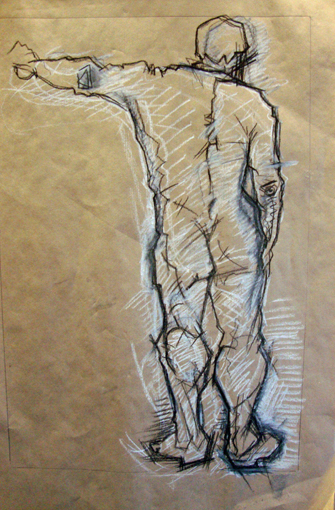
I did a couple of days training in Renaissance drawing techniques last week and day two was taken up with drawung drapery. It was really HARD. Give me a naked body anyday! Renaissance artists tend to draw drapery as if it’s sculpted – I found out why – it often was! They used to dip cloth into plaster and drape it the way they wanted and then let it set before using it for drawings and paintings.  I did the warm-up exercise and preliminary study above with pen, graphite and chalk. I wasn’t happy with it, way too far out of my comfort zone.

I’m happier with the one below; it took ages but I felt that I was starting to get somewhere with it, beginning to understand the tonal values. Normally I concentrate on line and studying and replicating complex tones in such a detailed way was very difficult for me. It made me realise that I need to do far more work on this.

Chalk and charcoal drawing.


Distorting To Fit [parental guidance, male nude]

Mixed media drawing: male nude.

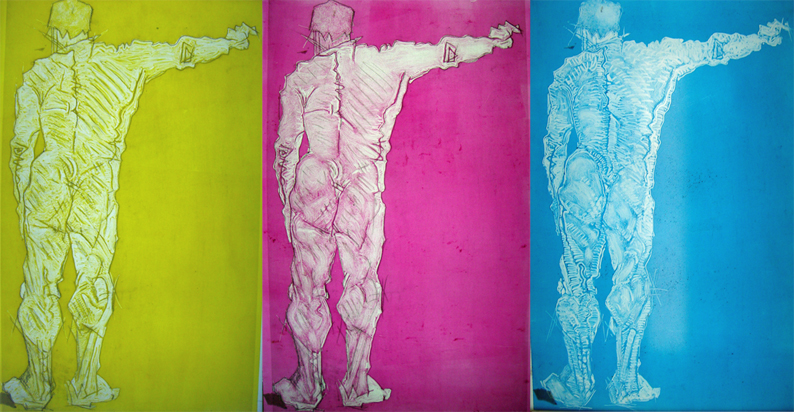
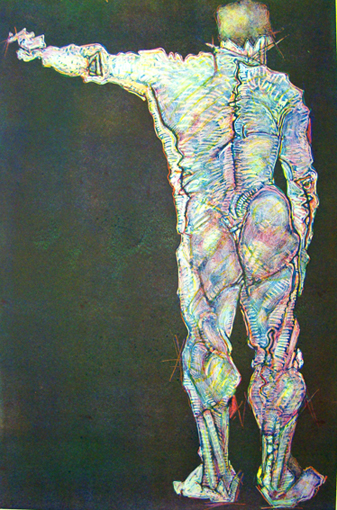
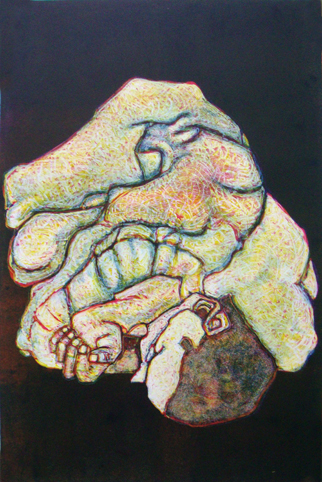
Last week I spent a couple of days doing some training in Renaissance drawing techniques but earlier in the week I finished this piece which had started out as a smaller drawing in my sketchbook. I was working within a specific size, which is my printing plate for monotypes because this will eventually become one of my large colour monotypes as well. I struggled with it for a while because I couldn’t get it to fit the space, but I took some time out to study some of Egon Schiele’s drawings and it gave me the confidence to distort the body quite considerably until it fitted. Schiele did it all the time and so did many Renaissance artists. They constantly looked for the patterns and ‘truth’ underlying the visual world and weren’t averse to altering what was in front of them to conform to what they considered to be ‘divine’ rules of nature. So I’m in good company, eh? 🙂

I did a lot of preparation on the ground underneath the drawing, stretching a large piece of Somerset and priming it with several layers of rabbit-skin glue, which gave it a lovely satin sheen. I washed over it with three layers of watered-down acrylic paint in yellow ochre, permanent rose and phthalo blue respectively. Finally I worked over the surface randomly with willow charcoal. And only then did I begin to draw, firstly by rubbing away the highlights from the charcoal background with a bit of rag, letting the drawing emerge. Then I worked it up with compressed charcoal and oil bars. This is based on a life drawing done with a young soldier model.

Things To Do With A Seagull

Quill and ink life drawing.

I’ve been on a two-day course in Renaissance-style drawing at Swansea Metropolitan University – which used to be the Art College. It was very thorough and we used the sort of paper and drawing materials that were available back in the days of Leonardo and Michaelangelo. Paper was scarce and expensive so they tended to make little drawings, using both sides of the paper and cramming as much on as possible. There were no pencils [check out the history of pencils at the Most Excellent British Pencil Museum] so they used silverpoint instead. They drew in ink using nib pens and quills made from bird feathers. Swansea, being a seaside city, has an enormous population of seagulls and their feathers are a very good size for quill pens. And so we were supplied with a pile of seagull feathers that had been bleached to get rid of any lurking lurgis and cut with a scalpel and off we went. The quill was surprisingly soft and almost brush-like, flowing across the paper with a free and easy, albeit blotchy, line. It wasn’t possible to do any detail with it but it’s good for rough sketching and blocking out a composition. I used white chalk to add highlights to the drawing above.

Sketch with quill, dip pen, ink and chalk.

Our teacher asked us to do a drawing with different media, using a rougher medium for the overall drawing and focussing in on a detailed section with a finer medium. I used a seagull quill and sepia ink for the main drawing above and a fine nib pen and chalk to develop the detail in the left hand. The local seagulls are a nuisance who rip open bin bags, cover cars with guano and steal food from small children, so it’s good to find something they’re useful for.

The Lego Riot Police experience an existential dilemma

This is a very funny short comedy animation from a very talented Welsh writer and filmaker. Made me Laugh Out Loud 🙂


The Lego Riot Police experience an existential dilemma.

Drawing With Silver

Portrait in silverpoint.

I’m very lucky to have been invited to study on an intensive two-day course in Renaissance drawing. Today was day 1 and I did some work in Silverpoint. I’d heard about it and admired reproductions but I’d never seen a Silverpoint tool before. The handle is a smooth barrel of wood like an etching needle but the point is a piece of silver wire, apparently 99% pure. It can be used flat or as a very sharp point, but you have to be accurate because it can’t be rubbed out. It seems that Renaissance artists didn’t use the technique for quick scribbling, it was for careful studies. The paper is coated with a special Silverpoint Medium; I don’t know what’s in the modern one, but back in the day it was supposedly ground bone in some sort of animal glue. Nothing wasted eh?

The drawing room was very full so I moved in close to the model. She wore a wig which had been elaborately plaited – daVinci was particularly fond of drawing plaits. I loved it. It helps that I normally draw directly in ink, without sketching in pencil first, so I had the confidence to get stuck in without worrying too much about accuracy. It’s a small drawing, about A5 onto prepared hand-made paper and took about 20 minutes.  I like the technique so much I might put a Silverpoint tool in my letter to Santa. 🙂

My Tiniest Model Ever.

Ink sketches: baby heads.

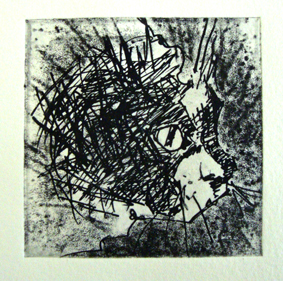
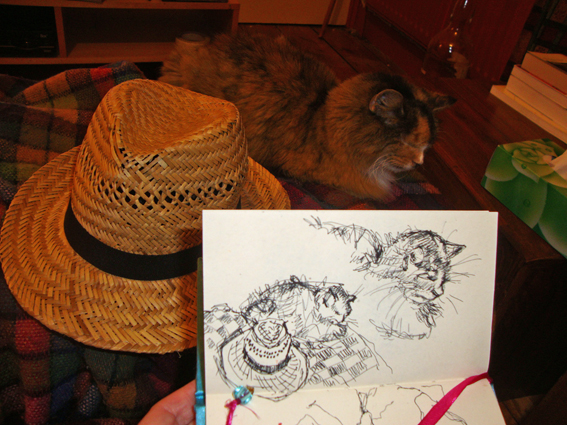
So this is my tiniest model ever; my new great-nephew aged eighteen days. He’s adorable. Nevertheless he’s a real pain to draw. Babies and children have such weird heads, all scrunched-up tiny faces set in the bottom bit of an enormous skull. And they’re either bald or have male-pattern baldness [even the girls] or have hair like upended mops. Terrible to draw! Anyway, the little darling was sleeping in the crook of my arm while I balanced my tiny sketchbook on top of him and drew with the other hand using a Faber Castell Pitt size S. I love his little squidged-up hands bent over and around each other, with dimples instead of knuckles. And funny little skinny nostrils. He’s actually much prettier than this. I haven’t done him justice. See how hopelessly in love I am?

An Older Male Model

Charcoal and pastel life drawing.


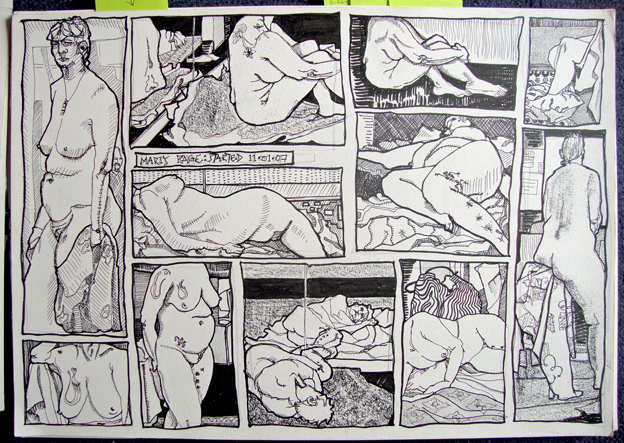
Well, as I’ve been posting a spate of life drawings of our younger male model, I thought it’s about time our older male model got a look-in. It’s great to be able to draw people at different stages in their lives and it makes me appreciate the beauty of the human body at all ages, not just when people are young and allegedly in their prime. I find the obsession with youth in our media distasteful; I’ve always had much older friends and mentors and we need to appreciate the experience, wisdom and confidence of our elders, not marginalise them and try to stop ourselves from ageing. It’s just stupid and vain.

It took me a long time to be able to draw this model accurately, although come to think about it, that’s true for most of the models I’ve worked with :). I’ve drawn with compressed charcoal and soft chalky pastels into my 30 x 30 cm Bockingford sketchbook, drawn across both pages.

More Male Nudes [parental guidance].

Ink sketch: male nude.

Here’s another of my most recent life drawings, working with our soldier model. I’ll be back in the studio tomorrow and I’ll begin working this up as a mixed media drawing. When I was doing it I was concentrating very hard on the hand and it’s a little bit larger than it appeared in real life, despite the foreshortening. It reminded me of something in Martin Gayford’s recent book of conversations with David Hockney, who spoke of how, when we look closely at something, it becomes bigger; it assumes greater importance. This makes traditional Renaissance geometric perspective a construct, it isn’t really what’s happening [according to Hockney] and it often does not feature in non-European art.

Contorted Man [parental guidance]

Ink sketch: male nude.

I had a really productive session at life drawing group on Thursday, getting in some good practice pieces and also some drawings that I’ll continue to work on to eventually turn into full-colour monotypes. Here’s one of them. Our model is a young soldier who poses for us between tours of duty. His army chums think he’s really brave to do life modelling; he reckons it isn’t as bad as being shot at! Because he’s very fit, he’s able to hold difficult poses, especially contrapposto – the ones that twist the body and put muscles and joints under a lot of stress. He held this for thirty minutes. I don’t think that artists’ models get the credit they deserve. It’s a hard job, much harder than most people imagine. The pay is OK but not brilliant and it’s difficult to do it as a permanent career.

I concentrated on trying to get the relationship between his head and hand right. It was tough because of the twist on the arm, which was quite severely foreshortened. But I like being pushed. Just as well really 🙂 It’s a Faber Castell Pitt pen size S into a 30cm square Bockingford sketchbook.

Head Hands and Feet

Ink sketch.

Went to my weekly life drawing group at Swansea Print Workshop last night and had a really good session with three drawings that I think I might be able to work up eventually into large monotypes. Towards the end I sat back and just had a bit of a practice with the head, hands and feet, always the problem areas for me. This model has a very striking face which I find hard to draw so it’s good for me to get in a bit of practice. It’s a reasonable likeness. His hands were in a very complex clasp and I’m pleased with the way they’ve turned out. I used a Faber Castell Pitt pen size S into an A3 Bockingford sketchbook.

Today I helped interview artists for the upcoming residencies for the ‘Drawn To Print’ project at the Print Workshop. We had an excellent shortlist and appointed three fabulous artists who base their printmaking practice on fantastic drawing competence. The first one starts in a few weeks and I can’t wait!

Here’s a bit of trivia – Heads Hands and Feet was the name of a British rock band in the early 1970’s.