The Celtic/Welsh May Cat, Y Gath Mis Mai

Pastel drawing: The Welsh May Cat.

Sparta, our two-year old tortoiseshell [calico] cat is simultaneously a tiny, sweet, adorable, cuddly little kitty and a rampaging murderous scourge of anything smaller than her that moves. Worse than that, she brings her prey into the house. People tell us she’s bringing us ‘presents’ but you know, I’d rather go without her little gifts. The worst thing of all is that they’re often alive when she throws them at our feet and we’ve often had to deal with terrorised rats, mice, voles and birds trapped in the house.

This morning we found a fairly large rat hiding in our hallway; it had probably been there all night. We devised a strategy to try and get it out the front door as it didn’t seem to be injured and it’s horrible to have to kill an animal. It was hysterical with fear and it’s not a good idea to get too close to a panicked rat, but eventually it rushed out the door. And all the while Sparta lolled about on top of the boiler in the kitchen, looking bored!

My father-in-law, who is a fluent Welsh speaker, told me about the Welsh ‘Cath Mis Mai’ translated as ‘The Month of May Cat’. According to Welsh tradition, you should avoid giving a home to a kitten born after the month of May as they will invariably bring their prey home. Sparta’s birth month? September!

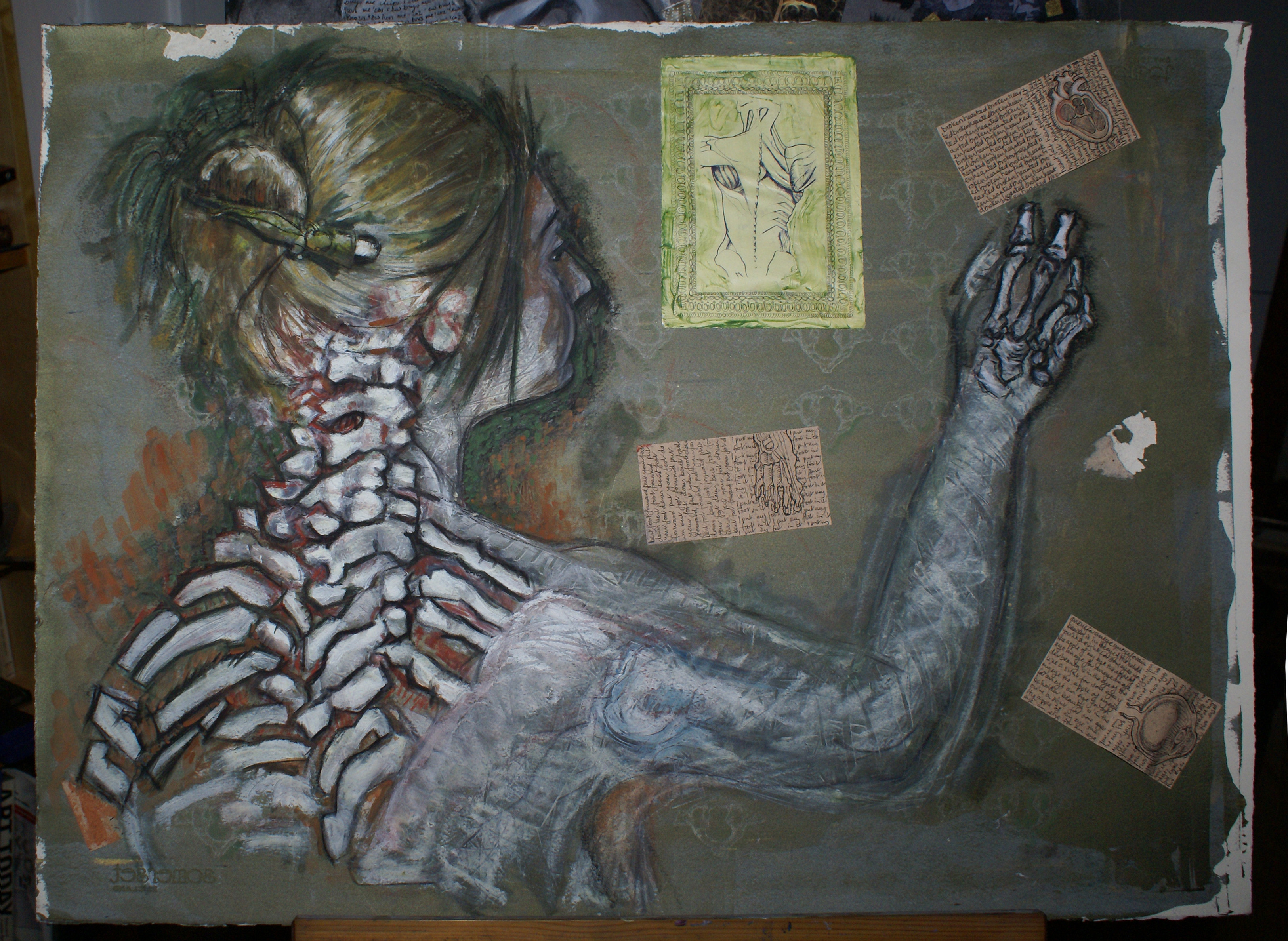
Here she is in a pastel drawing I did on BFK Rives 250 gms paper that I had previously coloured with acrylic pigment mixed with acrylic medium and metallic powder.


Printmakers – the Misers of the Artworld?

Drawing on recycled paper: The Yellow Towel.

All the serious printmakers I know never ever throw anything away. Left-over ink is carefully wrapped in cling film, prints that haven’t worked out are recycled for drawing or collage, paper stencils are carefully peeled off screens and applied to a background sheet as a unique monotype/collage, old bits of wooden furniture and offcuts of signwriters foamboard are used for blockprints and scraps of paper left over from editioning are used for proofing. It goes without saying that newspapers, old clothes and plastic bags all play their part in the endless cleaning up that is the lot of printmakers.

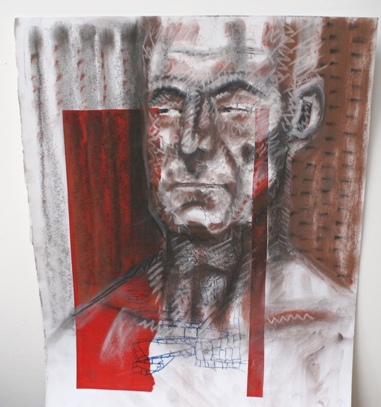
This drawing was done onto a large piece of Bockingford 250gsm that had been discarded by someone after a cyanotype course. It’s around A2 size and worked up in compressed charcoal, black conte crayon and white and yellow oil bars. The original is a much smaller ink drawing in one of my sketchbooks, which I did at life drawing group.


The Soaked Bride of Meenagahane

Driving along the County Kerry coast with husband and young niece, we followed a small road down a steep, narrow valley to a tiny inlet with an old stone jetty and a few ancient cottages. A friendly geriatric collie dog ran out of one of the gardens and showed us around the tiny bay. The waves were crashing over the jetty which was covered in a thin slimy seaweed – the old dog was used to it but we skidded around all over the rough stones. While we were exploring, a wedding party in cars and a minibus pulled into the small carpark and walked down to the pier, the bride shivering in a beautiful but skimpy gown and veil. The groom was in full formal dress but everyone else was casual and there was a photographer and film cameraman with the group.

Ink sketch: The Soaked Bride of Meenagahane.


To our surprise, the bride and groom, photographer and cameraman walked to the end of the jetty, stepped into a little wooden boat and rowed to a small rocky island a few hundred yards across the bay. The happy couple clambered up to the top of the steep rock and after holding hands for a few minutes for everyone to take photographs, they leapt fully clothed off the cliff into the choppy sea. We were gobsmacked! Some of the wedding party saw our faces and came up for a chat, explaining that it’s common in Ireland for newlyweds to have their formal wedding photos on the big day and then arrange an ‘adventure’ photoshoot for another time, things like skydiving, scuba diving, bungee jumping and, as we saw, jumping off precipitous islands into the sea!


It’s challenging sketching in circumstances like this. It was cold and wet, everyone was moving around a lot and it stretched my speed drawing skills! I did these two little sketches which are very rough and I was tempted to redraw them from photos that Husb took, but I decided not to because they captured a few moments in time and a particular set of events in a very spontaneous way. I had no idea what the couple were going to do when I made the drawings, but Husb has a great video of them jumping off the island [here’s a link to it – http://www.facebook.com/video/video.php?v=492822355829 ].


The Little Art Deco Chair

My dear Aunty Nin saved hard, putting money aside every week from her wages from the stall in Swansea Market where she worked. She paid the money directly to the best furniture store in Swansea and eventually after a couple of years she had a new leather suite- a settee and two chairs, delivered to her tiny council house on a new Garden City-style council estate called Townhill. It was 1934 and the furniture was small, boxy and classically Art Deco, in brown leather with French-polished wooden trim. The suite was already middle aged when I remember bouncing up and down on it in the mid-‘60s [we weren’t supposed to bounce on the furniture of course] and another generation of family children bounced on it throughout the 1980’s.


Ink drawing: The Art Deco Chair.


When she became too frail to live at home and went into care when she was nearly 90, the little Art Deco suite came to me. It was by then badly ripped and the springs had gone and the wooden trim was scuffed and the stuffing was pushing its way out and various relatives thought it should be thrown out, but we bought some cheap cotton throws to cover it and saved hard for the next couple of years until we could afford to have it renovated. Eventually we had enough money and a local restoration company rebuilt it using traditional craft methods. It’s like a brand new suite but with the original design intact.

And now another generation of small children crawl over it when we’re not looking,

Are you bouncing on the settee?”

Silence.

I’m sure I heard someone bouncing on the settee.”

Little fingers point at the cat.


An ink drawing into my Daler-Rowney hardbound sketchbook, 150gms.


Just a Quickie

Ink Drawing: Knitting at the Green Man Festival.


Just a very quick blog tonight because I’ve been at the studio all day then I was working at the opening of the exhibition at The Brunswick all evening and just got back home. Here’s a sketch I did a couple of years ago at The Green Man Festival in Usk, a beautiful part of Wales. Very laid back festival, this lady had positioned her chair on the main field and knitted throughout the set. Patterned socks they seemed to be.


The Sad Tale of William Pink

A couple of years ago I went to an exhibition at our local gallery and amongst the eclectic mix of curiosities was Smugglerius, an écorché of a smuggler who was skinned after being hanged at Tyburn in the eighteenth century. An écorché is a sculpture cast from a flayed body. The original Smugglerius was made by Agostino Carlini in bronze in the classical pose of The Dying Gaul, but this has been lost and only plaster casts, made by William Pink in the 1850s, remain and this écorché was nicknamed after him.  It used to be common for art students to draw from écorchés.

Ink drawing: William Pink and a festival fan.

I was visiting the exhibition with my sister, who is not an artist and she found William Pink utterly horrifying, so I went back a few days later to draw him.  At first I looked at him dispassionately, thinking it was just a plaster cast, but the amazing detail of the flayed body gradually made me feel more uncomfortable and I was eventually overcome with compassion for this poor soul who had lived in much more brutal times. Nobody is sure of his identity or even if he really was a smuggler – he might have committed some truly terrible crimes, but equally he might have been hanged for something relatively trivial, as so many people were in those sad days.

I took this sketchbook with me a few weeks later to the Green Man Festival in the lovely Usk Valley. I spent a happy few days wandering round listening to fab music, Jarvis Cocker headlined, and I sketched people around me. I noticed this young man sitting in a similar pose to William Pink and drew him on the same page. I am struck by the difference in their existences; the privileges we take for granted and how we are so lucky that our lives are relatively untouched by brutality and extreme poverty.


Really Artgeek Stuff – from Sketch to Drawing to Monotype [PG]

Just completed a new large full-colour monotype using the 3-colour reduction method.

Drawing, monotype and ghost.

I started off with a sketch which I did in a life drawing session then I developed it into a larger drawing [bottom image] in compressed charcoal, graphite block and white oil pastel onto a sheet of recycled Bockingford 250gsm paper. It had been used for a cyanotype and then thrown away – that’s the bluish colour you can see in places.  Then I traced it and used the reverse of the tracing to do a 3-colour reduction monotype, a method similar to that used by the Impressionists Degas and Monet.

I did the first two layers, in Process Yellow and Process Red on Saturday afternoon and went back to Swansea Print Workshop this morning to do the final layer in Process Blue. This method gives a lovely rich black and a full range of colours. I print onto BFK Rives 250gms using oil-based litho/relief inks thinned with plate oil. The method gives one full colour print [the centre image] and one ‘ghost’ monotype [the upper image]. Degas used to work over his ghost images with pastels and these are now possibly famous than his paintings.

This is REALLY geeky stuff isn’t it? 🙂

The Man With Huge Hands and the Cholesterol Special

We put up the next exhibition in The Brunswick this morning – 8.30am start on a SUNDAY!!!!! It’s looking fantastic [here’s a link to it’s Facebook site if you want to see more – http://www.facebook.com/event.php?eid=130341270397734 ].  Anyway, we finished just before lunch and after heading home to dump the tools and have a cuppa with Mike, who’s one of the exhibiting artists, we went off to our local greasy spoon café and ordered a couple of Full Cooked Breakfasts – proper cholesterol specials. I know we’ve shortened our lives by a decade or so but what the heck! Sometimes you just got to have some comfort food.

While we were waiting for our full-fat-feast to arrive, I did this sketch of some of the other diners. The man who is the main subject has the biggest hands I’ve ever seen. They look particularly large in the drawing because of foreshortening, but they’re still huge. I’ve seen him around for years but have never spoken to him. He has a very sad face. After I draw people I often wonder if I should have chatted to them but when I’m drawing I’m so absorbed in what I’m doing that I’m totally cut off and it never occurs to me until later.


Ink drawing: The Man With Huge Hands.


We headed home for a bath and a nap to sleep off the humungous FCB and then I prepared a rice pudding and put it in the oven on a very low heat while we went to the allotment and put in a couple of hours. I planted 150 onion sets, 30 potatoes [hoping to get some for Xmas] and a dozen garlic and then netted the onions and garlic to stop birds and rodents from pinching them. I checked the recent plantings – spinach beet, pak choi, stripy beetroot, Autumn carrots, winter ‘Spring’ onions and mooli radish and they’re all doing fine. I have to use slug pellets but I cover the beds with old net curtains and weight them down at the sides so wildlife can’t eat the few dead slugs that get through the barrier.

Digital photo: My Rice Pudding.

Then back home for this gorgeous rice pudding, made the traditional way with sultanas, butter and loads of nutmeg. We scoffed it all.


Things to Do With a Four Inch Screw

Instead of lino or wood for making block prints, I use offcuts of ‘Foamex’ signwriters’ foam board, which local firms throw out, so it’s free AND recycled. It isn’t easy to cut with conventional cutting tools as the blades need frequent sharpening, which I do with a leather Slip Strop, but it’s very easy to press and incise using old biros, nails, screwdrivers and chisels. I made my own specialist tool with a four-inch screw with a bit of masking tape wrapped around it – low tech and very cheap. I like this method.

I can incise very straight, fine lines with the four-inch screw and a steel ruler. Most soft woodblocks would split and fray at the edges with such fine lines, and lines in lino would probably distort when going through a press but this method gives lovely crisp lines. The screw also makes a fine dotted texture if you just jab it in repeatedly.  I also like to use a cross-head screwdriver to punch textures into the surface – it’s very therapeutic! Flat head screwdrivers and small chisels can be tapped onto the surface with a tiny toffee hammer. Biros give a lovely scribbly texture but are a bit hard on the hand as it takes a fair bit of pressure. I think this method involves far more mark making and is much nearer to drawing than using lino or wood.


Foam block ready to print.

This is a foamblock ready to print. It’s a portrait based on a drawing I made from a photograph I took during a trip to Pakistan a few years ago. I used conventional cutting tools for part of it, along with my four-inch screw to do the lines and dots and a cross-head screwdriver to do the decoration on the hat. The photo was taken after I’d cleaned it up after a printing session.

Block print: Islamabad Man #1.


This is the block printed up. I did an edition of 20, printed in Intaglio Printmakers black litho/relief ink onto Zercoll 145gsm paper, using a Colombian press which was made in 1855. I love it – there’s a carved brass plate on it and a large cast-iron gryphon that rises up when you pull the handle. Class!


King Coal’s Sacrifice

Charcoal and graphite drawing.


One morning when I was eleven years old our headmistress announced at assembly that a coaltip had engulfed a small primary school in a village just a few miles away. That village was Aberfan and almost 150 tiny children and their teachers were crushed and suffocated to death that dreadful day. I remember the silent sadness that hung over the school and when I went home, walking down our street, grown-ups were out talking to each other and openly weeping. I had never seen adults cry before.

And now another mining tragedy has hit South Wales as four miners died today in the Gleision pit in Cilybebyll, again just a few short miles away. We live our lives enjoying our wonderful standard of living but it’s only on days like this that we ever stop to think of the real cost of our consumerist lifestyles; the people labouring miles below ground in filthy, backbreaking conditions all over the world and the terrible cost to them and their families.

Sudden death,  burns, crippling injuries, wicked lung diseases that rot miners from the inside over many painful years before death finally claims them. And too many work in countries, for companies, that don’t have anywhere near the safety standards or free healthcare that we have here in Britain. These tragedies have been happening for centuries and they’ll keep on happening because we’ll keep on buying the goods that they provide the raw materials for.  And it will go on and on ….

This is a drawing in compressed charcoal and 6B graphite block into an A2 layout pad.