Doing what the Brits do best ‘Writing A Letter!’ A rant from a professional grumbler lol
Doing what the Brits do best ‘Writing A Letter!’ A rant from a professional grumbler lol

Had a lovely evening last night, visiting a friend’s house for a meal, conversation, music, molestation by a wet cat etc…… Our friend is a fabulous chef and put on a Middle Eastern spread of mezze followed by tagine. Then some of the chaps cleaned up and here’s one of them doing the dishes. It occurred to me how times have changed. When I was growing up, we didn’t have people round for a meal; there was barely enough food for the family and it was plain British grub – no-one would have a clue what an olive was, let alone mezze and a tagine. And as for men cleaning up?!? Unheard of. Things are so much better now 😀
The cat, Puss Puss, loves water and kept going out into the storm, getting absolutely soaked then coming in, drying herself on the guests and diving back out into the torrential rain again. We reverted to good old-fashioned British grub for dessert – rhubarb crumble – yum!

I hate shopping. I don’t understand why people love it. I’m happy to spend hours browsing in art supplies shops and tool shops but general shopping, in malls and stuff, I loathe it. Husb is the same, so after an hour or so in the city centre earlier we bolted to the cafe in Waterstones bookshop and chilled out for a bit with a nice hot drink and a biscuit. Hot drink necessary because this is a British summer, so it’s cold and wet outside. Did my usual of scribbling away at the people around me. The young man on the left seemed to be a student studying hard while the man on the right was with his wife and child and sported the sort of outrageous hat I haven’t seen since the 1970’s – they were called Donny Osmond hats back then. The man below was immensely tall with huge hands that dwarfed his cup of tea.
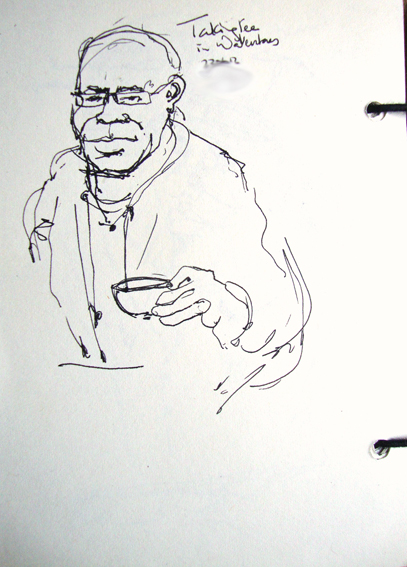
Scribbled in a couple of minutes each with a Faber Castell Pitt drawing pen [size S] into an A6 leatherbound, recycled sketchbook. When I got back from town, I transplanted a couple of loganberry plants that had tip-rooted themselves in my rhubarb patch using the first of our home-made compost made in one of the council’s free compost bins. The plants are destined for the gardens of friends. I love loganberries, but the fruits don’t last long so I guess they’re not suitable for growing commercially.

Midsummer’s Day and we have torrential rain! It’s humid and horrible but it was life drawing as usual this evening down at Swansea Print Workshop. I made an elderflower and lemon drizzle cake for tea break and set out to do something different with my drawings tonight. I did a short course in Renaissance style drawing a few weeks ago and I’ve done the first day of a phtotpolymer printmaking course this week. I’m hooked on the technique but the plates are quite expensive so I’ve decided to start working on A6. My usual full-colour monotypes are A1, so there’s a huge difference. I prepared some handmade paper [bought from the Tate Gallery – it’s gorgeous and wasn’t too expensive] with sepia wash, ripped it into A6 pieces and worked on them with a dip pen and Indian ink, brushes and washes and did the highlights with a fragment of white conte crayon. I did the four drawings in an hour and a half and I think I have enough to work with and adapt for a couple of little photopolymer plates next week. Watch this space………

Shattered after a full day on a photopolymer course at Swansea Print Workshop. Today, we focussed on experimenting with mark-making on Truegrain, then constructing a drawing on Truegrain, doing a testplate and then exposing a final plate ready for inking and printing next week. Here’s the test plate and the first proof. It’s a complicated process involving a series of 6 exposures resulting in 9 areas of different exposure times. I liked the effect in the bottom right hand corner and used that setting to expose my main plate. It’s a great technique for artists who like to draw.
I had a couple of minutes to spare, so did a quick scribble of one of my fellow printmakers inking up her plate behind the old Radcliffe etching press.


Our local print workshop has an artist-in-residence, Ros Ford, who is running the first part of a masterclass in photo polymer printmaking tomorrow and I have a place on it :D. I’m really excited [what a geek, eh?]. So I spent today at my studio trying out some different drawing ideas to take with me tomorrow. This is about A4 size and based on a huge painting I completed a few weeks ago. It’s just a rough study as we’ll be drawing and painting directly onto Trugrain tomorrow, before transferring the images to photo polymer plates. Look at what you can do with True-grain! [Really, what a geek!].
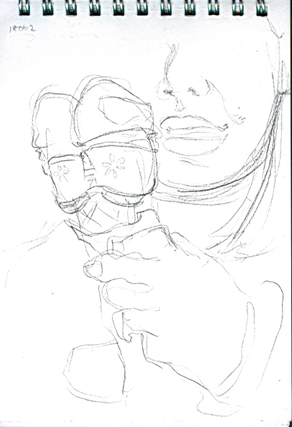
More sun today so I took my young niece for an icecream after school. We sat outside the ice-cream parlour overlooking the marina and I scribbled away while she munched her way through a mint-choc-chip-bubble-gum-double-cone. There were two very elderly gents at the next table, taking in the too-rare sunshine and one of them looked, to me anyway, like gonzo-king Hunter S. Thompson might have looked like if he’d survived another couple of decades. So I scribbled him as well. Both sketches took a couple of minutes each and are in HB pencil into a Daler Rowney A6 smooth cartridge, spiral bound sketchbook.

Hunter S. Thompson is probably my favourite author. I particularly love his collaborations with Ralph Steadman, whom I regard as one of Britain’s finest artists, and Steadman’s funny and poignant story of their relationship, The Joke’s Over. The sunshine didn’t last much longer; we walked home in the rain 😦

Today was one of the rare sunny days this summer, so Husb was up and out early getting a run along the promenade. Then a seagull spotted him. Literally. All over his head. I couldn’t stop laughing :D. Luckily he doesn’t have the thick verdant growth of his youth and he was able to scrape most of the gull droppings off his pate and carried on with his run.
After he cleaned up, we took advantage of the respite from the storms and headed off to the allotment – weeds thrive on persistent rain. I embarked on a war of attrition on the buttercups, hogweed, dock, speedwell, rosebay willowherb and scarlet pimpernel and before anyone complains that they’re just flowers in the wrong place – WRONG! They’re EVIL! And they’re trying to kill our allotment. I showed ’em no mercy!
We had a break to sup some of our recently made elderflower cordial [we’re lucky to have a sambucus nigra overhanging the plot] and we crushed some fresh mint leaves into it – delicious. I took a few minutes out to scribble this view from where we were sitting in front of our shed, looking through the lush growth of the Kiwi fruit plant ‘Jenny’, a self-fertile variety which is producing flower buds for the first time this year. Just under it is a large bin full of nettle compost; steep as many nettles as you can cram into a bin in water for a couple of weeks and the resulting evil-smelling brew is a highly nutritious liquid compost that can be applied with a watering can. Makes me smell awful though. But never mind, not as bad as seagull poo on the head, eh?
It’s hard to draw nature so I’ve been looking at how Van Gogh did it. He developed his own shorthand of marks to interpret what he saw and seems to have drawn very quickly. I’ve a long way to go, but that’s how I’m approaching the great outdoors. Faber Castell Pitt drawing pen, size S, into an A6 leather-bound, recycled sketchpad, used double.
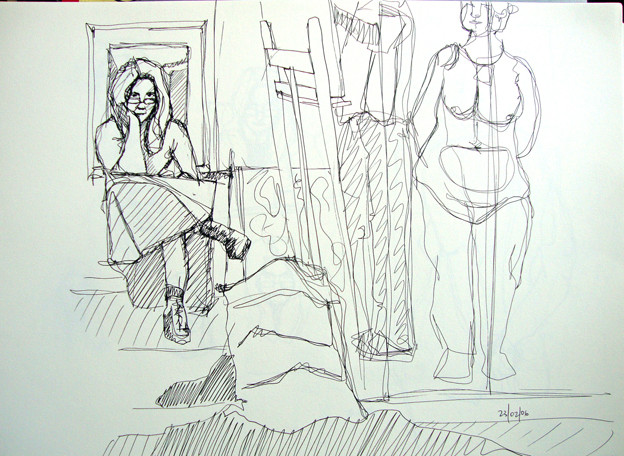
I’ve been photographing and cataloguing all my old sketchbooks, no small matter, there are dozens. This drawing is 6 years old. I was still using drawing pens but working on size A3 and sketching not just the model, but the life drawing room and whatever was reflected in the large mirrors. Here I am in the background with my well-worn and well-loved Hi Tec Magnum boots. They’re the most comfortable boots I’ve ever had. I bought them in the Army and Navy store. They had trouble getting my size because they’re supposed to be for men and I had to have the smallest ones and still have to pad them out a bit with socks. They have lasted really well, very good value. I first saw them when I did some training with the local police force and most of the officers wore them. I thought they’d look really good with thick woolly tights and a skirt. The chaps didn’t think so! 😀
Got home late from life drawing last night, too tired to blog and today I’ve been framing and mounting prints all day for next week’s printmaking exhibition at Oriel Canfas in Cardiff. Then this evening Husb and I went to the opening of this year’s MA show at Ty Bryn Glas – excellent. I think it’s the best MA show I’ve seen, consistently high standards and lots of well-crafted, considered and beautiful work. Definitely worth seeing.
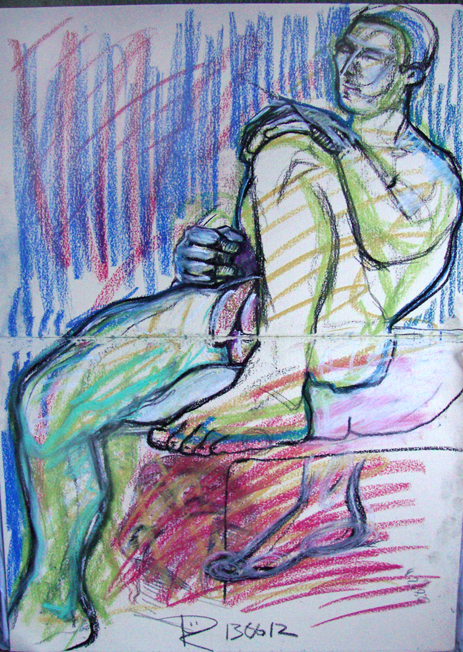
Anyway, here’s our soldier model who posed last night. This was a difficult one to draw. I deliberately went for an angle that gave me some foreshortening; his left foot was quite close but he was leaning sharply away so his head was noticeably smaller. His hands took a lot of effort. It’s got potential; I might rework this as I like the pose a lot. It’s drawn with chalky pastels and compressed charcoal into my A3 Bockingford sketchbook, using both pages.

