Really Artgeek Stuff – from Sketch to Drawing to Monotype [PG]

Just completed a new large full-colour monotype using the 3-colour reduction method.

Drawing, monotype and ghost.

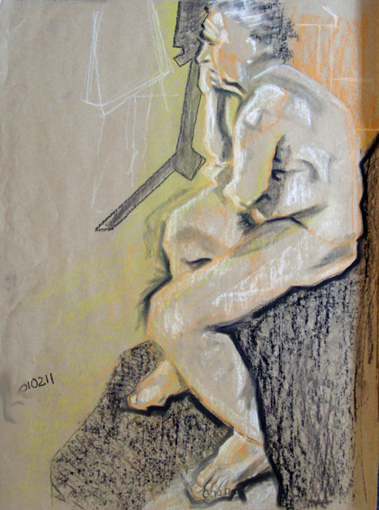
I started off with a sketch which I did in a life drawing session then I developed it into a larger drawing [bottom image] in compressed charcoal, graphite block and white oil pastel onto a sheet of recycled Bockingford 250gsm paper. It had been used for a cyanotype and then thrown away – that’s the bluish colour you can see in places.  Then I traced it and used the reverse of the tracing to do a 3-colour reduction monotype, a method similar to that used by the Impressionists Degas and Monet.

I did the first two layers, in Process Yellow and Process Red on Saturday afternoon and went back to Swansea Print Workshop this morning to do the final layer in Process Blue. This method gives a lovely rich black and a full range of colours. I print onto BFK Rives 250gms using oil-based litho/relief inks thinned with plate oil. The method gives one full colour print [the centre image] and one ‘ghost’ monotype [the upper image]. Degas used to work over his ghost images with pastels and these are now possibly famous than his paintings.

This is REALLY geeky stuff isn’t it? 🙂

The Man With Huge Hands and the Cholesterol Special

We put up the next exhibition in The Brunswick this morning – 8.30am start on a SUNDAY!!!!! It’s looking fantastic [here’s a link to it’s Facebook site if you want to see more – http://www.facebook.com/event.php?eid=130341270397734 ].  Anyway, we finished just before lunch and after heading home to dump the tools and have a cuppa with Mike, who’s one of the exhibiting artists, we went off to our local greasy spoon café and ordered a couple of Full Cooked Breakfasts – proper cholesterol specials. I know we’ve shortened our lives by a decade or so but what the heck! Sometimes you just got to have some comfort food.

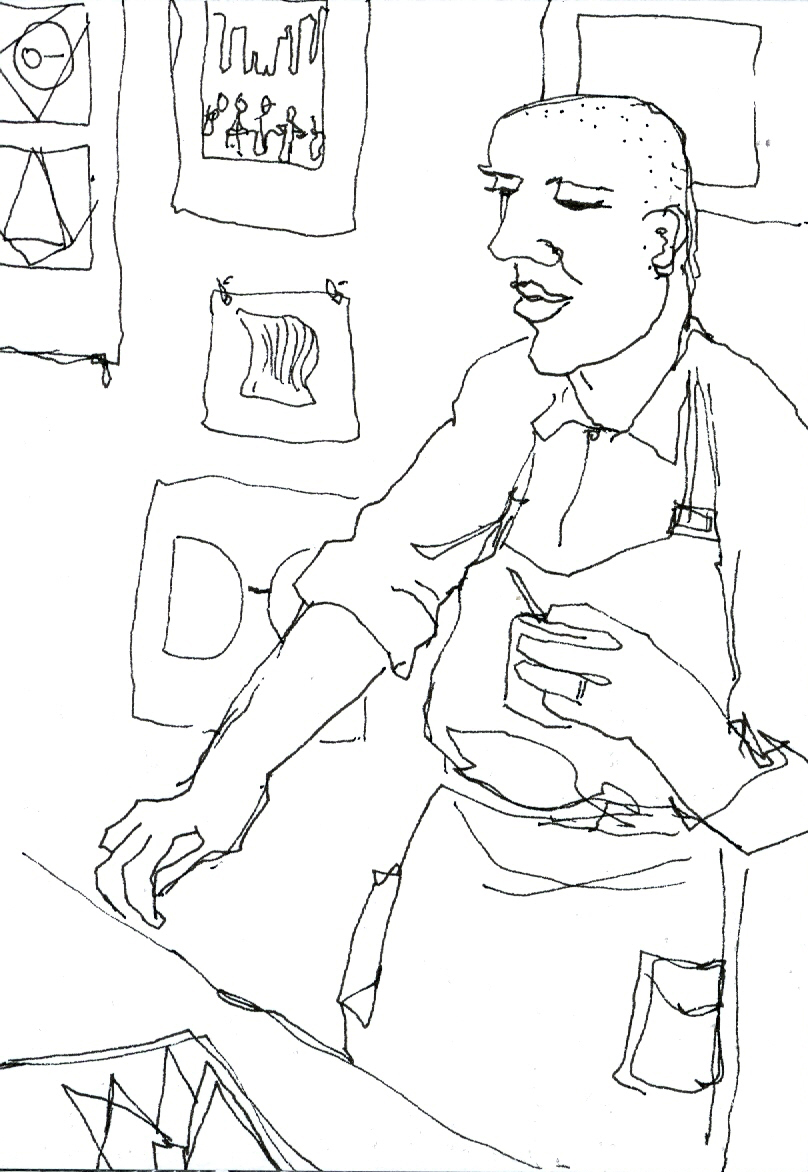
While we were waiting for our full-fat-feast to arrive, I did this sketch of some of the other diners. The man who is the main subject has the biggest hands I’ve ever seen. They look particularly large in the drawing because of foreshortening, but they’re still huge. I’ve seen him around for years but have never spoken to him. He has a very sad face. After I draw people I often wonder if I should have chatted to them but when I’m drawing I’m so absorbed in what I’m doing that I’m totally cut off and it never occurs to me until later.


Ink drawing: The Man With Huge Hands.


We headed home for a bath and a nap to sleep off the humungous FCB and then I prepared a rice pudding and put it in the oven on a very low heat while we went to the allotment and put in a couple of hours. I planted 150 onion sets, 30 potatoes [hoping to get some for Xmas] and a dozen garlic and then netted the onions and garlic to stop birds and rodents from pinching them. I checked the recent plantings – spinach beet, pak choi, stripy beetroot, Autumn carrots, winter ‘Spring’ onions and mooli radish and they’re all doing fine. I have to use slug pellets but I cover the beds with old net curtains and weight them down at the sides so wildlife can’t eat the few dead slugs that get through the barrier.

Digital photo: My Rice Pudding.

Then back home for this gorgeous rice pudding, made the traditional way with sultanas, butter and loads of nutmeg. We scoffed it all.


Things to Do With a Four Inch Screw

Instead of lino or wood for making block prints, I use offcuts of ‘Foamex’ signwriters’ foam board, which local firms throw out, so it’s free AND recycled. It isn’t easy to cut with conventional cutting tools as the blades need frequent sharpening, which I do with a leather Slip Strop, but it’s very easy to press and incise using old biros, nails, screwdrivers and chisels. I made my own specialist tool with a four-inch screw with a bit of masking tape wrapped around it – low tech and very cheap. I like this method.

I can incise very straight, fine lines with the four-inch screw and a steel ruler. Most soft woodblocks would split and fray at the edges with such fine lines, and lines in lino would probably distort when going through a press but this method gives lovely crisp lines. The screw also makes a fine dotted texture if you just jab it in repeatedly.  I also like to use a cross-head screwdriver to punch textures into the surface – it’s very therapeutic! Flat head screwdrivers and small chisels can be tapped onto the surface with a tiny toffee hammer. Biros give a lovely scribbly texture but are a bit hard on the hand as it takes a fair bit of pressure. I think this method involves far more mark making and is much nearer to drawing than using lino or wood.


Foam block ready to print.

This is a foamblock ready to print. It’s a portrait based on a drawing I made from a photograph I took during a trip to Pakistan a few years ago. I used conventional cutting tools for part of it, along with my four-inch screw to do the lines and dots and a cross-head screwdriver to do the decoration on the hat. The photo was taken after I’d cleaned it up after a printing session.

Block print: Islamabad Man #1.


This is the block printed up. I did an edition of 20, printed in Intaglio Printmakers black litho/relief ink onto Zercoll 145gsm paper, using a Colombian press which was made in 1855. I love it – there’s a carved brass plate on it and a large cast-iron gryphon that rises up when you pull the handle. Class!


King Coal’s Sacrifice

Charcoal and graphite drawing.


One morning when I was eleven years old our headmistress announced at assembly that a coaltip had engulfed a small primary school in a village just a few miles away. That village was Aberfan and almost 150 tiny children and their teachers were crushed and suffocated to death that dreadful day. I remember the silent sadness that hung over the school and when I went home, walking down our street, grown-ups were out talking to each other and openly weeping. I had never seen adults cry before.

And now another mining tragedy has hit South Wales as four miners died today in the Gleision pit in Cilybebyll, again just a few short miles away. We live our lives enjoying our wonderful standard of living but it’s only on days like this that we ever stop to think of the real cost of our consumerist lifestyles; the people labouring miles below ground in filthy, backbreaking conditions all over the world and the terrible cost to them and their families.

Sudden death,  burns, crippling injuries, wicked lung diseases that rot miners from the inside over many painful years before death finally claims them. And too many work in countries, for companies, that don’t have anywhere near the safety standards or free healthcare that we have here in Britain. These tragedies have been happening for centuries and they’ll keep on happening because we’ll keep on buying the goods that they provide the raw materials for.  And it will go on and on ….

This is a drawing in compressed charcoal and 6B graphite block into an A2 layout pad.


Upside Down Model and Why Things Cost an Arm and a Leg!

Ink drawing: One model upside down.


I like a challenge when I’m at life drawing and enjoy things like extreme foreshortening and drawing hands and feet, which I think are probably the most difficult parts of the human body to sketch. Now and again we get a model willing to go that bit further and do a more challenging pose, which often involves them in some discomfort – they suffer for our art!

I had a few challenges with this one. Our model lay on a table with his head facing towards me so there was a bit of foreshortening; there was a hand involved and his head was lolling over the edge of the table, partly upside down. I don’t go for an easy life! The test to see if you’ve drawn a pose like this successfully is to turn it upside down and the face should look like the model and be in proportion. Luckily, it looks like him.

The expression “It costs an arm and a leg” comes from centuries ago when rich people commissioned artists to paint their portrait. There was a basic rate just for a head and shoulders portrait. An arm was extra. A leg cost even more. Two arms and two legs were only for the immensely rich.

Spider Alley. (via Doodlemum)

Fabulous post from the incomparable Doodlemum 🙂

Spider Alley. Spider Alley, the place only the bravest children dare enter. Brave the sticky webs and wrapped bundles of mummified bugs, spun and wrapped, ready to stick in your hair. Run, run, run! … Read More

via Doodlemum

Life Drawing: Nude Study with Watercolour [PG]

Watercolour and ink: nude study in the studio.


I’m not a big fan of paint, I’d rather draw or make prints, but I like to use watercolours to add colour and pattern to some of the life drawings I do in pen and ink. I prefer watercolour to coloured ink because it has a lightness and transparency to it and in practical terms it will wash out if you spill it; definitely a consideration when you’re as clumsy as I am. I go through phases of working in black and white, usually just with Faber Castell Pitt pens, and then get a hankering to use colour for a while.

Some artists prefer to concentrate on the figure when they’re drawing from life but I want to put the figure into context; I think it helps with getting proportions and foreshortening right. The Life Drawing studio at Swansea Print Workshop has large mirrors which are useful for getting a different perspective of the model and it’s great to get two views in the same drawing.

I’ve done the initial drawing here in Faber Castell Pitt drawing pens and then added the watercolour with a stiff straight edge sable brush to give a choppy sort of effect. I haven’t used watercolour in the traditional way, overlaying delicate transparent glazes, because I want strident colours and definite brushstrokes. I’ve used Windsor and Newton half-pan artist quality watercolours. In the near future, I’ll be using this drawing as the basis for monochrome direct monotypes and full-colour reduction monotypes.


A Skeleton in my Studio

Ink drawing: a skeleton in my studio.

This is Felicity and she’s borrowed from another artist; she’s living in my studio at the moment and looks out into the street over the bus stop, scaring passengers who look up.


Why do I draw from a skeleton? It’s partly technical, to understand the beautiful mechanics of the human body which helps me with my life drawing. As an artist who works mostly with the human body, particularly with nudes, studying anatomy helps improve my artistic practice as I can better understand what’s going on under the skin, proportion, movement, foreshortening….. I’m lucky that I can share my studio with a skeleton as I can do a bit of anatomy whenever I want.


But there’s more to it than that. Having Felicity here constantly reminds me that we are ethereal creatures, here for such a short time and that all too soon we’ll end up just like her. It also reminds me that we are very alone. Our bodies are barriers to the universe, keeping ourselves inside and everything else outside. We can never really know what anyone, or anything, is thinking, feeling, experiencing or even if they see, smell, hear the same things as oneself. In a world teeming with billions of people, and even more billions of other life forms, each of us is essentially locked in to our own tiny fragile body. It’s a source of wonder to me that we manage to form societies and civilisations; that we put aside our separation and isolation to interact with each other and the world around us.


Sprogs are so difficult!!!!

Ink sketches: Owain in the milk bar.


I don’t find children easy to draw. They’re like animals and birds, they’re not still unless they’re asleep so sketches have to be very quick and you’re lucky if you get an accurate likeness. Here’s a page of sketches I did of Owain when we took him to the local milkshake bar. He was chuffed to find that he could have a milkshake made with a Curly Wurly. I know it’s not healthy but aunties are allowed to spoil nephews and nieces. I did some quick scribbles in between slurps of milkshake [of course, I had a fruit smoothie].


The bottom sketch looks reasonably like him. It’s easier to draw older people because features are stronger and more defined and there are more points of reference like wrinkles and saggy bits. A child’s head also has completely different proportions, with the face being ‘scrunched’ up into a smaller part of the head – it stretches as the child grows older. Noses are littler and cuter and eyes look much larger. Bit like aliens really.


Faber Castell Pitt pens into a Fabriano sketchbook.

The Balloon Flower at Ground Zero

Ink drawing: Jeff Koons' balloon flower.


I’ve never had much time for Jeff Koons’ work, I had thought it superficial and cynical until one of my visits to New York City when I finally made it down to the World Trade Centre. It was difficult to see the construction at Ground Zero because of all the fencing and the crowds of people milling round, but then I walked up onto a bridge above the area and I was shocked at the hugeness of the site and the depth of the hole in the ground.  What I’d seen on television didn’t prepare me for this, for the extent of the destruction.


I walked around the area and there was a small plaza with Jeff Koons’ massive red polished steel sculpture, Balloon Flower [Red], reflecting everything about it. I’d only seen Koons’ work before in magazines or TV documentaries, never in context and in this case, context is everything.  The sculpture is beautiful, uplifting and fun and is a wonderful antidote to the sadness that you feel when you see Ground Zero and remember what happened.  If we allow ourselves to remain sad and not experience laughter and joy then the tiny minority of fanatics in our species will have won.


This ink drawing was done in Faber Castell Pitt pens into a Tate ‘landscape’ sketchbook. The World Trade Centre construction site is in the background.