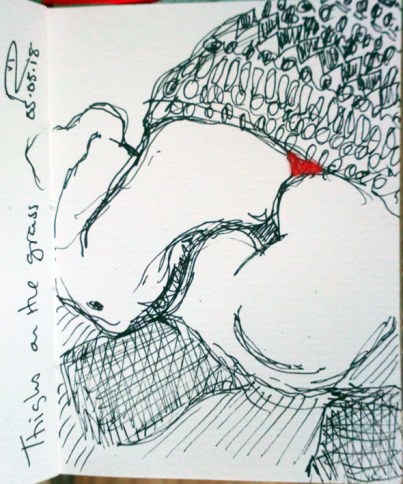
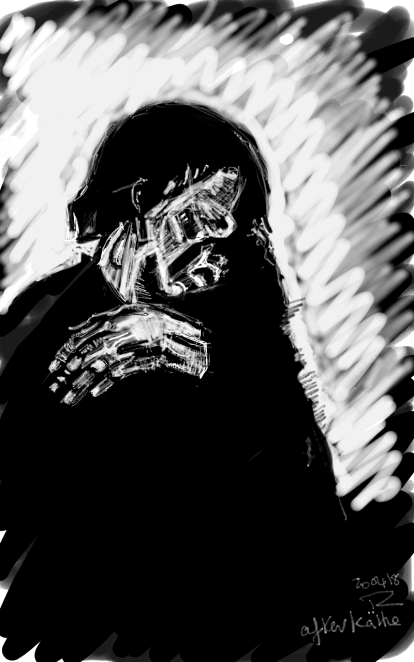
Here’s the second study I did at life drawing at Swansea Print Workshop in the week. I worked on my Samsung Galaxy Note 8 using a free app called Markers. I put in a black ground to start with and then worked on top with white and coloured pen functions. It’s a different approach to normal and it helped me to focus on different elements of the model, working more with highlights than my usual linear style.
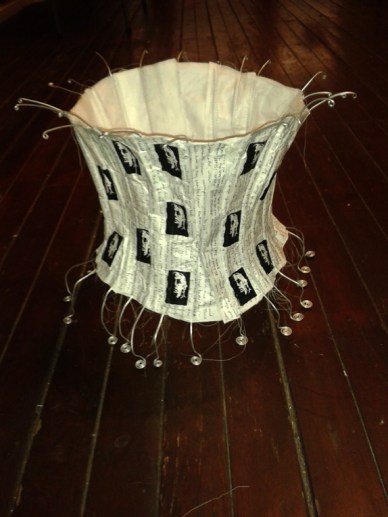
I’m exhibiting at “The Uncredited Woman” at Llanover Hall in Cardiff CF5 1FH until December 8th. Here I am at the opening of the Women’s Arts Association annual show, with the work I submitted, a screenprint of the French sculptor Camille Claudel. I used the liquid stencil method to prepare the screen, working from one of my drawings of her. If you want to find out more about the process, please click here.
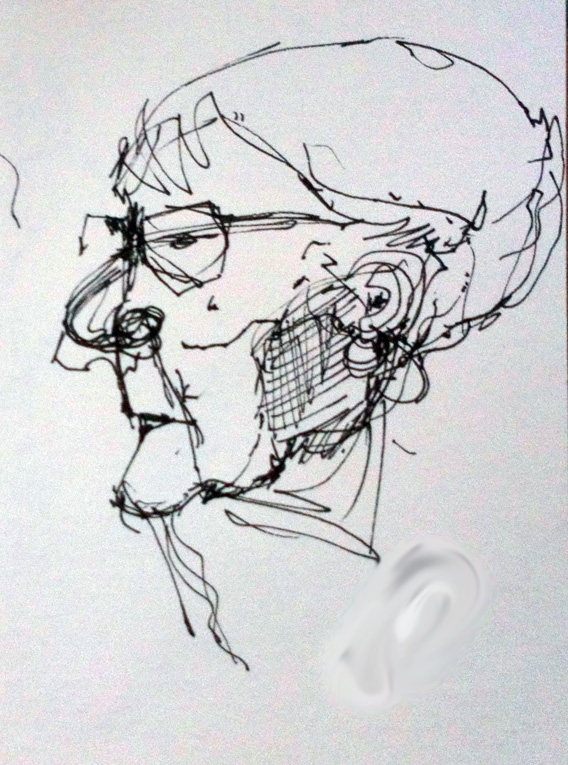
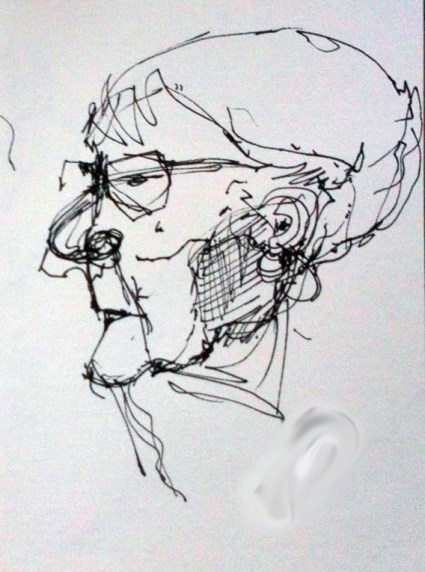
I’m just back from life drawing at Swansea Print Workshop, working this week with a super middle-aged female model who has great presence. I was reading a blog about the relationship between artists and models by fellow artist Michael Richards earlier today, where he explores the collaboration between the two. It’s a good read. I really appreciate what the models bring to the creative experience. I don’t always get inspired by a model or a particular session, the actual drawing practice is also important to me. But sometimes a model, or even a pose, triggers off something inspirational. This was a quick drawing onto my Samsung Galaxy Note 8 tablet using a free Markers app.
I’ve been experimenting doing monotypes on a gel plate from Gelli Arts, trying out different inks and paints over the last week or so. I’ve finished for the time being, ending up with Caligo Safe Wash oil-based printing inks. I used Process Yellow, Magenta and Cyan mixed approximately 50:50 with the brand’s Extender for translucency and to make it easier to roll. It gave good coverage over the gel plate, held texture well, printed with vibrant colours and also produced a decent ‘ghost’ (secondary) print.
Caligo Safe Wash printing ink
Mixing Process colours with Extender
The first roll, Process Yellow and Process Magenta
Texturing the plate with bubble wrap
The first layer printed ….
….and a ‘ghost’ image taken
Then on with the Process Cyan and more bubble wrap, adding some ripped paper stencils to mask out areas
The final print with excellent coverage and colours ….
….and a reasonable ‘ghost’ image
I’ve tried out 6 different inks / paints, all printed in two layers onto Daler Rowney cartridge paper (90gsm). I think the best for my own professional use are the Caligo Safe Wash oil-based printing ink and the Liquitex Heavy Body acrylic paint.
Caligo Safe Wash printing ink
Liquitex Heavy Body acrylic paint
For teaching, I would be happy to use both the Essdee and the Seawhites of Brighton water-based printing inks. And the other 2 media I used, Winsor & Newton Galeria acrylic paint and Liquitex acrylic inks were both too liquid to give satisfactory results on this brand of gel plate, so I’ll be keeping them for other projects.
I spent a lovely morning helping fellow Swansea artist and designer, Laura Niehorster, in her new enterprise, Proud Pads. Laura needed a hand cutting out the material to make a new batch of her eco-friendly re-usable sanitary pads. I think it’s a brilliant idea and they look really fun and funky too.
You can catch up with what Laura is doing here and click here to find out about market testing Proud Pads.
So, still experimenting with the Gelli Arts plate, this time trying out Liquitex Heavy Body acrylic paint. It gives excellent coverage and takes textures really well. Almost all the ink comes off onto the paper – Daler Rowney cartridge 90gsm – with gentle rubbing, leaving very little for a ‘ghost’ print. The only problem I think is that the colours are very intense, it’s high quality paint, and I either need to experiment with more subtle methods of removing and blending the paint on the plate or find some sort of medium to thin out the intensity of the colour without making the paint more watery.
Liquitex Heavy Body acrylic paint
Bubblewrap pressed into the Liquitex to give texture
The first layer of the print
After cleaning the plate with a babywipe, more Liquitex is rolled onto the plate
Texture is added with a scrunched up piece of stiff tissue paper……
……giving an ethereal effect
Ripped paper stencils are placed over the ink and the original print placed on top and rubbed by hand
There is very little ink left on the plate and virtually no secondary (ghost) image
I’m continuing top experiment with gel plate printmaking using a Gelli Arts plate. Today I tried it with Essdee block printing ink, staying with Daler Rowney cartridge paper (90gsm) for consistency,
The Essdee inks are easy to use, roll out nicely and take a good texture from bubblewrap and scrunchy tissue paper. The ink prints easy with a firm hand rub but leaves a faint and disappointing ‘ghost’ or secondary image. It cleans off easily with babywipes.
I have three drawings in the winter exhibition at the lovely Workers Gallery in Ynyshir, running from November 9th to December 23rd. It’s a gorgeous gallery, a local library closed because of government cutbacks and saved for the community by artists Gayle Rogers and Chris Williams. The theme this year is Winter Woodland. I’m not a landscape artist but I always carry a sketchbook with me and draw whatever’s in front of me and it just happens that I’m often in the countryside. That’s one of my drawings on the poster, on the right hand side. I hope you can make it to the gallery at some time, it’s really gorgeous.