The Giant

Tri Crug

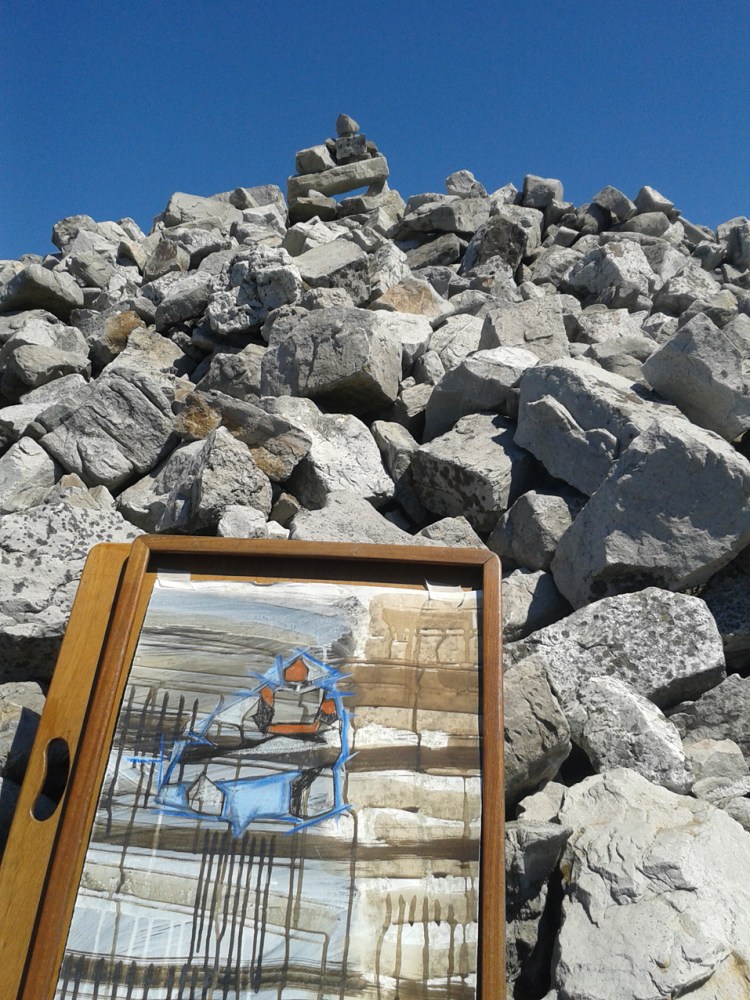
I went out drawing up the mountains in the Carreg Cennen area, at Tair Carn Isaf (The Three Lower Cairns). The area is covered in cairns, skipping over the countryside along rocky outcrops arranged like a spine across the landscape. In the distance is a rounded hill – I think it’s called Tri Grug – and legend has it a giant lived upon it and for entertainment, he created the cairns in the area by throwing stones from his hilltop.

Tri Crug 2

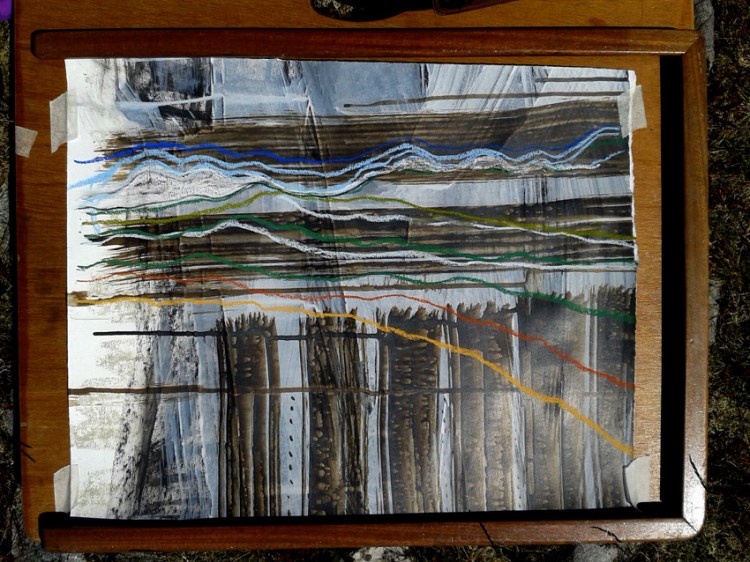
I took with me a portfolio stuffed full of Fabriano Accademica paper prepared with charcoal, white acrylic and home-made walnut ink – see how I prepared it here. I used Daler Rowney soft pastels (artist quality) to draw lines representing the contours of the landscape in front of me. It was difficult to do because although the weather was very sunny, there was a ferocious wind up on the mountain which kept buffeting my drawing board and wrenching it around.


I’ve been travelling around South Wales with archaeologist Dewi Bowen, who is researching his new book on Neolithic / Bronze Age monuments. His previous book on the stones of Ancient Siluria (South East Wales) can be found here. Also with us  is film maker Melvyn Williams, recording a documentary about our experiences. Some of Melvyn’s short films can be seen here. If you want to see some of my other artworks, please click here.
Bronze Age Piles Of Rocks

Tair Carn 2

Drawing at  Tair Carn Isaf (the Three Lower Cairns) yesterday with Dewi the archaeologist and Melvyn the film maker. It’s a complex site made up of many cairns, large and small, with more in the distance, lining up along a number of large rocky outcrops gambolling across the landscape. The problem for me as an artist is how to approach drawing these monuments which, although Bronze Age graves, are basically piles of rocks and to be honest, one pile of rocks is much the same as another.

Tair Carn 3

For this one, I chose an aspect that shows the most easterly of the three cairns on the Tair Carn Isaf (Three Lower Cairns) site, with two of the three cairns on the Tair Carn Uchaf (Three Upper Cairns) site in the distance. I chose a piece of Fabriano prepared with charcoal, white acrylic paint and walnut ink (that I made myself). Then, with Daler Rowney artists’ soft pastels I used a variety of colours to indicate the contours of the landscape and the shape of the cairns against the sky.

Dewi is researching his new book on Neolithic / Bronze Age monuments. His previous book on the stones of Ancient Siluria (South East Wales) can be found here. Melvyn is recording a documentary about our experiences. Some of Melvyn’s short films can be seen here. I’m currently working on a series of expressive drawings of ancestral sites and if you want to see some of my other artworks, please click here.

Cairns, Castle And Garlic

Tair Carn 1

Back to hunting the wild megalith in South Wales with archaeologist Dewi Bowen and film maker Melvyn Williams, visiting Neolithic monuments on the Trail Of The Boar, a legend from The Mabinogion. Today we took off to Tair Carn Isaf (the Three Lower Cairns) near Carreg Cennen Castle in Carmarthenshire. The cairns were a hefty walk from the road, steeply uphill over rough ground but worth the effort for the spectacular 360° views. The first and largest cairn we came to has been enhanced with a small rock sculpture perched on top. I like the way that modern people interact with the ancestors by adding to the cairns and even making new ones alongside the old.

I drew onto a piece of Fabriano paper I had previously prepared with charcoal, acrylic paint and my own home-made walnut ink. I drew with Daler Rowney artists’ soft pastels. I don’t want to do representational drawings when I’m out with the ancestral stones, rather I want to express my feelings about the place, to create my own personal impression.

Here’s  a bit of trivia. The castle name, Carreg Cennen is Welsh for Leek Rock – the area is covered with wild garlic, or Ramsons, which was apparently the original Welsh leek. We could smell it for miles around as we travelled to the castle for tea and cake after our trek.

Dewi is researching his new book on Neolithic / Bronze Age monuments. His previous book on the stones of Ancient Siluria (South East Wales) can be found here. Melvyn is recording a documentary about our experiences. Some of Melvyn’s short films can be seen here. I’m currently working on a series of expressive drawings of ancestral sites and if you want to see some of my other artworks, please click here.
The Hat And The Fox

FAB 7 8

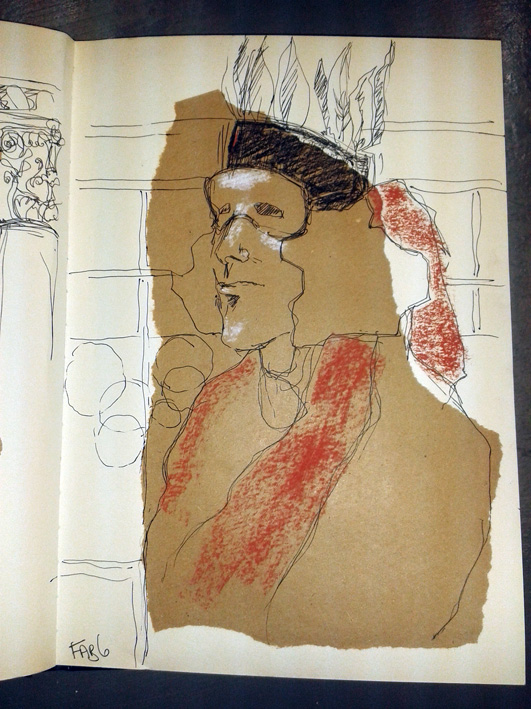
Here’s the final pair of drawings I made during Fringe Arts Bath last Saturday. Working with an ad hoc group of artists, The Plebeian Scribblers, we did some sessions of performance drawing in the street during A FAB Intervention, curated by Melanie Ezra and Tim Kelly. The drawing on the left features the hat of fellow Plebeian Scribbler, Melvyn Williams and on the right, the back of Lynne Bebb‘s head wearing a bespoke needle-felted fox mask by Ann Lucas. I prepared my A3 bound sketchbook with brown parcel wrapping paper, stuck in with Pritt stick glue and drew with conté crayons in black, sanguine and white with fine line work in Faber Castell Pitt drawing pen, size S.


I’m currently working on a series of expressive drawings of ancestral stones and if you want to see some of my other artworks, please click here.


Middle Aged Legs

FAB 5 6

Out with The Plebeian Scribblers at Fringe Arts Bath on Saturday, the four of use did a choreographed drawing performance. Well, simply choreographed. We turned and faced a different direction every 7.5 minutes, turning 90 degrees each time and drawing what was in front of us. After the complete 360 degrees we went back to HQ in the basement of the 44AD Gallery to recover a bit before the next round. It was pretty hot and very crowded and standing for half an hour at a time on the pavement was a bit heavy on middle aged legs.

A FAB Intervention was organised and curated by Swansea artists Melanie Ezraand Tim Kelly.

I’m currently working on a series of expressive drawings of ancestral sites and if you want to see some of my other artworks, please click here.


Fox In The Street.

FAB 3 4

I spent last Saturday drawing in the street at A FAB Intervention, a public art event in Fringe Arts Bath. I am part of an ad hoc group called The Plebeian Scribblers and four of us drew in unison in the centre of Bath, giving passers by the opportunity to see artists in action. I did 8 drawings in all, here are the third and fourth, a generic street scene and a close up of fellow Plebeian Scribbler, Patricia McKenna-Jones, who happened to be wearing a fox mask by Swansea artist Ann Lucas. I prepared my sketchbook in advance by pasting in pieces of brown wrapping paper. We stuck to a very strict timescale, changing position every 7.5 minutes so each drawing was done quickly which forced me to focus on the absolute essentials of the subject. It’s good practice for not getting too precious about your work.

A FAB Intervention was organised and curated by Swansea artists Melanie Ezra and Tim Kelly.

I’m currently working on a series of expressive drawings of ancestral sites and if you want to see some of my other artworks, please click here.


Hot Public Scribbling

Drawing at Fringe Arts Bath

This is the fourth year that I have been involved in the fabulous Fringe Arts Bath, a crazy, anarchic festival of visual and performing arts, taking place all over Bath’s city centre, in empty shops, old mortuary chapels and the street. Last year and this year I was one quarter of a four part combo of artists who draw, The Plebeian Scribblers. We were part of a public access art event, A FAB Intervention, featuring 20 artists and organised by Melanie Ezra and Tim Kelly from the Swansea artscene.

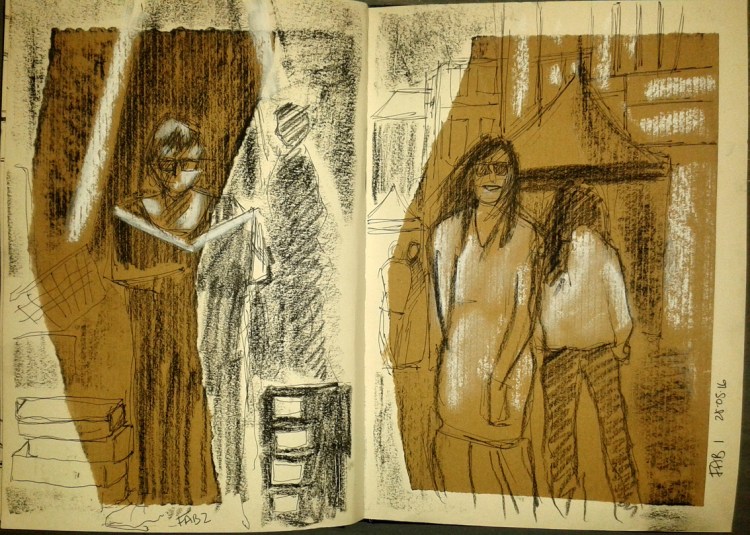
It was hot but not as hot as last year and we found some shade to stand and draw. I drew into my A3 bound sketchbook that I had prepared by sticking ripped pieces of brown wrapping paper into it with Pritt stick glue and I drew with conté crayons in black and sanguine along with some white chalk and a Faber Castell Pitt drawing pen, size S.

The drawing on the left is a reflection in a large shop window, difficult to draw, to decide what to focus on; what’s important to the drawing because there’s so much going on. More drawings tomorrow……


I’m currently working on a series of expressive drawings of ancestral sites and if you want to see some of my other artworks, please click here.
Scribbling A Shaman

shaman

Not long back from drawing with The Plebeian Scribblers at Fringe Arts Bath (FAB). It’s been a beautiful day but very hard work with lots of travelling so I’m going to catch an early night – more about FAB tomorrow 🙂 I drew this shamanic figure into my A3 bound sketchbook with chalk and black and sanguine conte crayons, I prepared the book first with brown wrapping paper.

The Larssons’ Handmade, Homemade Bliss: Swedish Arts and Crafts

A fascinating artblog and the beginning of the Swedish style

ArtLark's avatarA R T L▼R K

51N8GZEVEEL._On the 28th of May 1853, artist and designer Carl Larsson was born in Stockholm. Following a difficult childhood spent in poverty, Larsson got a break when an art teacher recognised his talent and directed him towards a creative career. He started off working as an illustrator of books, magazines, and newspapers, then moved to Paris in 1877, where he did not integrate into the circle of the French progressive Impressionists and found it difficult to assert himself. Alongside other Swedish artists, he distanced himself from the innovative avant-garde and retired to Barbizon for two summers where he worked en plein air. In 1882 he settled at a Scandinavian artists’ colony outside Paris in Grez-sur-Loing; here he met his future wife, the artist Karin Bergöö, with whom he would develop a glowing career centred around their famous home and large family of eight children. As Larsson’s colours changed from…

View original post 845 more words

Storytelling And A Photobombing Cat

Sparta Puss photobombing

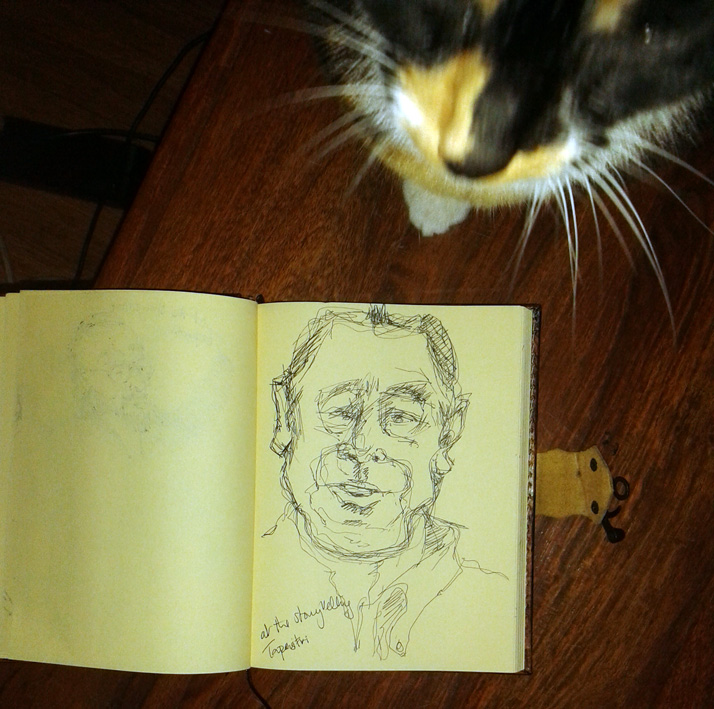
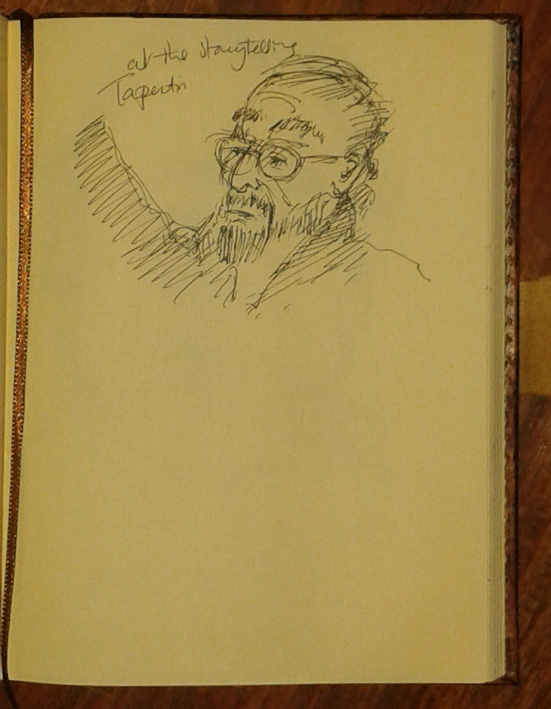
Just back from a great evening of storytelling at Swansea’s Tapestri art centre. I did a couple of quick sketches of the performers. It’s harder to sketch someone who’s moving but very good practice. The storytelling is a regular event on the last Friday of each month.

David Pitt


I’m currently working on a series of expressive drawings of ancestral sites and if you want to see some of my other artworks, please click here.