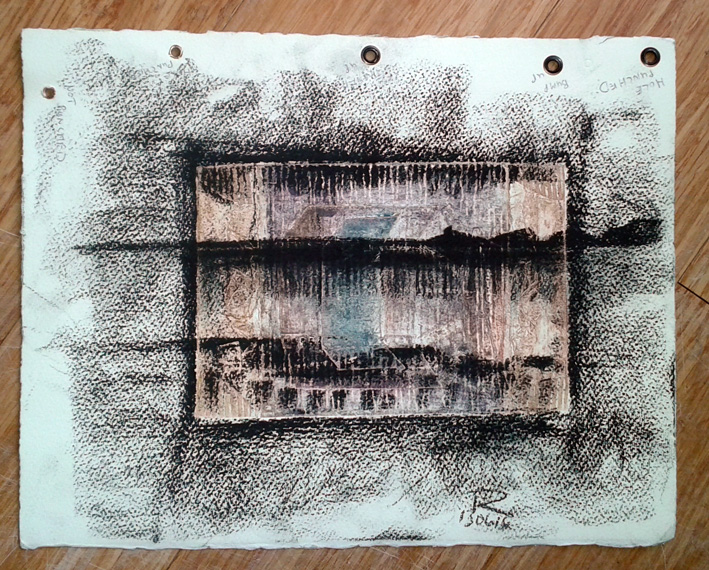
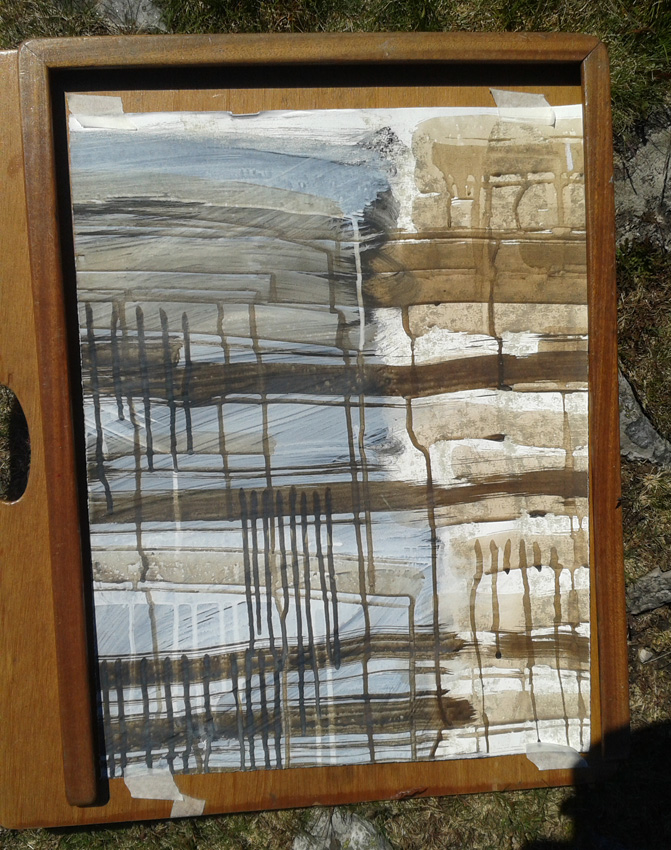
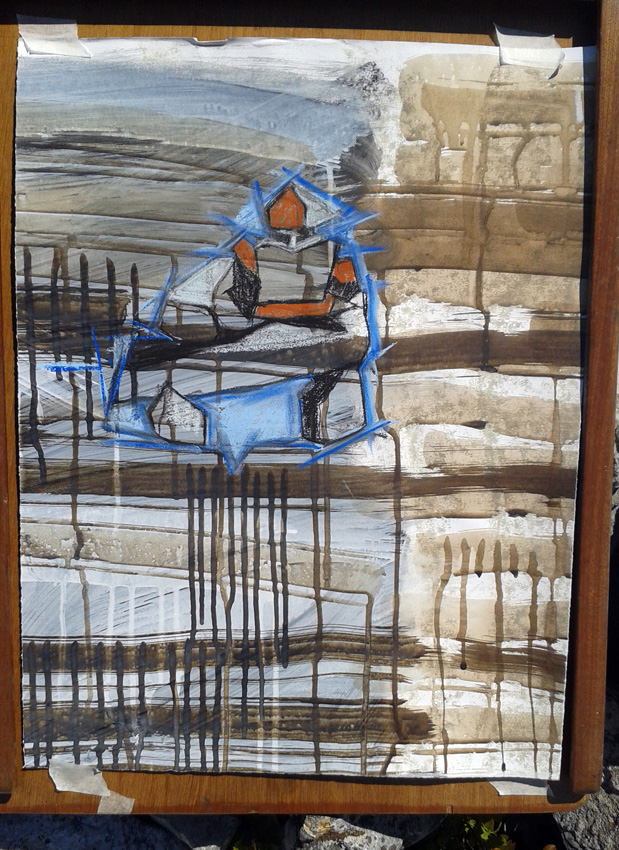
I’m always surprised at what people throw away. I often pull discarded prints out of the waste paper bin at the workshop, they’re done on beautiful paper with top quality inks and can be reused for drawings and collage but still people chuck them. Other people’s waste is my raw material and I use these thrown away prints for my own drawings. I like starting to draw over something unfamiliar. I took this down to the beach last night and drew with compressed charcoal, used neat and also rubbed in with my fingers. I might eventually cut it down to a small border or even no border at all. I was standing outside the Civic Centre, looking across Swansea Bay at Mumbles.
I’m currently working on a series of expressive drawings of ancestral sites and if you want to see some of my other artworks, please click here.
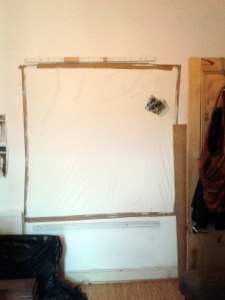
I always was a mucky kid, climbing trees, making dens, digging the garden with my fingers. I haven’t changed. One good thing about being an artist is that I can be just as mucky as I was back then. Today I prepared a huge piece of paper for manier noir drawing.
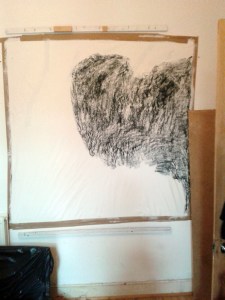
Starting to apply compressed charcoal onto stretched paper that has been primed with 2 coats of acrylic gesso
Building up layers of texture, the rough wall behind helps.
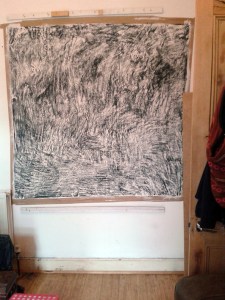
Almost there……
Compressed charcoal covers the giant sheet
A textural close up
And rubbing it in
I was intending to cut up the sheet into smaller pieces to do a series of drawings, but I quite like this huge piece …. maybe I should keep it like this and do one giant drawing. What do you think?
So…shall I split this up into smaller pieces or do one enormous drawing?
I’m currently working on a series of expressive drawings of ancestral sites and if you want to see some of my other artworks, please click here.
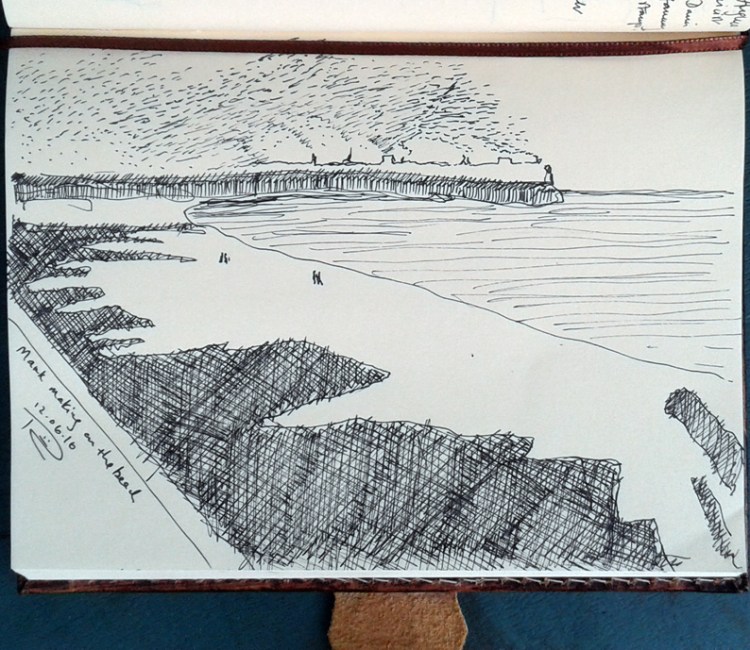
I’m lucky to live near one of the loveliest beaches anywhere, Swansea Bay, and Husb and I often wander down for a stroll. I used to sketch it a lot but haven’t done for ages because it got boring; I couldn’t find anything new to draw. I had recently been thinking about the drawings of van Gogh and his wonderful expressive mark-making and so today I decided to take a different approach. Instead of trying to find something different about the subject, I concentrated on mark-making, on the way I put the drawing down on the paper. That took my attention away from what I was drawing and onto how I was drawing and in a roundabout way the subject emerged more or less on its own. The mark making took in the lengthy shadows on the beach cast by an evening summer sun, the pier, the smoke from the Port Talbot chimneys in the distance, the tiny figures strolling near the water’s edge.
I’m currently working on a series of expressive drawings of ancestral sites and if you want to see some of my other artworks, please click here.
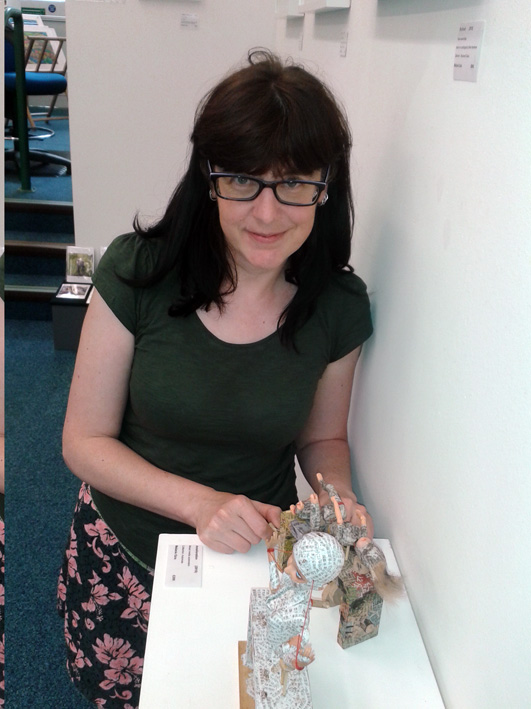
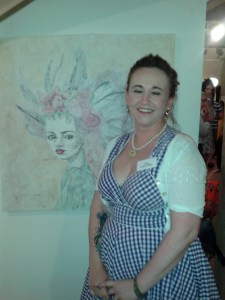
South Wales is so full of talented artists, despite the poor economy and our relative isolation on the Western fringes of Europe – or maybe because of it. Property is cheap and there’s an intensity and freedom to be had from being so far from the frenetic centre of the art establishment in London. Husb and I went to the opening of Melanie Ezra’s new exhibition, Methodology, at The Workers Gallery in Ynyshir in the Rhondda Valley. I love The Workers Gallery. Started by illustrator Gale Rogers and sculptor Chris Williams about 18 months ago it continues defiantly in an area of immense social and economic deprivation, receiving no public funding, building a stable of enthusiastic and eclectic artists across the area. It was lovely there this afternoon, with lashings of tea and Welsh cakes. I also met up with some fellow artists who follow this blog and had some great conversations with them. About art of course 😀
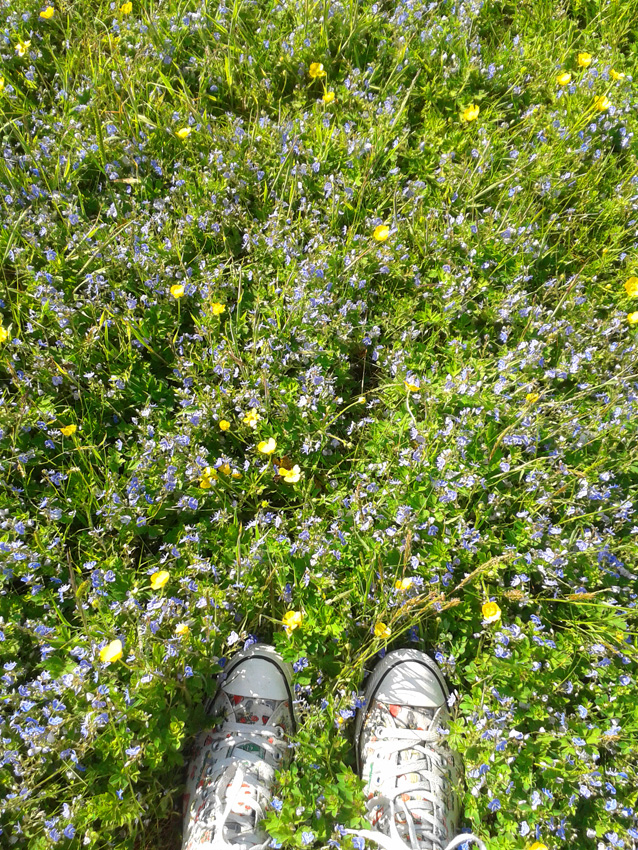
My favourite trainers overwhelmed by wild flowers
The image that many people have of Wales is one of post industrial dereliction but what avaricious industrialists once destroyed, nature has reclaimed and the mountains and valleys are now breathtakingly beautiful and can stand comparison with anywhere in Europe. We drove back across the mountain via Treherbert and stopped at a viewing spot above Llyn Fawr, a carpet of wild flowers spilled over my feet.
The memorials above Llyn Fawr
People have constructed memorials at the edge of the mountain, looking across the valley. This resonates with so much of my work, from Yr Helfa (The Hunt) about the ancient Neolithic ancestral stones I have been drawing in recent months; to last year’s series, Er Gôf, based on the Holocaust Memorial; from the currently ongoing drawn portraits of Baby Boomers, to the series of monotypes, Warrior, working with a young Welsh soldier – so much of my art is about loss, mortality and memory.
I’m currently working on a series of expressive drawings of ancestral sites and if you want to see some of my other artworks, please click here.
I went to the opening of the Art In The Tawe Valley (AitTV) group show this evening at Pontardawe Arts Centre. It was fab. Lots of lovely art, artists and conversations. I took a few minutes for a quick scribble, a woman in a backless dress showing her rather lovely butterfly tattoo – a Red Admiral I think. I used to recognise lots of butterflies when I was little, but there don’t seem to be so many around any more.
Viv Rhule
Leanne Vaughan Philips
Angie Stevens (Doodlemum)
Here are three of the artists exhibiting at the show who have close links with Swansea Print Workshop. Viv is exhibiting a beautiful landscape in hand-made felt, Leanne a delicate illustrative canvas, and Doodlemum a selection of her delightful drawings of everyday family life. The Tawe Valley Arts Week is happening at many venues up and down the Swansea Valley until June the 19th. Check out what’s happening here.
I’m currently working on a series of expressive drawings of ancestral sites and if you want to see some of my other artworks, please click here.
I’d love for you to join me on Saturday 11th June 2-4pm at Workers Gallery, Ynyshir, Rhondda for the launch of my new show Methodology.
My creations have always questioned the nature of how art is made. Here I’ll be sharing my policies and approach in a rigorous examination of the ‘facts’ that artists are fed as apprentices of their craft. I believe it is the duty of every artist to openly question and assess as thoroughly as scientists. Using influences as diverse as theoretical physics, astronomy, literature, maths, and music, I try to leave no stone unturned in questioning the nature of our being as artists. Through sharing my Methodology, I’ll be transforming cake into cameras, photographs into assemblage, collage into print, and bringing life to the inanimate.
In questioning my own procedures I’ve always felt I’m reflecting on the continuous flux of my own identity. Previous versions of ourselves are rewritten…
I had a meeting today so we took advantage of the extraordinary dry and sunny weather to go al fresco at Blackpill Lido, half way between the city centre and Mumbles. I met up with my fellow artists Sylvie Evans and Graham Parker to hatch some plans for the future of our artist collective, 15 Hundred Lives. Of course I had a scribble; there were loads of people enjoying the sun, supping tea at the Junction cafe, playing in the paddling pool, looking at the wildlife on the beach. I drew with a Faber Castell Pitt drawing pen into a leatherbound, Steampunk style A5 sketchbook. Here’s an interesting site with historical anecdotes about Blackpill.
Blackpill Lido
I’m currently working on a series of expressive drawings of ancestral sites and if you want to see some of my other artworks, please click here.
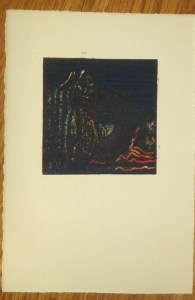
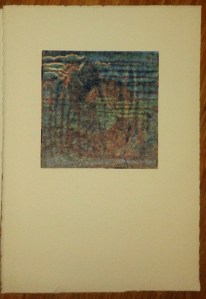
Making art can be so frustrating, things don’t always turn out right. I was down at Swansea Print Workshop yesterday working on a new full-colour monotype. It’s a complex process and things can go badly wrong at any stage. But more often than not, it will go wrong when you remove the final plate, after a long day of printmaking. And that’s what happened yesterday. The technique produces two pieces – the first one is full colour and the second one is much paler, a ‘ghost’ monotype. Well, the first one I did I left far too much dark blue ink on the plate for the final layer and the whole thing is almost black!
Then when I put the final plate onto the paper for the ghost image, I wasn’t paying attention and I put the plate on the wrong way round so the final print is a higgledy piggledy mish mash. Thank goodness yesterday is over.
If you want to find out more about the full-colour reduction monotype technique, please click here.
I’m currently working on a series of expressive drawings of ancestral sites and if you want to see some of my other artworks, please click here.
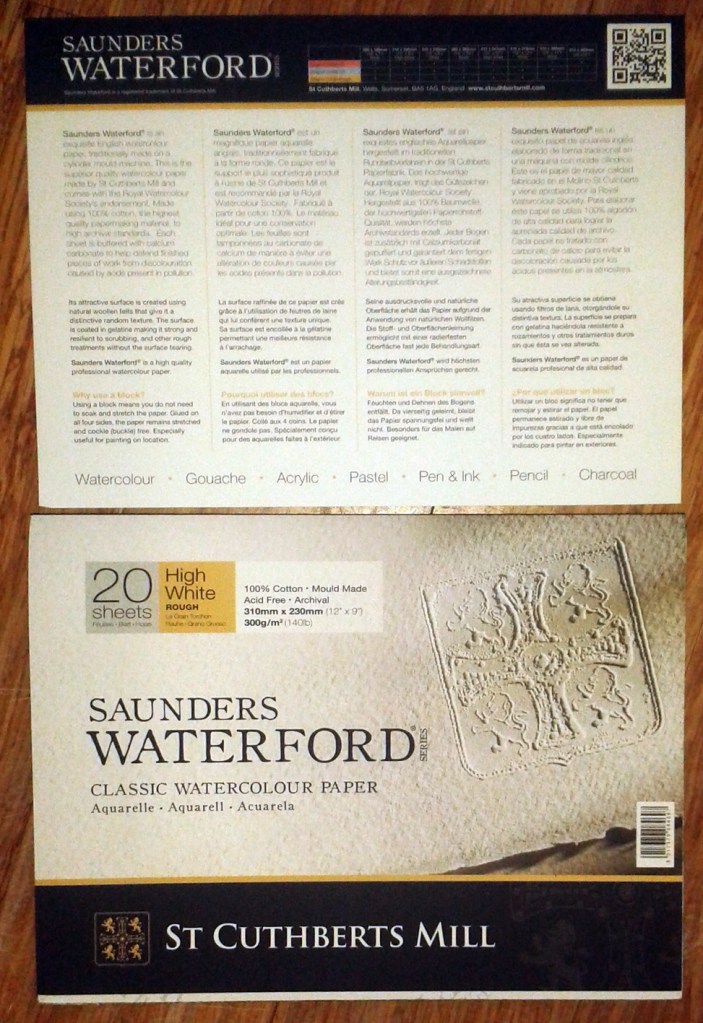
I rarely win anything, probably because I don’t enter competitions or do the lottery and things like that. But sometimes you see little competitions on Facebook and Twitter asking you to like and repost / retweet something and then you’ll be entered for a prize draw. I often click these and I’ve won twice. The first time I won a lovely printed tote bag designed by illustrator Gayle Rogers from the Workers Gallery. And recently I clicked on a link to the Sunday Times Watercolour competition organised by Parker Harris and my prize came through the post today, a pad of very expensive Saunders cotton paper from St. Cuthbert’s Mill. Lovely.
I’m currently working on a series of expressive drawings of ancestral sites and if you want to see some of my other artworks, please click here.








 scribblah