
Strolled along the promenade in Mumbles this evening. I’m so lucky to live in this beautiful part of the world.

Strolled along the promenade in Mumbles this evening. I’m so lucky to live in this beautiful part of the world.
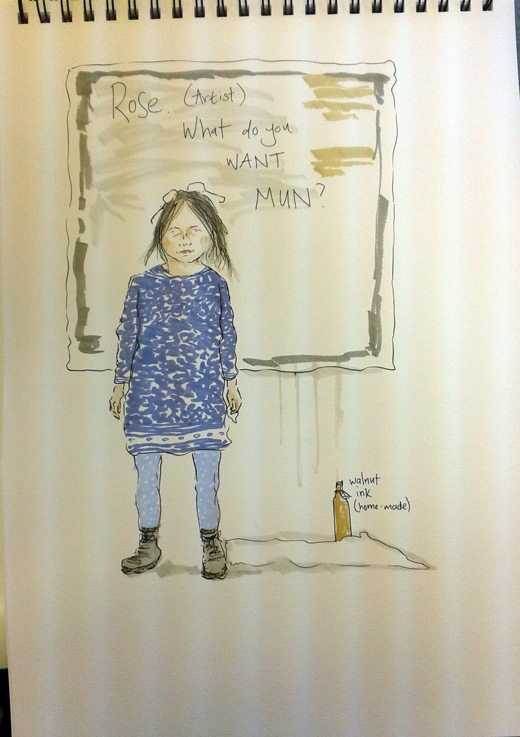
Over the past three years I’ve been part of an art collective called 15 Hundred Lives with fellow artists Sylvie Evans and Graham Parker and we have put on 27 public access art events at the Creative Bubble Artspace. This last event at the weekend was our final regular monthly one.
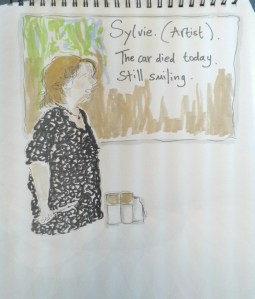
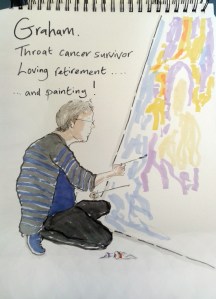

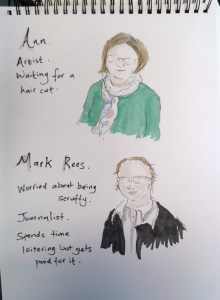


That doesn’t mean we’re packing up completely, but we are busy with individual projects and in future we’ll be popping up from time to time to do arty things but not as often as we have been.
Our final event was called TRANSITION, about the transition each of us is making artistically at the moment, we’re all trying out new approaches in our art practice.
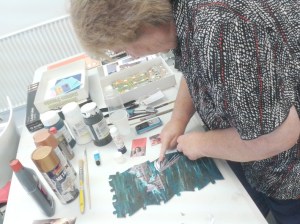
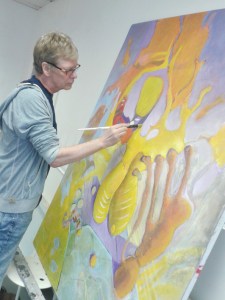

We welcomed 2 guest artists over the weekend, Swansea’s Doodlemum Angie Stevens who doodled us and visitors on Friday and Melanie Ezra and her automata, soon to be the subject of a solo show at The Workers Gallery and Workshops, on the Saturday.
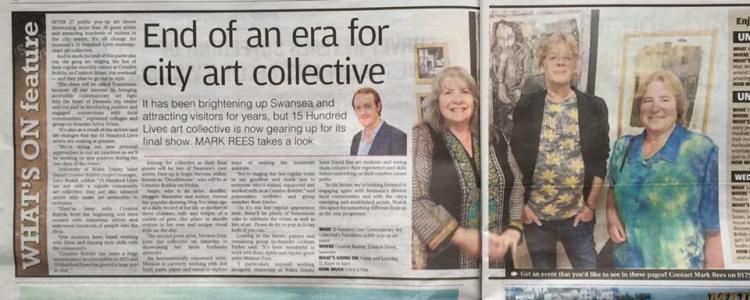
It was a bittersweet couple of days, we’ve worked with over 30 guest artists and welcomed hundreds of visitors to the Creative Bubble over the past two and a half years, but all good things come to an end.
I’m currently working on a series of expressive drawings of ancestral sites and if you want to see some of my other artworks, please click here.
I’ve been travelling around South West Wales with archaeologist Dewi Bowen and film maker Melvyn Williams, searching out ancient standing stones linked with the ancient Welsh legends in the book of the Mabinogion.

When I started I just took along a sketchbook and some pieces of paper without much idea of how to approach drawing these stones, but I soon realised that I needed to have a more complex background to draw on, drawing on white just wasn’t working for me. I tried out some paper I had marbled and that worked better but things didn’t really spark until I cut up a large drawing I’d done in walnut ink onto Fabriano paper. Then things clicked into place and I have been inspired not only by the subject matter but also by the materials I’m using, it’s a synthesis of both.
I’ve done so many drawings now over 11 day trips out across South Wales, that I soon ran out of the original recycled paper so I’ve been preparing more and I did some at the weekend. I started with a large sheet of paper that I had covered with compressed charcoal on a previous outing and then painted all over with white acrylic, watered down a fair bit. Once that dried, it didn’t take long, I started working into it with my home-made walnut ink, drawing a loaded brush across horizontally, enjoying the drippage.

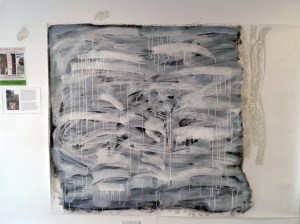


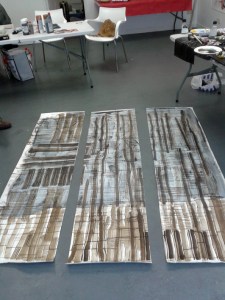
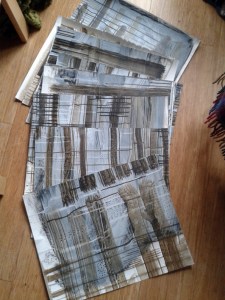
When it dried, I put it on the floor and ripped it up into 15 pieces, which will keep me going for a few more drawing trips.
Dewi is researching his new book on Neolithic / Bronze Age monuments. His previous book on the stones of Ancient Siluria (South East Wales) can be found here. Melvyn is recording a documentary about our experiences. Some of Melvyn’s short films can be seen here. I’m currently working on a series of expressive drawings of ancestral sites and if you want to see some of my other artworks, please click here.
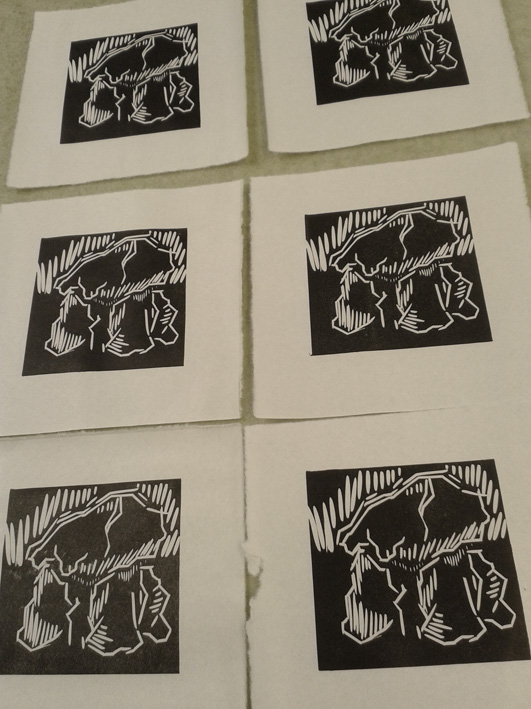
I normally use a printing press to take prints from the plates and blocks I make, but today I had a go taking prints by hand. It hinges on the alchemy between the right sort of ink at the right consistency and the right paper. I’ve been experimenting for a while but today I hit jackpot with a mixture of Intaglio Printmaker’s litho / relief ink mixed with extender onto Hosho paper. I built up lots of layers of very thin ink onto the vinyl block and took the print with a Japanese baren.
I cut this image into a small block of ‘Softcut’ vinyl from a drawing I did while I was travelling around South West Wales with archaeologist Dewi Bowen who is researching his new book on Neolithic / Bronze Age monuments. His previous book on the stones of Ancient Siluria (South East Wales) can be found here. Accompanying us is film maker Melvyn Williams who is recording a documentary about our experiences. Some of Melvyn’s short films can be seen here. If you want to see some of my other artworks, please click here.

This is the other life drawing I did at Swansea Print Workshop last week, working with a middle aged female model. I am always influenced by the model and often draw each of them in different styles with different media. I am using a very free line with this model, drawing with conté crayons in black, white and sanguine into an A2 size brown paper sketchbook. I like drawing onto coloured paper, it breaks the tyranny of the white surface.
If you would like to see some of my other artworks, please click here.

Here’s another sketch from this week’s life drawing session at Swansea Print Workshop. I had about 10 minutes to kill towards the end so I did a study of the model’s hand – good practice. I drew into a large, A2, brown paper sketchbook with white, sanguine and black conte crayon and some compressed charcoal. I took digital photos as I went along so the development of the drawing can be seen in the slideshow below.
I’m currently working on a series of expressive drawings of Neolithic and Bronze Age ancestral sites and if you want to see some of my other artworks, please click here.
Here’s a quick video of me out drawing recently, one of the standing stones I’ve been visiting this year on a mission to draw many of the ancestral monuments on the Trail of the Boar Hunt (Y Twrch Trwyth), an ancient Welsh legend from The Mabinogion. It’s an unusual stone in a wall at Ysbyty Cynfyn in Ceredigion and it’s the star of this short film. And I’m in there doing a bit of scribbling too.

I’m travelling around South West Wales with archaeologist Dewi Bowen who is researching his new book on Neolithic / Bronze Age monuments. His previous book on the stones of Ancient Siluria (South East Wales) can be found here. Accompanying us is film maker Melvyn Williams who is recording a documentary about our experiences. Some of Melvyn’s short films can be seen here. I’m currently working on a series of expressive drawings of ancestral sites and if you want to see some of my other artworks, please click here.

Just back from life drawing at Swansea Print Workshop working with a super model, such an interesting body. I drew into a large, A2, brown paper sketchbook with white, sanguine and black conte crayon and some compressed charcoal. I quickly sketched in the rough outline of the figure in white and then drew into it with sanguine and then black, adding more layers of detail as I went along. It was also great to draw a contrapposto pose, quite challenging.
I’m currently working on a series of expressive drawings of Neolithic and Bronze Age ancestral sites and if you want to see some of my other artworks, please click here.
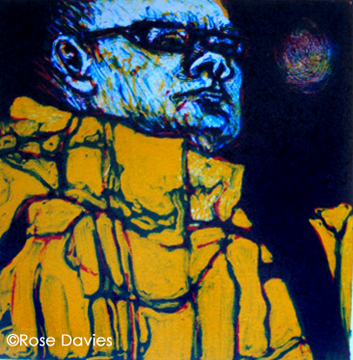
Husb is so patient, being married to an artist means he is constantly under scrutiny and liable to be scribbled at any time. And he sometimes finds his way out of the sketchbook and into other media. This is a full-colour ‘stacking’ monotype based on a sketch I did of him when we were on a train in Berlin a few years ago. He looks cold, it was -20 Celcius at the time and there was thick snow on the ground.
If you want to find out more about this monotype technique, please check out the link here 😀
I’m currently working on a series of expressive drawings of Neolithic and Bronze Age ancestral sites and if you want to see some of my other artworks, please click here.


My very first solo show is coming up in September in the fabulous Workers Gallery in Ynyshir in the Rhondda Valley. Check out the details here.
I have spent the past few months travelling across South Wales with Rhondda-born archaeologist Dewi Bowen and Swansea film maker Melvyn Williams, hunting the wild megalith, accompanied by my portable drawing board, portfolio of Fabriano paper and a bag full of assorted artist’s materials. Dewi is researching his latest book on Neolithic monuments and Melvyn is making a documentary film of our literary and artistic adventures. We are following the legendary trail of the boar hunt, y Twrch Trwyth from the Mabinogion, recording the Bronze Age ancestral stones that those ancient hunters would have encountered.
As time goes on, my drawings have become far less substantial because I’m beginning to realise how peripheral these stones are to our everyday life and culture. Apart from a few years in England, I’ve lived in Wales all my life and I never realised how ubiquitous these ancient monuments are. They seem reasonably well documented, but how many people actually know the extent of them outside a relatively small group of academics and enthusiasts? Despite their monumental size and their presence throughout millennia, they almost seem to be hidden in plain view, unseen and ignored by motorists and ramblers and dog walkers.


What influences a drawing? Lots of things; the subject, the artist’s reactions to the subject; the drawing materials; the weather. People often assume that artists have an easy time of it, sitting around dabbing a bit of paint in warmth and comfort, but the reality? Wrestling with a drawing board in a quagmire, gale force winds, relentless sun, hailstorms. I have been reflecting on the influence of these massive Neolithic monuments on our culture. We still use stone for memorials and until recently as waymarkers. And these massive constructions also remind me of modern environmental art and I feel that connection with fellow artists as I draw them, although four or five millenia separate us.
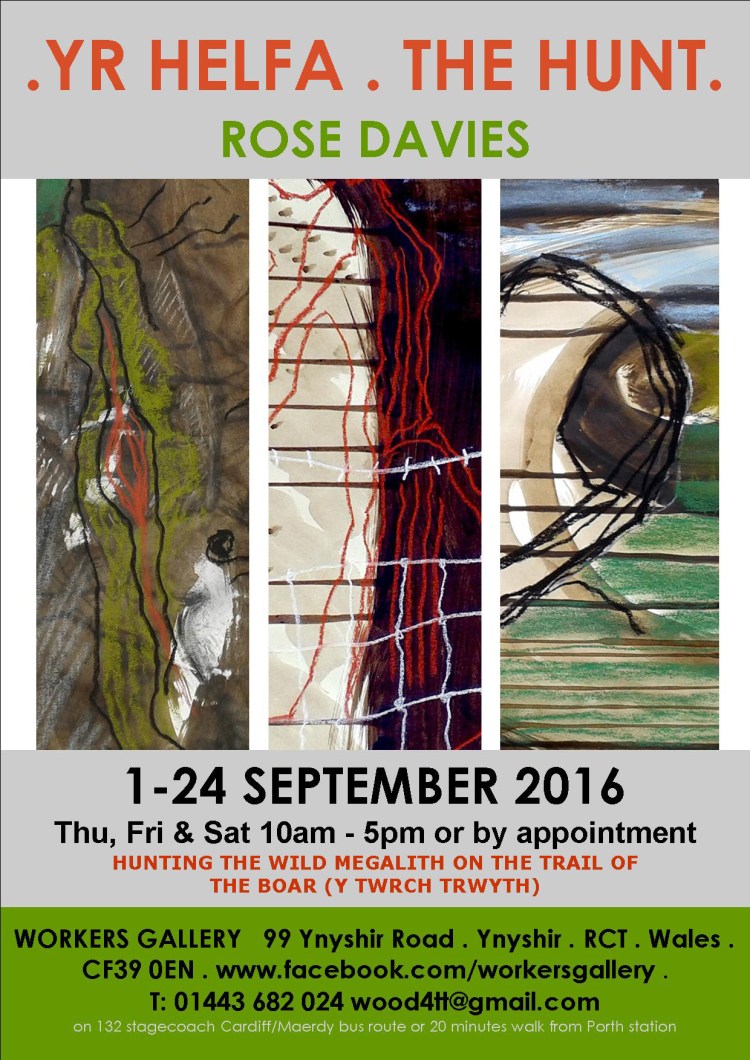
This new body of work on the stones will be on show at The Workers Gallery in Ynyshir in the Rhondda Valley in September. It’s a terrific gallery run by illustrator Gayle Rogers and sculptor Chris Williams who took over the old library in the village when it was closed at short notice due to austerity cutbacks and I’m so pleased that the stones will get their debut there. If you want to see some of my other artworks, please click here.
 scribblah