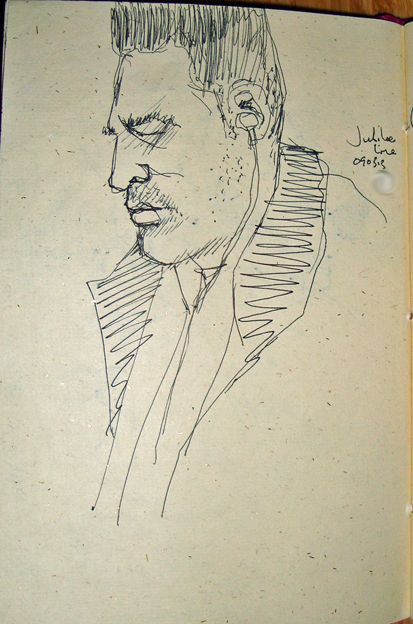
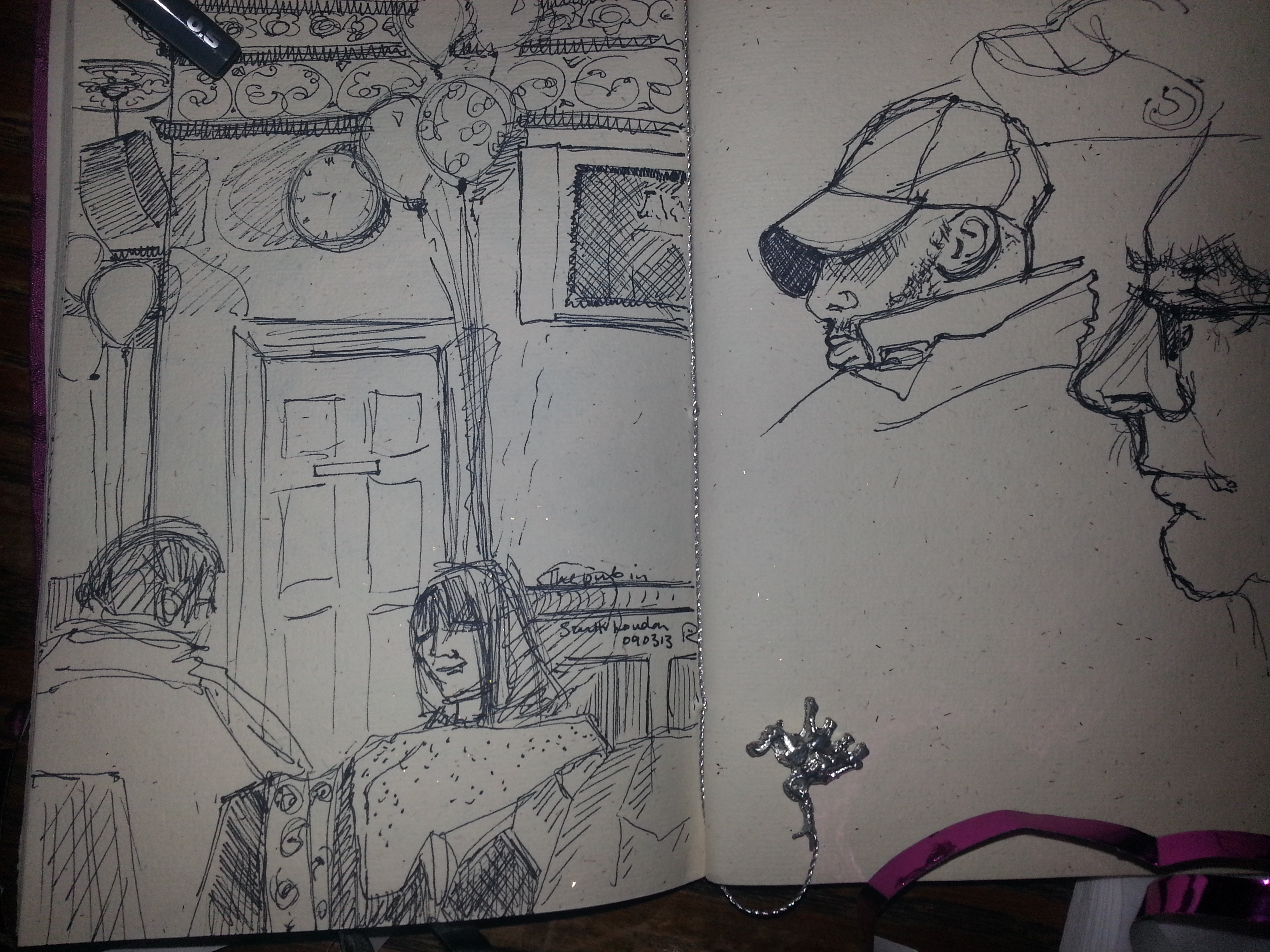
This is the last of my scribbles from London. It was a bitterly cold evening and as we were waiting at Paddington train station to come home, I saw this homeless man sitting in front of us, his life packed onto a supermarket trolley, including a walking stick. One of his legs was in plaster and he wore a comedy fake-fur tiger hat. He was a nice man, chatting companiably to people nearby, sometimes dozing and thankfully he wasn’t hassled to move on by station personnel. I don’t know what his story is, but no doubt our present government would say it’s his own fault for being poor.
Study Scribbles
I normally scribble my daily life in my sketchbooks but sometimes I use them for research and study. These sketches above are from the current Ice Age Art exhibition at The British Museum, showing some female figurines, a mammoth spear thrower and various carved patterns that may be derived from entoptic phenomena, or images that are seen when the eyes are closed, sometimes under the influence of trance or hallucinogenic substances. Richard Rudgely‘s book discusses this sort of imagery in Stone Age art at length.
I love Assyrian art and always visit that section in the British Museum. Their carvings and sculptures are very detailed and I sketched some decorative motifs (above) and these giant talons (below), part of a complex man/beast. The Assyrians were creating these hybrid creatures centuries before the more famous Egyptian examples.
Black On Black
First off, Wales won the Six Nations Cup in the International Rugby today. A great end to a fab week. At the start Husb and I were in London for a few days, taking in some exhibitions. The Ice Age Art show at the British Museum was fantastic and it’s influence stayed with me during life drawing group on Thursday. We had a model who reminded me of the sculptures I’d seen at The British Museum so I pushed out of my comfort zone and used similar materials to the ones available to paleolithic artists, lumps of graphite, charcoal, chalk and carbon. I couldn’t use my usual fine line style so the drawing developed tonally using diagonal strokes, pulling the figure out of the darkness. It’s about A4 size and I prepared the background with a block of graphite before drawing on top. I like the effect of the different blacks on black. It’s on handmade paper I bought from the Tate gallery a couple of years ago.
Jewels Of The Courtauld
My sketchbooks are mainly a record of my daily life and to practice drawing. When I’m visiting galleries and museums I like to study the artwork and make visual and verbal notes. Husb and I visited the Courtauld Gallery this week and saw their amazing exhibition, ‘Making Picasso’, his early art. I’m one of those annoying people who get up really close to see the brushstrokes and try to work out how the artist has done it. This is a scribble of ‘Casagemas In His Coffin‘ from 1901, an after-death portrait of a friend who committed suicide and allegedly the first of Picasso’s sombre Blue Period work. I particularly liked the very loose brushstrokes picking out the details – they look like scribbled lines. He did several versions and I believe the one in this exhibition is in oil on cardboard.
On the right is a quick sketch of the main features of a tiny painting of Mary Magdalene in tempera by Fra Angelico. It’s an exquisite little jewel. It’s an early Renaissance piece, combining a very formal rendering of the drapery with a much more naturalistic approach to the head and hands, which I sketched very quickly. Although the paintings are minute, Fra Angelico has painted them with so much expression – the figure in this painting looks much more angry than in my scribble. The Courtauld is a fantastic gallery and with half price on a Monday, was only £3 each to get in.
Another Hat Another Hairdo
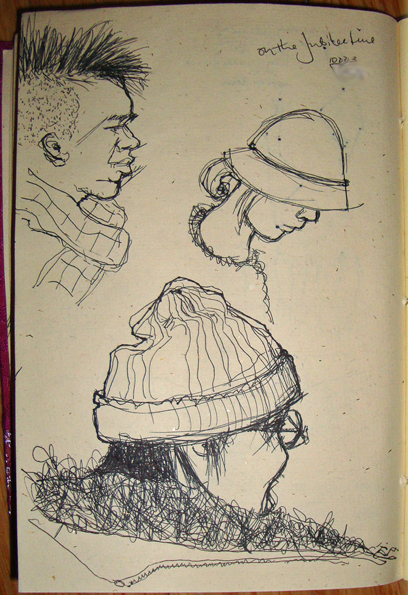
Sketching on the London Underground is great because no-one looks at you and if anyone happens to make eye contact, they look down again immediately. So I can indulge my voyeurism and scribble away. Here’s a great hairdo above and below a rather fetching hat – it was freezing and snowing while we were there.
Problems with drawing on the Tube though, it wobbles like mad so the scribbles can get very shaky and your victim – er I mean subject, might get off at the next stop so you have to draw the essentials quickly and if you’re lucky you’ll have the chance to fill in some details as well. Good practice.
Hats And Hairdo
Last weekend in London was freezing and loads of people wore hats, great for scribbling. I like sketching on the Tube because people generally don’t look at each other so I can scribble away without being noticed. I find it hard to draw hats on heads, difficult to get the proportions right so it’s great to get a chance to practice. The guy had a fab hairdo and a nice Rupert the Bear scarf.
Drawn in my A5 pink silk recycled sari sketchbook with a Pentel V5 pen size 0.5mm.
Ancient Nudes
Husb and I have just come back from a few days in London being culture vultures. Top on our agenda was The British Museum. I always get in a visit whenever I’m in London. It’s one of my all-time favourite places. I’m embarrassed that it’s full of plunder from our imperialist past but it is so awesome to have all these magnificent cultural treasures in one place. And it’s free – well, mostly. We managed to get tickets for the Ice Age Art exhibition. It is truly amazing.
I’m often asked why I work mainly with the nude. It’s because it’s a very old tradition in European art, starting with the Greeks about 2,500 years ago (and a millenium or so before that, in Mesopotamia). But as I’ve just found out, this tradition was well established in Europe way back in the Stone Age. These magnificent sculptures of the female nudes (above) go back 20,000 to 30,ooo years in European culture. They are very voluptuous and celebrate pregnant women or those who have had a number of children. The figure from France was very influential on Picasso who had a copy in his studio.
By the late Stone Age, about 13,000 years ago, the style of representing the female nude had changed to a more streamlined and abstract form, much less voluptuous. These could almost be Modiglianis. I was glad to see other people sketching at the exhibition, as drawing the artefacts helped me to connect with those ancient artists; trying to understand how they worked gave me a depth of analysis that I wouldn’t have achieved by taking photographs.
In Old London Town
Apricots And Bunnies (not for vegetarians)
I’ve been having lots of discussions about rabbit skin glue with local artists recently. It seems that some art colleges don’t bother teaching about technique and materials any more. Well, there we are then! Anyway, rabbit skin glue is a very versatile and cheap size for applying to canvas, paper, wood and cardboard before painting, drawing or doing traditional or digital printmaking. It forms a barrier between the surface and the material you are applying. This is important because the surface might contain chemicals that will damage your pigment, such as cheaper papers, some kinds of wood, and also because your pigment might rot the surface, such as oil paints on canvas or paper.
It’s largely been superceded by acrylic gesso, printmaking papers with internal size, and commercially prepared art papers for digital printing. These can be very expensive. To prepare rabbit skin glue I use one teaspoonful of glue granules to 12 teaspoons of cold water, leave overnight to set into a revolting grey jelly then stand the pot in a bain marie (I use an old saucepan) to melt the glue. When it’s thin brush it quickly over the surface you want to prime. It leaves a lovely satiny sheen and is a joy to work on. I usually do 2 coats and stretch papers first, although some heavy-duty artpapers can take the strain.
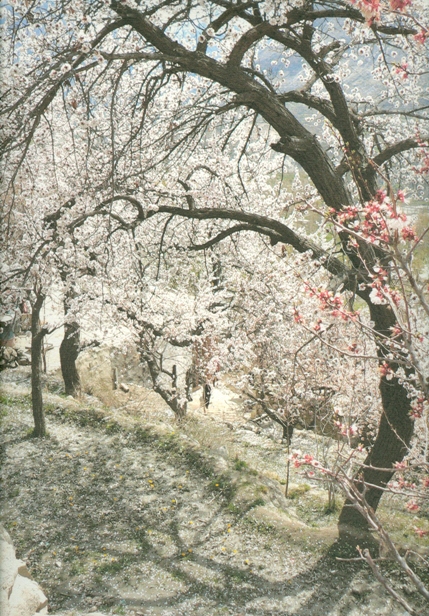
This piece started as a digital photograph I took on my travels to the Hunza Valley in Pakistan when the millions of apricot trees were in Spring bloom. I tweaked it a bit in Photoshop (just very slightly with Cutout filter) and then printed it out using a good quality inkjet onto an A3 piece of Somerset I’d previously sized and dried with rabbit skin glue. The piece has a beautiful velvety quality that doesn’t really come over on the screen.
ps Toulouse-Lautrec did loads of paintings onto cardboard, usually with gouache and oil.
A Bit Different
I tried something a bit different at life drawing tonight. I’d prepared some small scraps of card with white acrylic gesso and Indian ink before I went to Iceland a few months ago but I didn’t use them all. “Waste not, want not” as my Nana used to say. I started with black and white chinagraph pencils but the effect was too translucent so I switched to black and white conte crayons. Much better. Because they’re quite chunky, I had to ditch my usual fine-line style, but that’s OK, I like to get out of my comfort zone.