While I’m Away …..

sketch 4


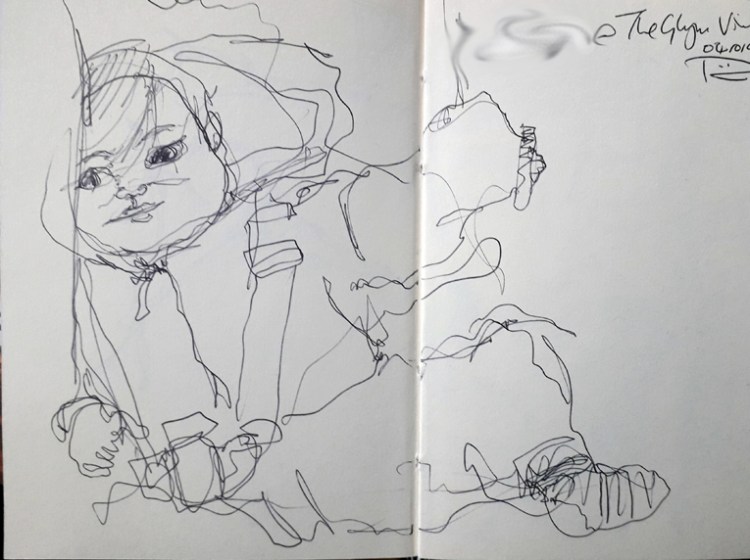
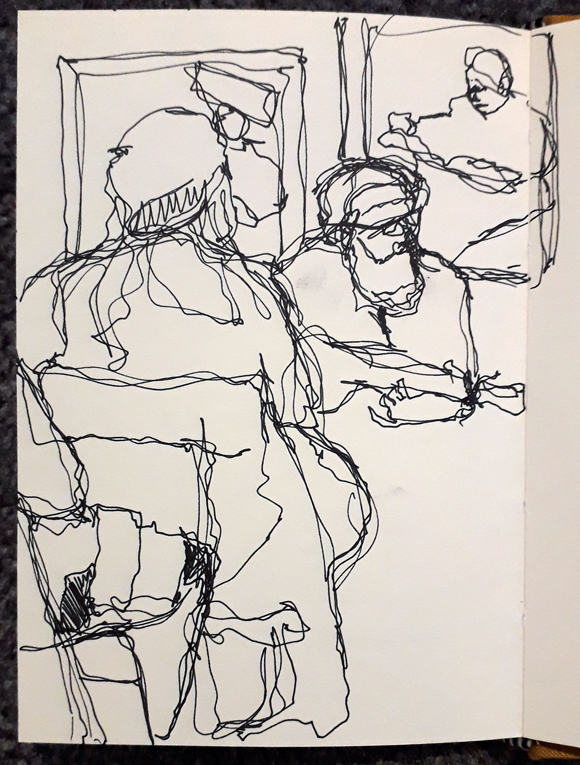
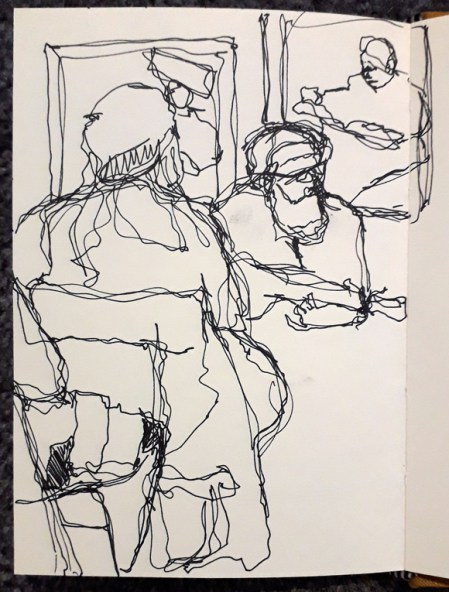
Here’s a couple of ‘blind contour’ sketches I did recently on a field trip to Craig-y-Nos with colleagues from the FIRE Lab. I did the sketches without looking at the paper and without taking my conté crayon off the paper. Forces me to focus on what’s absolutely essential and gives the linework a lot of life and dynamism.


The FIRE Laboratory

I am currently artist in residence with The Fire Laboratory  at Swansea University and have been going on field trips with scientific colleagues along the course of The River Tawe.

While I’m Away….

sketch 3


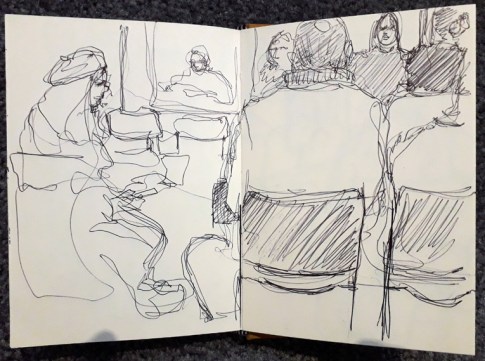
Another of my quick sketches from my field trip with FIRE Lab colleagues a couple of weeks ago. I like doing these very quick sketchbook studies, they’re dynamic because I have to work so fast.


The FIRE Laboratory

I am currently artist in residence with The Fire Laboratory  at Swansea University and have been going on field trips with scientific colleagues along the course of The River Tawe.

Engage And Scribble

RSA1


Husb was pitching an idea at the RSA Engage event at Swansea’s Cinema & Co this evening. The RSA is holding 20 Engage events across the UK which give people an opportunity to pitch an idea they want to develop in their local community, to get support from an informed audience and make new connections to get their idea off the ground. There were 9 ideas pitched this evening, all of them excellent.


RSA2

Of course, I had a scribble!


MWGA


Husb pitched his notion to fill the enormous roof of Swansea Market with stained glass. He did a spoof mock-up for the cover of his recently published book but the image has generated such a lot of interest that he decided to see if there was any possibility in moving the idea forward. There is! He now has some advisors and collaborators on board.


Swansea Market is the largest covered market in Wales and the roof is an enormous single span steel and glass construction. There has been a market in Swansea since the 1600s and one on this site since 1830. The present one was built in 1961 as the previous one was destroyed by bombs in World War 2.


Studying Shrimp

sketch 2


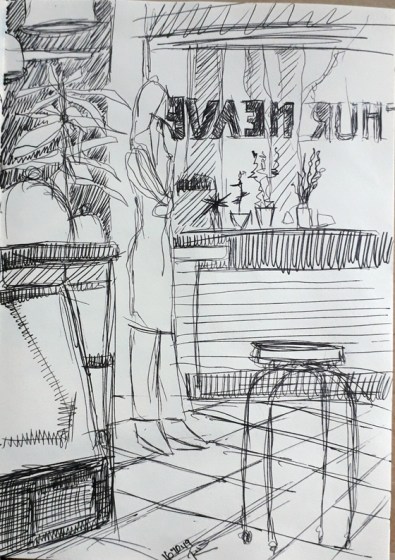
Alongside making cyanotypes with my colleagues on a recent field trip, I also did some drawings. Here’s one at Craig-y-Nos in conté crayons – black, white and sanguine into an A4 sketchbook made from brown parcel paper. It took about 3 minutes and I did it mostly without looking at the paper. It forced me to focus on the essentials in the drawing. Steph and Joelle are looking at shrimp in the River Tawe.


The FIRE Laboratory

I am currently artist in residence with The Fire Laboratory  at Swansea University and have been going on field trips with scientific colleagues along the course of The River Tawe.

Tydfil The Martyr

annibyniaeth a 070919


Husb and I went to the Annibyniaeth march in Merthyr Tydfil today, it was great. There were 5,300 people marching for independence and 53 dogs. Of course I had to have a scribble – of the people and the dogs. The people stayed still for longer!


annibyniaeth b 070919


Tydfil was a daughter of King Brychan of Brycheiniog who was martyred in the area by pagans around 480 CE and the place was named Merthyr Tydfil in her honour. In modern Welsh, merthyr means martyr but in old Welsh it means a church built over the relics of a martyr.

A Roundup Of The Blue Field Trip

Out In The Field

Last week I went on a couple of FIRE Lab field trips with colleagues Steph and Joelle to walk the River Tawe Path, making cyanotypes, or blueprints, along the way. I’d prepared Bockingford paper with a solution of two chemicals, Ammonium ferric citrate and Potassium ferricyanide, in a darkroom and took them with me in a light-proof bag to prevent fogging. On the first day we exposed objects against the paper in brilliant sunshine for 10 minutes but on the overcast and rainy day 2, I upped the exposure time to 20 minutes.


Historic Process

Cyanotype was one of the earliest forms of photography, invented by Sir John Herschel the Astronomer Royal in 1842. It was quickly adopted by botanists;  Anna Atkins used it to record botanical specimens and produced the first photographic book in 1843 using cyanotype. Before long it was superseded by other more reliable forms of photography but was still used to produce blueprints for engineers. Nowadays it’s very popular in fine art printmaking and alternative photography. The exposed papers are developed simply in cold water with a dash of vinegar, keeping the water flowing for the first five minutes or so.


Using What’s There

We used plants alongside the riverbank, rubbish found along the path, and gravel from the water’s edge to construct our compositions, mostly holding the objects in place with sheets of glass or larger stones. Some of the digital photographs of the compositions in situ are as lovely as the finished prints.


SciArt

I’ve always acknowledged the close links between science, technology and art and since I’ve been artist in residence with the FIRE Lab team I’ve been able to put this into practice in a structured way. This collaboration between science, art and design in FIRE Lab is part of the growing SciArt movement that started about half a century ago, back in the 1960’s, when some engineers and artists in the USA got together and started working on interdisciplinary projects that became known as SciArt. Then it all sort of fizzled out …

Fast forward a quarter century to the UK in the mid ‘90s and SciArt resurfaced with the Wellcome Trust, which funded a decade of research projects to see what happened when medical scientists and artists work together. It was good! Since then, there have been more and more scientific research projects across British universities that include an artist as part of the team.


Seasonal Visits

As well as producing some interesting works of art, the cyanotypes are also useful for recording the rubbish we found polluting the river and the land around it in a way that is more evocative than a photograph and which might resonate with people because they’re such lovely images. We’ll be walking the Tawe every season for the next couple of years, trying out different art techniques each time. On the first field trip in May 2019 we did ‘walk and draw’ and then cyanotype at the end of August. Next season we’ll be into early Winter so we’re going to do some land art  …… watch this space ….

I Drew As Well

sketch 1


I’ve been posting pictures of the cyanotypes that I and other colleagues from Swansea University’s FIRE Lab team did during two field trips along the banks of the River Tawe recently. But I also did some drawings as well. Here’s one at Craig-y-Nos in conté crayons – black, white and sanguine into an A4 sketchbook made from brown parcel paper. It took about 5 minutes.


The FIRE Lab

I am currently artist in residence with The Fire Lab at Swansea University and have been going on field trips with scientific colleagues along the course of The River Tawe. This cyanotype experiment is our latest field trip.

Rubbish Into Art

develop 5


Here’s another cyanotype print done en plein air at Craig-y-Nos last week, on a field trip with colleagues from Swansea University’s FIRE Lab. My colleague, Steph, picked up a discarded fishing net from the river and arranged it on the photosensitised paper with some fallen leaves and stones picked up from the banks of the River Tawe. It was around midday but heavily overcast so I guesstimated a 20 minute exposure time, which has worked well. It’s a shame that thoughtless people dumped their rubbish into the river, but it’s been recycled into art and the fishing net was disposed of responsibly.


The Swansea Devil


sketch 3


I popped down to Swansea Museum today to do some sketching. It’s a lovely museum with loads of interesting stuff to draw and it’s served generations of Swansea people. I sketched the Swansea Devil, a local legend.


Two quick sketches to start
Two quick sketches to start ….


He was recently rehomed to the Museum because after a chequered history he was in pretty poor condition – he’s made from wood- and the Museum is able to look after him under the controlled conditions he needs.


sketch 1

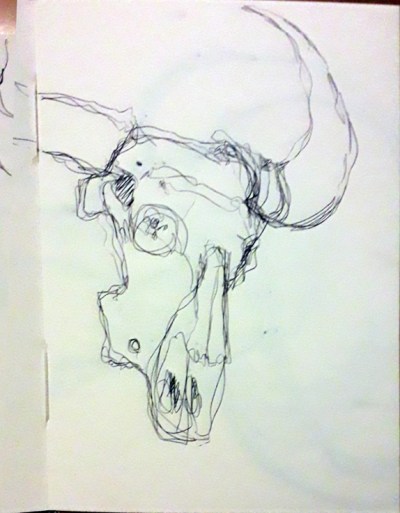
I did a few sketches in Faber Castell Pitt drawing pen and one with walnut ink wash and a brush. Today I wanted to get a feel for the sculpture before I develop some more complex work. I find it difficult to draw other people’s art as I keep wanting to put my stamp on it.

White Leaves And Pooled Corners


develop 4

Craig-y-Nos

Another one of the cyanotype prints I did at Craig-y-Nos a few days ago. The gardeners had been trimming hedges so I picked up a few leaves and arranged some stones and gravel from the river bank onto the treated paper. It was a very overcast day, around midday, so I guesstimated an exposure time of 20 minutes. When I developed it in cold water, I added a dash of vinegar, which is supposed to increase the contrast. It’s quite a good colour and I like the softness of the leaves. The photo below was taken while I was exposing the cyanotype. I think it’s a nice image in it’s own right.


exposure 4


Pooling

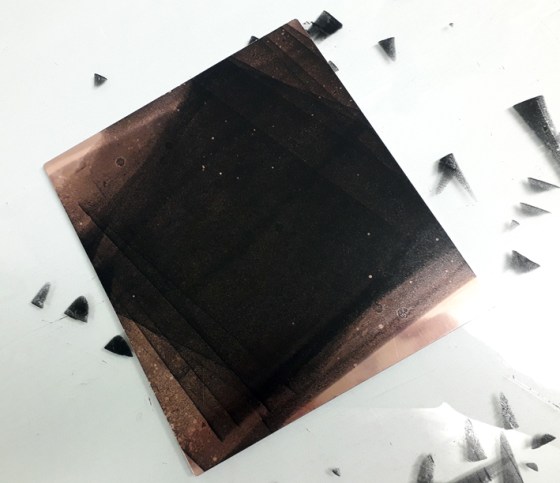
The dark splodges in the corners came from the initial coating process. The received wisdom is to coat the paper and let them dry on a flat surface, but I found that almost all the sheets of paper had ‘pooled’ at the corners. The previous batch had been hung to dry and the coating was much more even.


The FIRE Lab

I am currently artist in residence with The Fire Lab at Swansea University and have been going on field trips with scientific colleagues along the course of The River Tawe. This cyanotype experiment is our latest field trip.