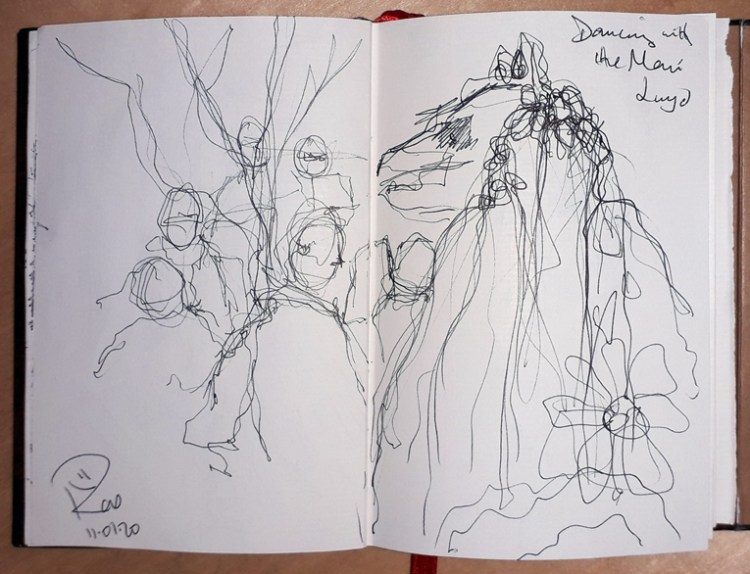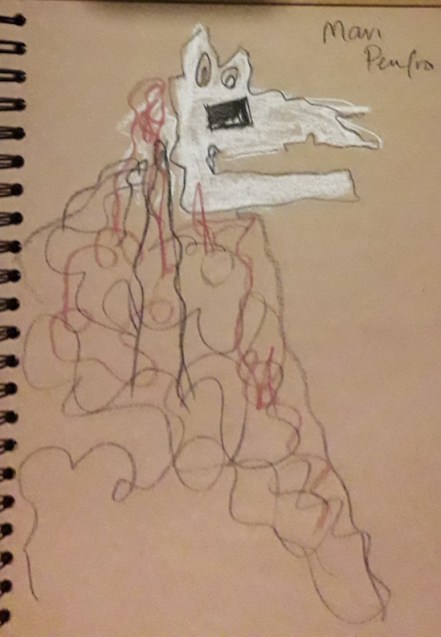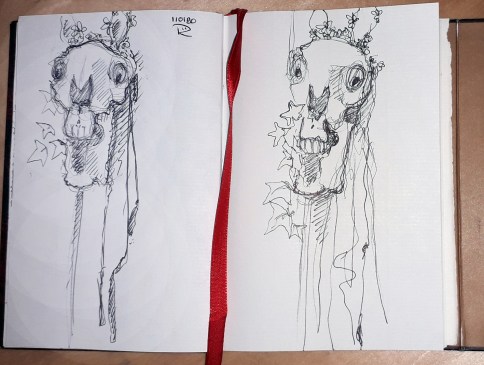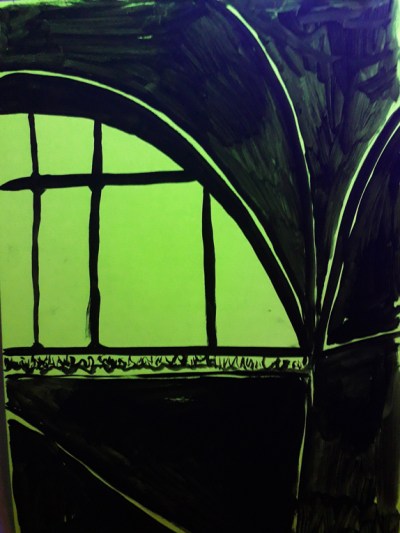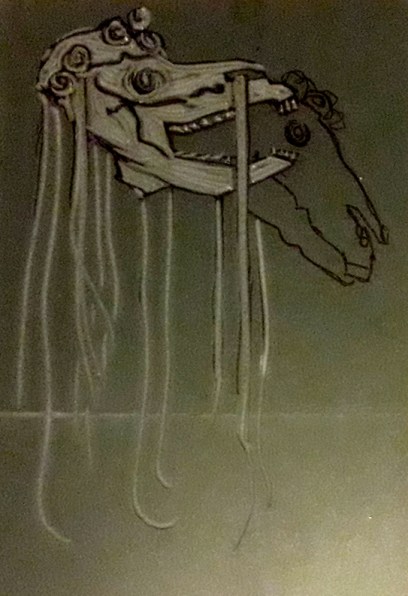
And here are the last two heads that I drew at the Riverside Folk Club in Loughor last week. It’s right by, well, the river side.
Gigs are a good opportunity for drawing as people are usually engrossed in what’s going on and keep reasonably still. Unless it’s a heavy metal gig. I’m usually too busy headbanging to draw then.
Scribbling away at Loughor folk club the other evening, I saw this interesting arrangement of a hand in the foreground and a head in the back ground. Nice bit of perspective, I thought. So I scribbled it…..
Some more scribbles from the Loughor Folk Club the other evening. Loughor is an interesting little fishing village on the estuary of the River Loughor / Afan Llwchwr.
Husb sings in a small community choir and they did a few songs at Loughor Folk Club, so I went along. Of course, I had to have a scribble. It’s held at the local yacht club which is why there are boaty things on the wall.
Today, Husb and I went to help with the annual maintenance at the labyrinth in Rosehill Quarry, installed back in 1987 by Bob Shaw and Dewi Bowen. It’s based on an ancient Cretan design and is cut into the grass, the incised path filled with crushed cockle shells that are a by-product of the local seafood industry. It’s an important place for Husb and me because this is where we met back in the 1980’s. Britain was in the middle of a recession, there was mass unemployment, especially affecting young people and graduates. Husb and I were both out of work and ended up involved in a job creation programme that paid unemployed people to work part-time on community projects.
Local residents had started a group to reclaim this amazing inner-city wild space and turn it into one of the first urban wildlife refuges in the country. The Cretan labyrinth is a lasting legacy of their vision and foresight and a subsequent generation of residents have been active in keeping Rosehill Quarry maintained and open for all to enjoy.
Here I am a while back sketching the labyrinth in chalk, charcoal and soft pastels.
I did some research on medieval clothing to try and picture Gwenllian ferch Gruffydd for the flag design I was working on. Unmarried women wore their hair in elaborate braids but as soon as they married, they adopted a veil-like headdress.
Medieval Clothing
Gwenllian was married at 16 so I tried out a few ideas based on a typical headdress of the early 1100s. It didn’t do it for me. I think the medieval clothing erects a barrier between her and us. Heroes and legends are constantly changed, updated, made relevant for each age and I wanted people here and now in the 21st century to identify with her.
The medieval Gwenllian…. graphite on paper
Norman Invaders
I wanted to know what she would be like if I could go back in time to meet her. I tried to get to know her, what she was like in real life. She was a woman in her mid-30s when she was murdered by the Norman invaders and a mother of 5. She was great Lady of a castle and an educated and gracious diplomat.
Lived as an Outlaw
She fought for her people and her nation and lived as an outlaw. Although she was recognised as a beauty, she wasn’t young; she was a mature, strong woman with a lot of confidence, someone accessible to modern people, someone we would respond to if we saw her on the street – not someone from the distant and unfamiliar past.
Back to the drawing board ……
Gwenllian was suggested by Christine Moore of the YesCymru Bridgend group as the subject of a fourth flag to be carried on the Independence march in Caernarfon on July 27th organised by AUOB Cymru, a non-party political, non-partisan organisation. The flags and banner have been donated by Charles Ashburner of Grŵp Baner Cymru.
A couple of weeks ago, local flagmaker Charles Ashburner sent me an email asking if I’d like to get involved in the creation of a new flag. We had met last year when I was working on a commission for the SkyArts TV channel, creating a new artwork – a new flag for Britain that I called “Here Be Dragons“.
Gwenllian ferch Gruffydd
He asked me to develop an image of the historical Welsh heroine, Gwenllian ferch Gruffydd, for the AUOB Cymru (All Under One Banner Wales) march in Caernarfon on July 27th. That wasn’t a lot of time and I nearly said no. But it’s a cause I support so I took a deep breath and said yes and started to research our Welsh warrior princess.
Gwenllian in graphite, one of my original sketches
Zena Warrior Princess
So where to start? I found a very interesting little book by Laurel Rockerfeller which gave me the outline of her life but thinking about how to portray her visually was challenging as there are no contemporary drawings and I didn’t want to go down the “Zena Warrior Princess” route (although I love Zena).
Hugh Williams
And although I liked the painting by Hugh Williams from 1909 that’s associated with her, I didn’t want to reproduce that because it has a very Edwardian sensibility and style. I realised that I had to bring her out of the middle ages and rescue her from early 20th century Art Nouveau and bring her bang up to date into the 21st century.
Gwenllian by Hugh Williams 1909
I wondered what she would be like if I could pop into the Tardis with Doctor Who and travel back in time to meet her …… with my pencil and sketchbook …..
Husb and I endured eleven hours on a coach with the smelliest toilets in the universe on Saturday to get to and from the YES Cymru march in Caernarfon. It was amazing! Over 8,000 people crammed into the tiny cobbled streets and little market square, enjoying the party atmosphere and listening to inspiring speakers. It was a great crowd and of course, I had to have a scribble! Our coach from Swansea picked up the Llanelli / Carmarthen posse that included a bunch of lads who rocked the Welsh costume – here’s one of them in a rather fetching mini-skirted version.
And a few faces in the crowd…..
….including Lloyd-George modelling an ANNIBYNIAETH banner!
And I did a quick sketch of Scottish speaker and supporter Hardeep Singh Kohli as he sat and waited for his turn behind the ever-moving flags and legs. He was hilarious and such a fervent supporter of Scottish … and Welsh … independence.
I’m still recovering from the travel sickness. But it was worth it.
It’s been years since I did a rainbow roll to put colour into the background of a block print. I’ve been trying out proof prints for my “Streambed” vinyl block and that’s how I ended up doing a rainbow roll. I put out three lumps of Caligo Safewash litho/relief ink – Process Blue on the right, Extender in the middle and Process Blue with Process Yellow on the left and then I rolled them very carefully in one direction until they were blended, with a dark blue merging through an almost-white to green. The colours are very strong and I remembered that I should have used far more Extender and less pigment.
Masking
I needed to mask out the edge of the coloured area so I ripped a hole in a sheet of newspaper to form a stencil and put it over the rainbow roll.
Strength
Then I put a piece of Japanese Hosho paper on top of it and rubbed with a baren. The result is reasonable, but I think the pigment is too strong, I need to add far more extender to the colours to make them paler and more translucent. Finally, I overprinted with my “Streambed” block in a black oil-based litho/relief ink from Intaglio Printmaker in London. I like it, it’s different.
The FIRE Lab
I based this block on an original sketch I did with colleagues from the FIRELab project at the Zoology Department at Swansea University. Here’s one of the FIRE Lab’s blogs, talking about uses for the saliva of The Tench (it’s a fish).