Constrained, A Victorian Tapestri

constrained

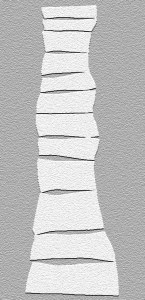
I’ve finally finished the piece I’ve been working on for the exhibition ‘A Victorian Tapestri’  at the end of this week. It’s constructed of the 12 pieces that make up a Victorian corset, cut from a heavyweight Somerset paper. I coated each with cyanotype chemicals and printed them with some of my sketchbook drawings. I’ve called it ‘Constrained’ because it reflects the physical and social constraints endured by Victorian women. The cyanotype process was invented in Victorian times by Sir John Herschel, one of the earliest of photographic processes. I’ve tied the pieces together with mauve ribbon. The aniline dye Mauve was invented by the Victorian chemist William Perkin in 1856.

I decided on a corset when I saw the brief for the show, “all kinds of archaeological, historical, metaphorical, and allegorical excavations of Swansea’s Victorian heritage.” I have vivid memories of my Mam taking me to a corsetry shop called Madam Foner’s in Swansea’s High Street to be fitted for brassieres when I was in my early teens. She believed in ‘proper’ underwear and wouldn’t let me have those flimsy, pretty department store bras that my schoolfriends wore. So I had to endure an adolescence of engineered constructions that looked like they’d been built in a shipyard. The Victorian connection? Madam Foner’s was in a beautiful Victorian shop, now housing the rather lovely Galerie Simpson. Click here to see a photo of this gorgeous building.


The exhibition opens this Friday at Tapestri on Alexandra Road, Swansea at 7pm and runs until October the 9th.
One From The Archives 11: Rinascere #6 and The Flower

01 Mari orchid

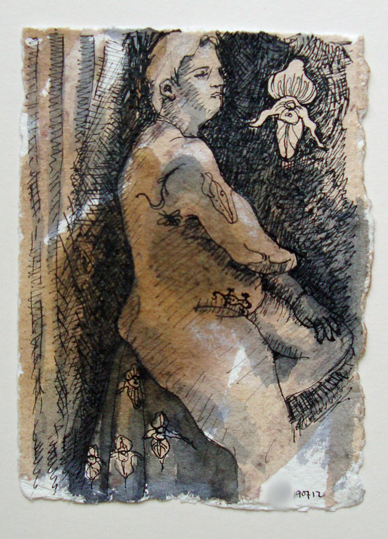
Variations on the themes of tattoos and flowers.  I love working with this model.  Older women are often invisible in our society.  She is an elder and voluptuous and larger-than-life and covered with tattoos. Some of them are carnivorous plants engulfing insects across her body. She is confident in her own skin and first featured in my blog in August 2012 and again in April 2013, when I produced an etching from the drawing.

The first drawing is in Indian ink using a traditional dip pen is on handmade paper, prepared with black and sepia ink washes. For that drawing I focussed in on an orchid tattoo, lifting it off her body to place it on the drapery underneath her and the wall behind her.

21 mari tattoo

In this second drawing I wanted to feature both her and the pitcher plant tattoo on her arm.  I like to recycle materials, especially papers and mounting boards and I prepared this piece with an ink wash, sponged randomly across it before I began to draw. I used Faber Castell Pitt drawing pens, ink wash, black and white conté crayon onto mounting (matte) board.

I was able to use the wash to further develop the theme of the flower in the background.  Here it is more integral to the background and seems to emerge, organically; as if from the shadows. Her face, deep in thought, is part of the same broad area of wash which make the pitcher plant look like the product of a dream, reminiscent of the Goya etching ‘The Sleep of Reason Produces Monsters’.

If you want to find out more technical details about techniques I use please clickhere to go through to the technical section on my website. The drawings, Rinascere #6 and The Flower are available for sale on Artfinder and if you’d like to find out more, please click on the links here and here to go directly to them or click on the link below to see other works for sale.  AF logo


Sunshine Prints

Cyanotypes adjusted

I did a whole load of cyanotypes yesterday for an exhibition and I had some pieces of paper and chemicals left over so, waste not want not, I coated the paper scraps and stored them away in a folder in a dark cupboard. Today, I shrank my negatives digitally and printed them out on acetate. We had a brief respite in the rain with some truly brilliant sunshine for a couple of hours around lunchtime so I put a drawing board onto the floor with the back door open, put the coated paper face up on it, placed the little negs onto the paper and a sheet of glass on top to keep them still.

washing

They only take 6 minutes in the UV Unit at Swansea Print Workshop, but I had to take an educated guess for today’s exposure. I left them for 22 minutes, checking regularly. I could see the cyanotype chemicals changing colour around the edges of the negatives. You can see the undeveloped images in the top photo. I removed the negs and rushed the little prints off to the kitchen sink and washed them gently in cold, running water for 20 minutes. Here they are above in the washing up bowl. I drained them and they’re now being pressed between boards and tissue paper to dry flat. I’m really pleased with the result. It’s a way of using my sketchbook drawings.

I think I might put these onto Artfinder tomorrow.

One From The Archives 10: Fan Girl

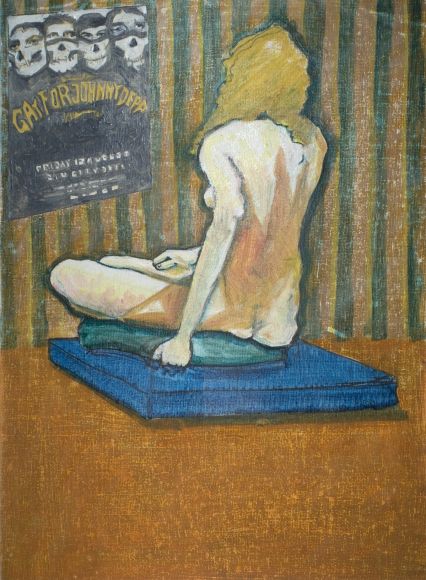
Fangirl painting

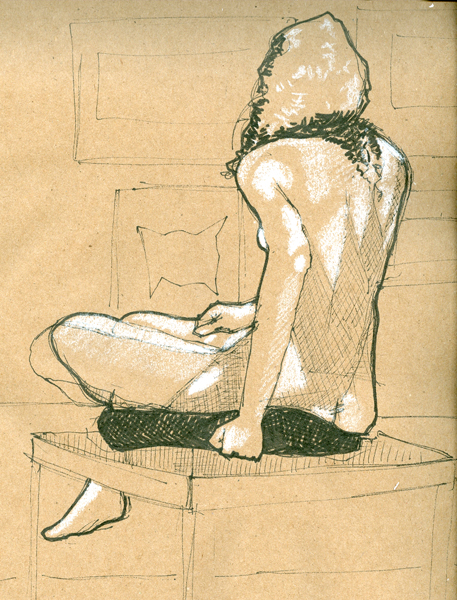
Here you can see the original (below) and the finished painting (above).  I usually have no idea how I will be using the original life drawing when I first get it down on paper. At that point it is often just a case of describing what I see in front of me using line and shade.

Often I will combine the figure drawing with other sketches from incredibly diverse sources. In this case a poster for a rock band and remembering those teenage crushes on pop stars – I LOVED The Monkees – and how so much of my time was spent day dreaming about them. Where did the time come from? Not enough hours in the day now!

As part of my artistic practice, I like to study and build upon my theoretical base. This is one of a series of small oil paintings inspired by re-acquainting myself with Johannes Itten’s colour theories.

fangirl drawing

Using the theories enables me to work up a full colour painting from monochrome sketches. Not having the distraction of the real colours of the scene allows me to develop paintings so the colours are more harmonious and satisfying to the eye.

If you want to find out more technical details about techniques I use please click here to go through to the technical section on my website. The painting Fan Girl is available for sale on Artfinder here and if you’d like to find out more, please click on the link here to go directly to it or click on the link on the right hand side of this blog to see other works for sale.

Blue Sunday

2 heads

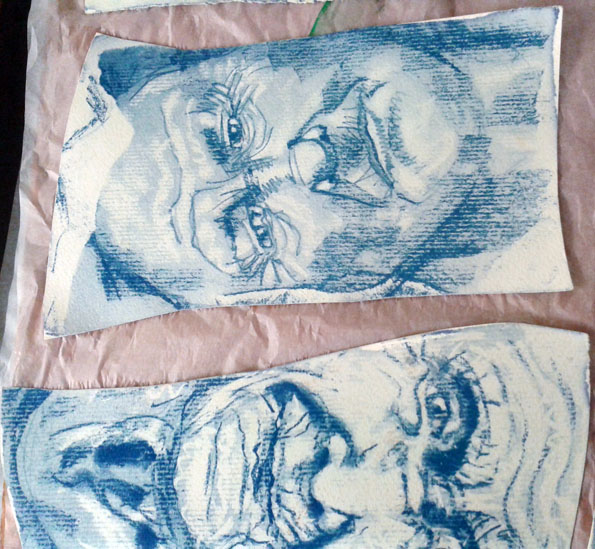
A while back I began a new piece of artwork, quite an ambitious one using some of my sketchbook drawings of older women and a Victorian corset pattern to create a 3D piece in cyanotype, an archaic photographic technique. I cut the pieces from some lovely Somerset Velvet paper, 12 in all, and scanned and printed some of my drawings onto sheets of acetate (after reversing them in Photoshop so they are negatives). Yesterday, I coated the pieces of Somerset with the cyanotype chemicals and put them to dry overnight in a lightproof cupboard. And today I took them to Swansea Print Workshop to develop them in the UV Unit.

After exposing them for 6 minutes, I washed them face down to start the developing process then turned them over – you never know if it’s worked until this point. I’m delighted with them. They were drained for 10 minutes then I put them between sheets of tissue paper between low-density fibre drying boards.

washing 2

Next step is to assemble them and get them ready for the exhibition. More about that tomorrow……..

Listen And Look

Here I am drawing while David Pitt plays gong at The Bagpuss Window on Swansea’s High Street. Just a very short video showing the manky old shop when we got it and the still quite manky artspace it is now. It’s being knocked down in a few weeks so everything we do in there is ephemeral, it will eventually only exist in our photos and videos.

tableau

As well as the huge drawing on the wall, I’ve been getting into making little tableaux in the window. This one features tiny handmade books by Bud Francis and drawings by me.

ralph paints

And in this one, Robodog Ralph shows Bagpuss how to paint (it’s actually by Tim Swain. AI isn’t that good yet. Not round here anyway).

Having A Play

layout

I started this piece a few weeks ago. It’s for an exhibition, “A Victorian Tapestri” which starts on September the 25th.  I cut the 12 pieces of lovely Somerset Velvet paper from a vintage pattern for a Victorian corset. I will be coating each piece with an image in cyanotype, an archaic Victorian form of photography invented by John Hershel. The paper cannot be sewn to make up a corset so I intend to attach the pieces to each other with eyelets and ribbon.

I laid the pieces out on the floor in sequence to take a photo and I quite liked the pattern they made, so I had a bit of a play on Adobe Photoshop. Nothing serious, but sometimes it’s good to relax and play around, it helps the creative process.


One From The Archives 9: The Cushion

Cushion

Surrounded by symbolism, the interplay of shadows describes the form of the nude. This is an etching of one of the female models I work with and is developed from a nude study drawn with Renaissance materials, inspired by artwork I did for a television series about da Vinci.

This type of etching allows me to translate my line drawings into a more permanent medium. It gives me the freedom to be as expressive as I like and to draw using a fast, energetic style. The fact that I am taking a drawing onto another stage of development means I can introduce additional elements of design. The objects on the wallpaper behind the figure look like a a simple decorative pattern at first.

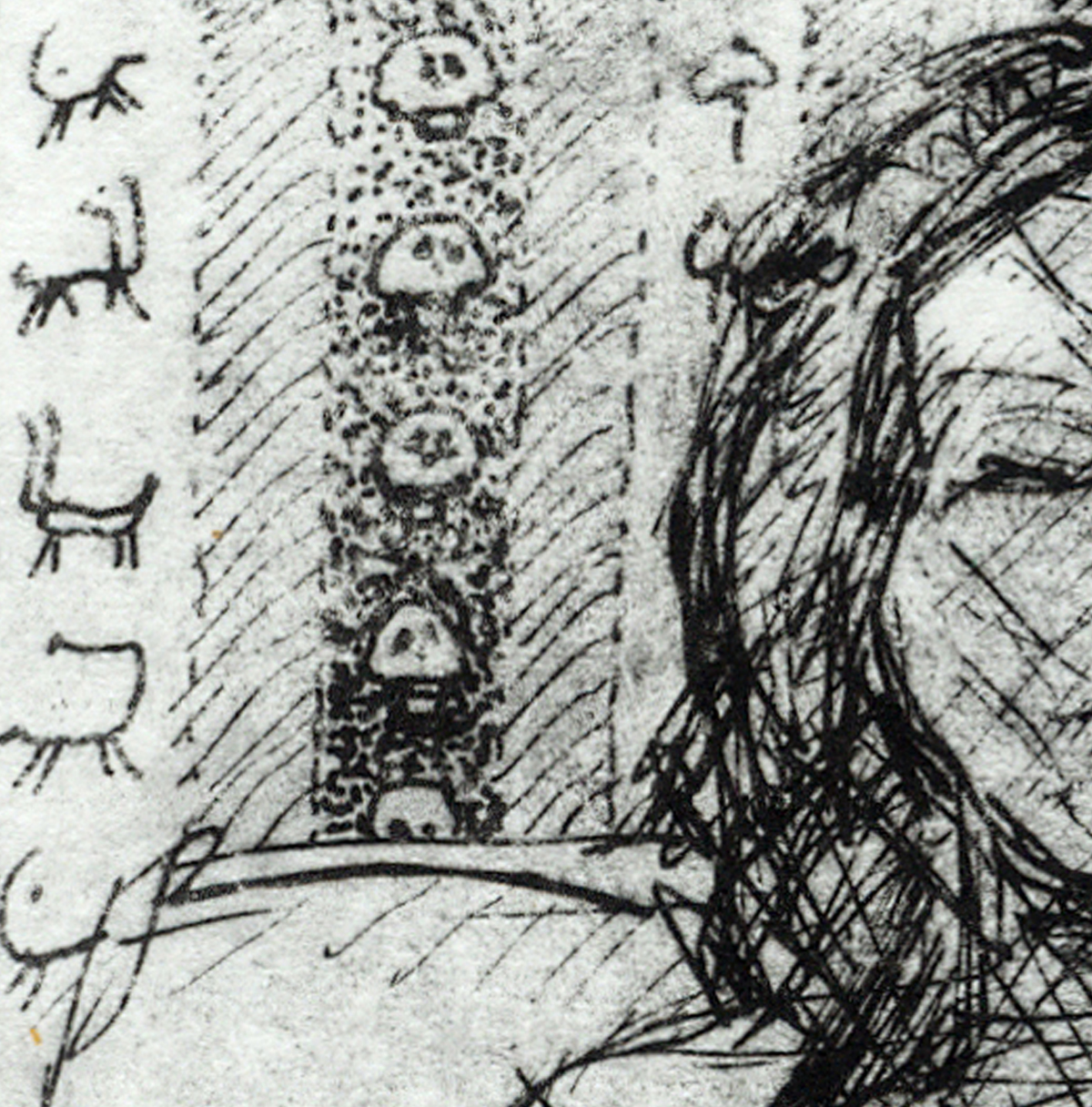
Look closer and you can see that they are skulls and petroglyphic animals, without being too arty you could see these as symbolising the brief life of the individual versus human culture; which can last for tens of thousands of years.

Cushion Detail

One of the main reasons we create art is to attempt to live beyond our allotted life span in some way. This coupled with the enormous emotional impact death has on the lives of each and every one of us makes it a massive subject.

In this piece I am also recalling the Memento Mori, a tradition in European [and latterly American] art, dating back to Roman times, where the viewer is reminded that death is the inevitable consequence of life, typically by including a skull.  You can see a previous blog featuring one of my other ‘Memento Mori’ here.

If you want to find out more technical details about the printmaking techniques I use please click here to go through to the technical section on my website. The etching “The Cushion” is available for sale on Artfinder and if you’d like to find out more, please click on the link here to go directly to it or click on the link on the right hand side of this blog to see other works for sale.

Drawing And Gonging

wall m

Coming up to the end of the second week at The Bagpuss Window and I’m getting on with the gigantic wall drawing, worked mostly intuitively. I’ve been pushing out of my comfort zone. I normally work directly from life, small, with fine pens and my drawing can be very tight and controlled. I want to use these few weeks in the old shop to experiment and loosen up my drawing as much as possible.

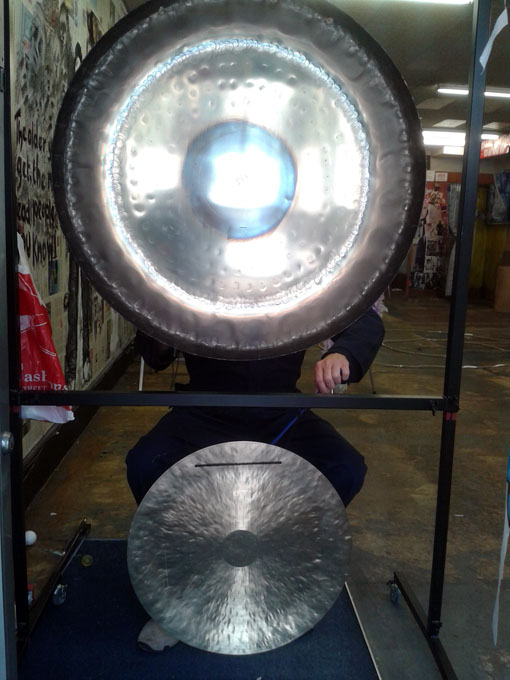
The past few days, we’ve been joined by David Pitt who, amongst other creative activities, plays gongs. Wonderful instruments, such incredible music. He was playing today as I was drawing and I got right into ‘the zone’, carried away by the incredible sounds and drawing automatically. When I looked at what I’d done, it was markedly different to the drawings I’d done earlier in the week, much freer. I used my fingers more, smudging the sparse features rather than fretting over details and doing loads of cross-hatching.

Gong
David Pitt and two gongs

It’s been a really good experience so far and there’s so much arty stuff happening locally that Swansea’s being called the new Montmartre. 

Popping Up

2


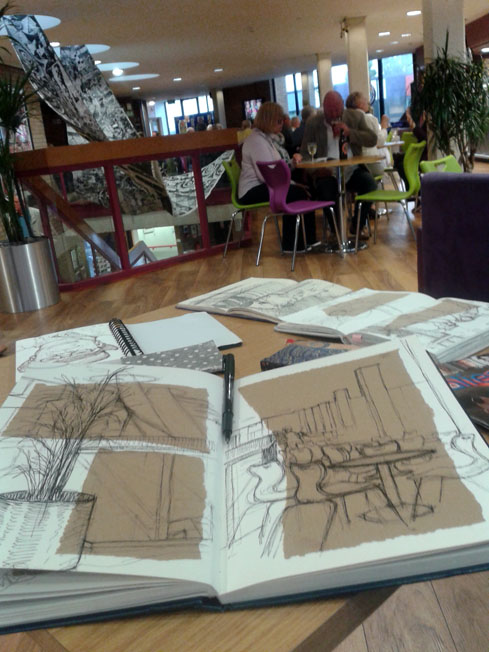
This evening I did my third stint in a little pop-up studio at the Taliesin Arts Centre. I’m a member of an artist collective, 15 Hundred Lives, and we have an exhibition at Oriel Ceri Richards Gallery until the 26th of September. We’ve been given some space in the Taliesin foyer/bar to do live art, so I’m there on Wednesday evenings throughout the exhibition’s run and collagist Sylvie Evans is also doing some sessions. You can see her collaged sail installation hanging in the stairwell.

1

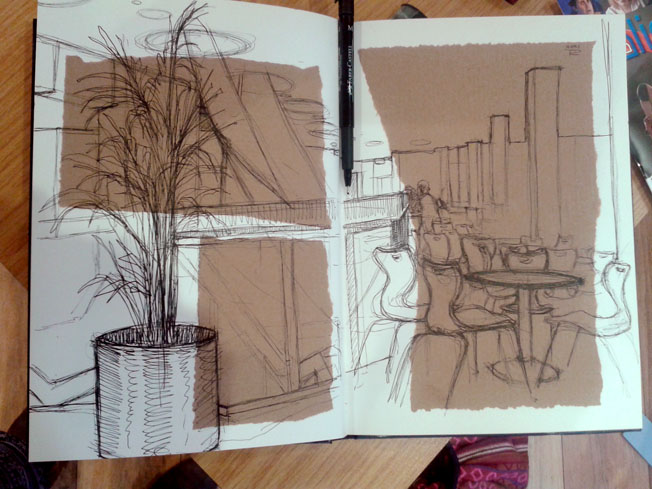
I started when the bar was fairly quiet which gave me a chance to draw something other than people. I don’t like drawing architecture and interiors, really hard, much prefer to draw people and animals. So this evening was good practice for me. I used a double page from my A4 hardbound sketchbook that I’d prepared with brown wrapping paper glued in with Pritt stick. I drew with Faber Castell Pitt drawing pens, sizes S and F.

Eventually the bar filled up with people come to see this evening’s film and I had some great conversations with those interested in what I was doing. I took along some completed sketchbooks for browsing. It’s a good opportunity to publicise my work, hand out business cards and direct people downstairs to the gallery to see the exhibition. Only one more pop-up studio session to go, but I’m going to be doing an artist walk-and-talk around the exhibition on Saturday the 26th. More about this soon.

Here’s a short video about our exhibition showing the three of us doing our art and you get to hear me speak.