Seeing What’s There

rhiannon

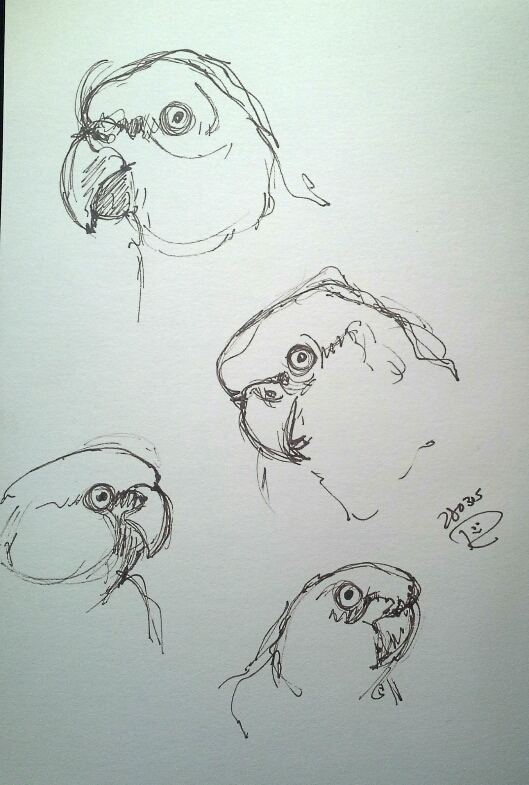
Husb and I are babysitting three little relatives having a sleepover. Loads of pancakes made, corn popped and films on DVD stacked up ready. It’s a good opportunity to practice drawing young heads. I’ve long been of the opinion that children have alien heads; little tiny nose squished onto a little tiny face squashed onto an enormous head. With massive eyelashes.

I’ve been trying to draw my little niece for ages, but I still can’t get the proportions right. I’m getting there but still a way to go. I just can’t believe what I’m seeing, can’t accept the impossibly tiny chin and unfeasibly huge eyes. It just doesn’t compute. More practice needed. I drew this with a graphite pencil into my A5 Tate Gallery sketchbook.

Art’s Birthday

arts birthday

January the 17th is Art’s Birthday according to Robert Filliou, a French Fluxus artist, who proposed “Art’s Birthday” in 1963. He suggested that a million years ago there was no art. But one day, on January 17 Art was born when someone dropped a dry sponge into a bucket of water. Now, lots of artists and arts organisations across the world celebrate Art’s birthday. Today Husb and I went to a symposium on Utopia in the Mission Gallery in Swansea called ‘Collective Misunderstandings’, by Copenhagen-based collective ATB. A challenging and interesting day. I did an extended scribble with Faber Castell Pitt drawing pens into my A6 Tate Gallery sketchbook.

The Orange Reflection

supermoon 1

There was a strange reflection that caught my eye recently while Husb and I were walking on the beach. The full moon was bright silvery white but its reflection on the calm high tide was orange. I used my little Khadi sketchbook, handmade paper with a very rough texture. I had pre-coloured it with an Indian ink wash and I drew onto it with Daler Rowney artists’ soft pastels. The very rough texture of the paper gives a strong speckled effect.

Spots and Twists

warrior spots

I like working on direct line (trace) monotypes. It’s an immediate and spontaneous way to get an original print and the quality of the line is soft and smudgy. I also like to work with models in poses that are twisted or contrapposto, they have a dynamic interplay of forms and planes that I find more interesting that passive standing poses. I particularly enjoy setting the model against or within a pattered  artefact like a rug or blanket. This model is a young soldier who often models for our life drawing group when he’s on leave.

The monotype is printed from a perspex (plexiglass, acrylic sheet) plate coated with black oil-based litho / relief ink thinned with a little extender. It’s important to roll the ink super thin otherwise you’ll get huge black smudges everywhere. Once there is a very thin layer of ink on the perspex, a sheet of fairly thin paper (a good cartridge paper around 150 gsm will be fine) is placed on top and a pencil drawing done on the top of the paper. The pencil needs to be kept sharp. When the paper is lifted off the perspex, the ink will have stuck to the places the pencil touched, creating an unique monotype. It’s a very good method for artists who love drawing.

On The Hoof

wpid-wp-1421275303814.jpeg

Did some speedy sketching out and about. I put some basic lines down very quickly in pale grey graphite then worked over it when I got home with dark graphite in my A5 Tate Gallery sketchbook. It’s difficult to do much detail when you’re sketching on the hoof, so I find it useful to just block in the main shapes for development later, especially if there’s more than one figure.

Cat. Feet.

20150113_223617(1)

I often do my daily drawing at the end of a busy day, when I’m crashed on my chair in front of the TV. That’s why there are a lot of drawings in previous posts of my cat or my feet. Tonight I have a drawing of my cat AND my feet. Bargain. I had my feet up on a stool and she lay along my legs, taking advantage of my body heat. I scribbled her into my Tate Gallery A5 sketchbook, across two pages, with two tones of graphite. This is Sparta Puss. Ming the Merciless is ignoring us.

Twisted

the twist


Here’s another direct line(or trace)  monotype, based on an original drawing I did in a life drawing session. I like twisted and contrapposto poses; I like the challenge of drawing them. This sort of monotype technique gives a gentle line and soft, smudgy textures. I used Intaglio Printmakers black litho/relief ink and a fairly thin paper, just a good quality cartridge paper for this.

Testament of Youth

wpid-wp-1421015855475.jpeg

Husb and I went to see the new film based on Vera Brittain’s book, ‘Testament of Youth’ this morning. Deeply moving, I cried buckets but don’t let that put you off. It’s a beautiful film and well worth seeing. Just be sure to take hankies. We sat between 2 couples, one in their 20s and the other were seniors. I drew these, just a quick scribble. It was good to see the wide range of ages in the audience. I remember seeing the TV series at the end of the seventies which was very good but this was more intense.

Impossible Lashes

wpid-wp-1420925723962.jpeg

Husb and I have a small visitor having a sleepover. He’s 10 and his face is starting to elongate but still has childlike chubbiness. Very young faces are so hard to draw, no wrinkles, no saggy bits, very few visual cues to go on. I used graphite into my A5 Tate Gallery sketchbook.

Why do children have such impossibly huge eyelashes?

Smudginess Abounds

fairy back


There are different ways of doing monotype prints. This technique is called a direct line monotype. You ink up a plate, usually perspex or glass, with a very thin layer of litho / relief printing ink. Then you gently lay a piece of good quality paper, not too thick,  onto it and carefully draw onto the paper with a sharp pencil. Peel the paper off the plate and there’s a monotype. Artist Tracey Emin does this a lot. I like to do it when I’m doing life drawings. A sharp pencil will give a good line and you can use your thumb or finger to press on a bit of tone and texture. There is a characteristic smudginess and softness with this technique.