Bauhaus and the Bates Motel in New Jersey

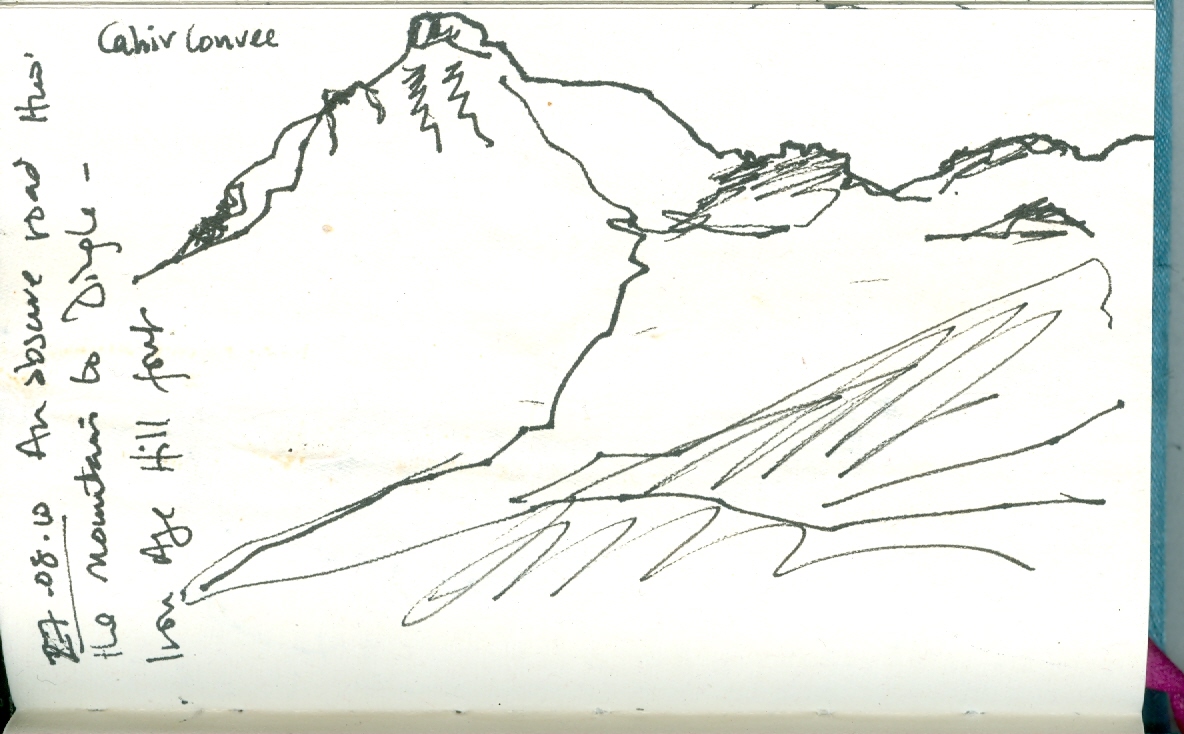
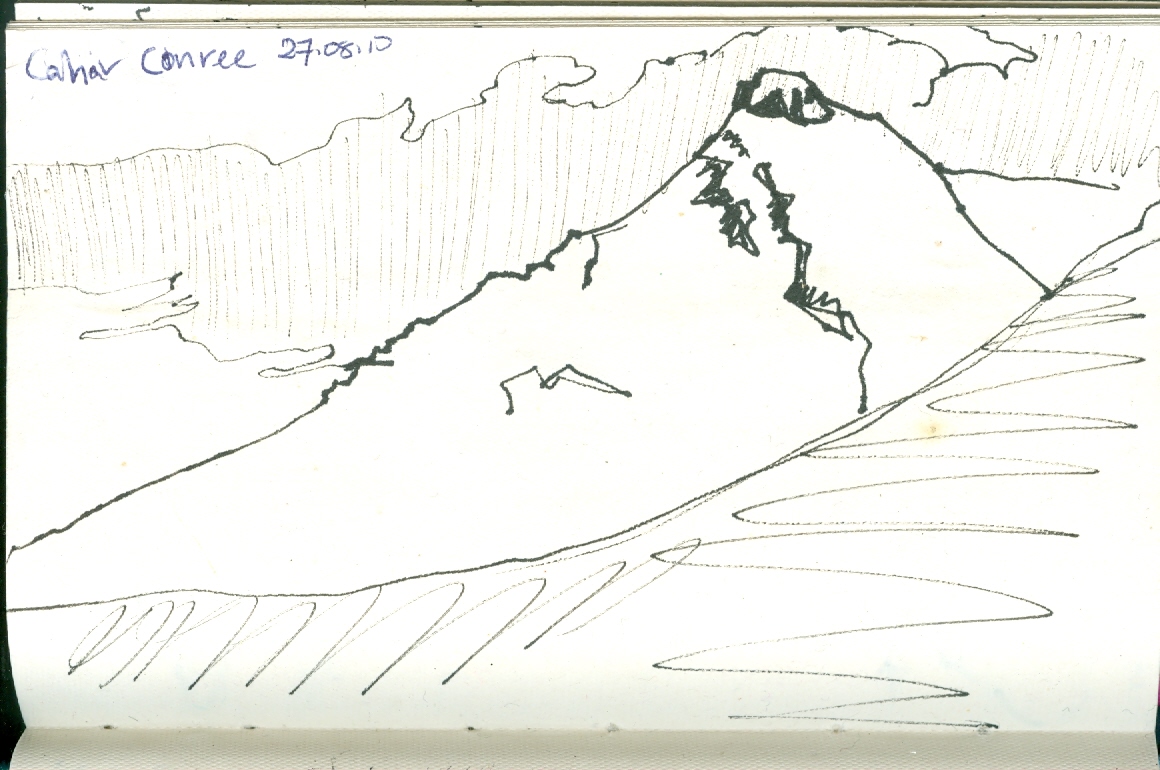
Ink drawing: the Bauhaus apartment.

A couple of years ago I was lucky enough to visit friends based at the Princeton University Institute of Advanced Studies in the USA. I was expecting New Jersey to be a cross between a Bruce Springsteen song and The Sopranos but I had a surprise because it was beautiful. The university campus is an odd mix of all sorts of architectural periods; rich benefactors endow buildings and seem to prefer historic styles, even to having mature trees transplanted in front of their buildings so they look very old and well-established instead of newbuild faux Victorian or whatever. I’m a keen gardener so I know how hard it is to keep a large transplanted tree alive and to stop it from falling over. That’s REAL money.

Our friends had a wonderful Bauhaus style apartment in a development of similar units set in parkland. The layout was a piece of brilliant modern open-plan design, spacious and airy with a vacuum cleaner that sucked dust into the cavity wall. Cool. We’re so used to modern architecture that it’s easy to forget that how revolutionary this stuff was when it was first built and this complex is one of the best examples I have seen.

While I was there my friends drove me up to visit the Printmaking Centre of New Jersey, about 45 minutes through beautiful Autumn countryside that reminded me of Powys back home except the houses were mostly made from wood. Eventually a tall rickety wooden building came into view that resembled Bates’ Motel from the film Psycho. It was the printmaking centre and it looked very sinister. I told my friends but as they’re Danish and Pakistani, they didn’t get the cultural reference and thought it was quaint. It spooked me out at first but inside is lovely with loads of printmaking facilities and a gallery.

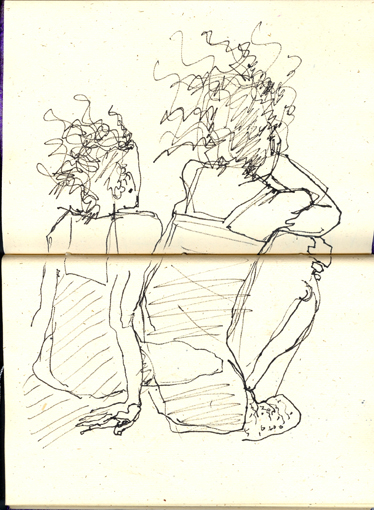
I did this ink drawing in my sketchbook of Melvyn, my husband, looking out of the Bauhaus apartment through the large picture window onto the parkland in Princeton. You can see electrical cables clearly; I was surprised to see so many wherever we went; most cabling in Britain is buried. It was also the first place that I saw black squirrels, but they’ve now arrived in the UK.


Self Portrait? I Don’t Think So!

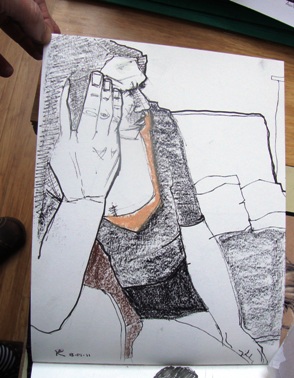
Ink drawing: self portrait.


I admire professional artists’ models because they put up with a level of scrutiny that would terrify most people and that includes me. I rarely do a self-portrait because when I look into a mirror I see what I want to see, someone younger and thinner! Subjecting myself to the same level of objective scrutiny that I inflict on models is hard going. You can’t avoid seeing the wrinkles and flab and you have to confront all the bits you’ve always avoided looking at too closely.

In my case it’s the lopsided mouth that reminds me of my Mam; the huge nostrils that got me the nickname ‘Mersey Tunnels’ in school; the big fat apple cheeks that old people used to pinch when I was tiny – what is it with old people and cheeks? I’ve started doing it to kids now! And my pointy eyebrows. I hate them. They’d get me into a Star Trek film as a Vulcan.

Here’s one I did a few months ago in Faber Castell Pitt pen onto Bockingford paper. I left most of my wrinkles off. Artistic licence see  😉

Cwtching computer cat

Ink drawing: Little Ming computer cat.

It’s funny how cats choose their people. All the cats that have lived with us have preferred one more than the other. Little Ming has been Melvyn’s cat from the start; she follows him around and she’s especially clingy when he’s using his computer. She rolls about on his PC keyboard and pushes in between him and the screen [just like the new Simon’s Cat cartoon] and he can’t sit on his own with his laptop; it’s obviously been made as a cwtch for a small fluffy cat. She twists herself into all sorts of daft positions so she can squeeze herself around his computer.

Here they are this evening relaxing in our living room. It’s dark outside; Autumn has come very quickly and the nights are drawing in but we’re very cosy here and Little Ming is making the most of the combined heat of Melvyn’s lap AND laptop while we’re listening to the Planet Rock ‘Amps Off’ show and doing Internet stuff.  This afternoon we went to Dynefor Park near Llandeilo for a walk with old friends, from the Gothic Victorian castle through silent woods and up to the old medieval castle ruins in the soft rain. Nice end to a difficult week. These quiet moments make you appreciate what’s really important.


Woollies Pigeons

Ink sketch: Woollies pigeon #1.

I sometimes go for coffee to Waterstones bookshop in Swansea, where the cafe is upstairs opposite the old Woolworths store. After Woollies closed, the signage was colonised by pigeons; before that, the signs were always lit up and too hot for the pigeons to sit on.  I liked to sit in the big old window and it gave me a great view over the street and started sketching the pigeons. I’d never drawn birds before and I found that they never keep still. Not when I’m looking at them anyway.

I went regularly for a few months and did dozens of drawings, using a variety of Faber Castell Pitt drawing pens.  Because they’re constantly moving, the sketches are very impressionistic and capture the essence of the birds rather than trying – and failing – to be accurate zoological drawings. Recently the store was re-opened with different signage and I must make time to go back and draw the pigeons on their new perches which is very different to the old Woollies lettering; it’s more loopy.


Ink sketch: Woollies pigeon #2.


I mounted some of them onto hand-coloured Zercoll paper, which I squeegeed with a gold metallic Acrylic System 3 paint, thinned with Acrylic medium. I squeegeed it straight onto the paper, rather than using a screen so it was very textured, rather than flat.

It’s very civilised sitting in a café in a bookshop in a converted early 20th century cinema, sketching. Must do it more often.

A classic nude

Ink drawing: a classic nude.


Thursday night is life drawing night in this little corner of Wales and we’re lucky enough to have an excellent group of models to work with, all ages, all shapes. The drawing studio at Swansea Print Workshop isn’t very big and it’s often crowded out. Last night I sat on the floor to get closer to our model otherwise I’d have sat at the back and it was a bit difficult to see well. I noticed that this pose is very classical and similar to the French artist Ingres painting ‘The Valpinçon Bather’. She’s drawn in Faber Castell Pitt pen size ‘S’ into a Fabriano sketchbook.


The Valpincon Bather by Ingres.


Ingres was a brilliant painter and I’ll never be able to match his technique but I like the drawing and it might become the basis for one of my large full colour monotypes.


Scribbling skeletons at random

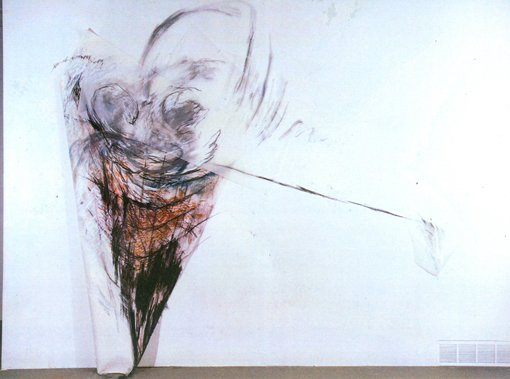
Conte scribble.


Sometimes it’s good to just have a scribble  and see what happens. It becomes an automatic thing, undirected and not linked to what’s in front of your eyes. It’s a chance to feel the drawing medium under your fingers and feel how it moves across the paper. Yesterday was a bit manic; studio first thing, gallery duty in the afternoon, life drawing in the evening and by the time I got back at 11pm I was too tired to blog, so here’s yesterday’s blog. I normally do some cataloguing or admin on my laptop while I’m sitting in on exhibitions at the gallery but my laptop died so I spent the afternoon randomly scribbling sort-of-skeletons. It was fun and made me think how bits are put together instead of relying on drawing it from life.

Tiny Art in a Venetian Plastic Sphere

Had a week off and back to the studio today. Strangely I worked better this morning; I’m usually at my best after lunch. I’m a bit tired because we spent most of last week travelling, entertaining, running and digging and now it’s catching up with me. I spent my time finishing my entries for the ‘100 artists’ installation at the Venice Arts Biennale Fringe. It’s a chance to get two tiny artworks into vending machines situated in galleries in Venice. The work will be put into little plastic spheres [smaller than 10 centimetres] and collectors will have to take a chance on what they get for their money.

Drawing / print construction: Pathogen

I’ve made two drawing / print constructions based on a traditional children’s game. ‘Pathogen’ is drawn from dangerous bacteria and viruses that attack the human animal. With the population of the planet increasing to huge numbers it becomes more likely that our species will be slaughtered by these or similar pathogens. The central image of a skull is a lino block print developed from original anatomical drawings. Cheerful aren’t I?

Drawing / print construction: Pathogen interior.

‘Petroglyph’ is based on sketchbook drawings I did during a trip to the Karakoram Mountains in Pakistan a couple of years ago. They are ancient rock carvings, picked into roadside boulders by people at least ten thousand years ago and they mostly represent local animals and hunting scenes.

Drawing / print construction: Petroglyph.


Their existence is now threatened by the proposed development of a hydro-electric dam in the Indus Valley which will drown this extraordinary monument of early human art. The central image is a lino block print developed from a drawing of an ibex petroglyph.

Drawing / print construction: Petroglyph interior.


Draw Draw Draw: Feet to the Fore

Ink drawing: My husband's feet.


Call me old-fashioned but I draw almost every day and I make no apologies for that. I believe that drawing underpins visual art and that all artists should draw regularly to constantly improve what we do. Sometimes at the end of a long day I don’t really feel like sketching and it’s more out of duty than anything else and this is when feet come in really handy [see what I did there] as they’re never far away and they stay put, so I have quite a few drawings of my feet …… and my husband’s. It’s good practice because they’re not easy to draw so you get some anatomy and perspective practice as well. These ink drawings are in my sketchbook and they’re drawn using the continuous line technique with Faber Castell Pitt drawing pens.


Ink drawing: my feet.


Archaic Blue Photography [very artgeek stuff]

Cyanotype portrait: Melvyn, Lahore.

I don’t always work from drawings although 90% of my work, or more, is based on sketches. Sometimes I have a bit of a play with photographic imagery and translate it into various forms of printmaking – monotype, block, screen, photogravure and cyanotype.


Cyan is the colour blue and also the first four letters of cyanide and it’s this combined with ferric compounds that form the chemical basis for cyanotype, one of the earliest forms of photography. I start by shoving a digital photo through Adobe Photoshop Elements, changing to black and white and inverting it to get a negative. Then I either put it through a Cutout filter to reduce it to four or five greytones, or into Threshold to make it a very stark black and white image, like Pop Art. Then I print it out onto acetate through an inkjet printer so I have a contact negative.


The next step is to coat a sheet of Bockingford or Somerset, at least 250gsm, with the cyanotype solution, leaving some brushstrokes around the edges, and dry it off in the darkroom, then into the UV Unit with the negative for 6 minutes [it can be done in daylight but takes a lot longer]. The development is easy; pop it into running cold water until the print turns blue and white and the water runs clear. Leave it to drain for a while then between tissue-lined drying boards while it’s still damp.


I took this photo of my husband at night in a rooftop restaurant in Lahore, Pakistan and gave him the cyanotype treatment.


A Little Black Panther and Pavlov’s Humans

Ink drawing: two kitties on a cushion.

Our lovely black tomcat, Bola, died a couple of years ago at the age of 19. He was an enormous sleek neutered tom and he looked like a scaled down black panther but he had the sweetest personality and loved food. He was a bit of a gourmet and I know you’re not supposed to do it, but I always let him sit next to me at the table and I fed him tidbits. He liked Indian, Chinese, Italian and Mediterranean food as well as good home cooking. Meat, fish and cheese were his favourites but he’d happily eat rice, pasta and veg as long as there was some sort of gravy or sauce on them.

At the end of the meal he loved to be given a tiny slice of honeydew melon which he’s suck and suck until it was dry. He always had to have his human food at the table – he wouldn’t eat tidbits if I put them in his cat bowl. I wished that there were restaurants that would accept cat guests because he would have loved to be taken out to dine and he was very well-behaved, but that’s ‘Elfin Safety for you!

I swear he had a wristwatch hidden on him somewhere because throughout his long life he never missed a mealtime. We’ve always fed our cats at 7am and 5pm and he’d be there, first thing in the morning, meowing loudly dead on seven o’clock every single day, never understood the concept of a lie-in. Even though he’s been gone now for two years we still automatically wake up at 7am, no need for an alarm clock. It’s like those experiments with Pavlov’s dogs.

This is an ink sketch I did of Bola and Bobbit, our tortoiseshell [calico] queen in a rare moment of tolerating each other, curled up on a chair next to the boiler in the kitchen.