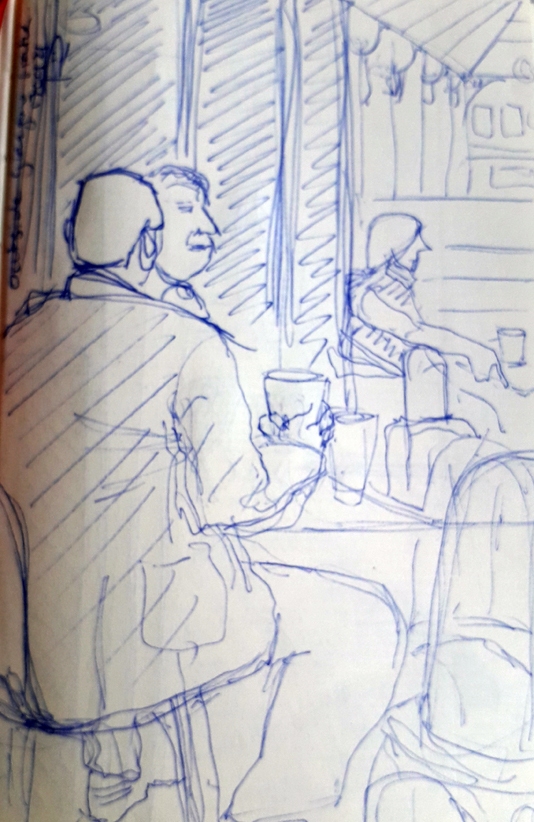
Here’s a little scribble I did in my sketchbook the other week when I was waiting for the train back from Glasgow. What a brilliant city, I loved it. I like doing these tiny drawings of everyday life into my sketchbook, just little slices of normality which mean more to me than ever before after 16 months of the pandemic.
This is the last few days of my September fundraiser for LATCH: The Children’s Cancer Charity.
This is me with my young nephew who has been helped enormously by LATCH over the past 3 years. We’ve got together to raise funds for LATCH, which is a small independent charity. Please click on the link below to find out more. Thanks xxx
LATCH, The Children’s Cancer Charity, Painting Fundraiser
I’ve been painting these ‘fakes’ with Ed Sumner’s Cheese and Wine Painting Club on Facebook since lockdown started in Spring 2020. I’m selling some of them to raise funds for this lovely charity which has given so much support to my young nephew over the past few years.
If you would like to see the paintings and maybe buy one, please click on the boats picture to visit the page. Thanks xxx
I painted this “fake” of Piet Mondrian’s “Evening: The Red Tree” recently and Husb made a time-lapse film of it – all done in under a minute – I wish!! Sparta Puss hung out with me while I painted. Here’s the video below.
This is the last few days of my September fundraiser for LATCH: The Children’s Cancer Charity.
This is me with my young nephew who has been helped enormously by LATCH over the past 3 years. We’ve got together to raise funds for LATCH, which is a small independent charity. Please click on the link below to find out more. Thanks xxx
LATCH, The Children’s Cancer Charity, Painting Fundraiser
I’ve been painting these ‘fakes’ with Ed Sumner’s Cheese and Wine Painting Club on Facebook since lockdown started in Spring 2020. I’m selling some of them to raise funds for this lovely charity which has given so much support to my young nephew over the past few years.
If you would like to see the paintings and maybe buy one, please click on the boats picture to visit the page. Thanks xxx
It’s the last few days to see my exhibition of “Pandemic Paintings” on Swansea Print Workshop’s digital gallery. It’s our September show and I’m chuffed to be showing the “fakes” I’ve done with Ed Sumner’s Cheese and Wine Painting Club on Facebook. Here are a few of them but there are plenty more in the exhibition. Please click here to see the show.
I’ve done a podcast to go with a selection of 10 of the paintings, quite a short one, just enough time for a sit down and a cuppa tea – here it is.
LATCH, The Children’s Cancer Charity, Painting Fundraiser
I’ve been painting these ‘fakes’ with Ed Sumner’s Cheese and Wine Painting Club on Facebook since lockdown started in Spring 2020. I’m selling some of them to raise funds for this lovely charity which has given so much support to my young relative over the past few years.
If you would like to see the paintings and maybe buy one, please click on the boats picture to visit the page. Thanks xxx
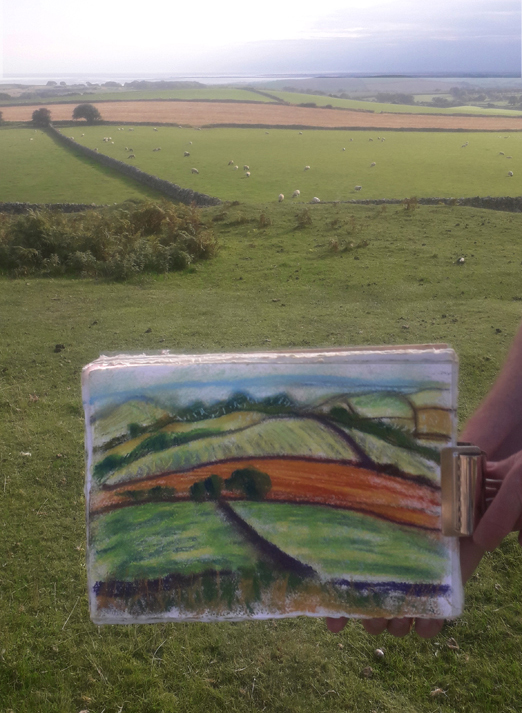
I’m starting to paint my own work now, after 18 months of copying great artists with Ed Sumner’s Cheese and Wine Painting Club on Facebook. I did a pastel drawing when I was visiting the Lake District last week and I’m developing it into a painting. Here’s a section of it, using Liquitex Heavy Body acrylic paints onto stretched canvas. It still needs a lot of work.
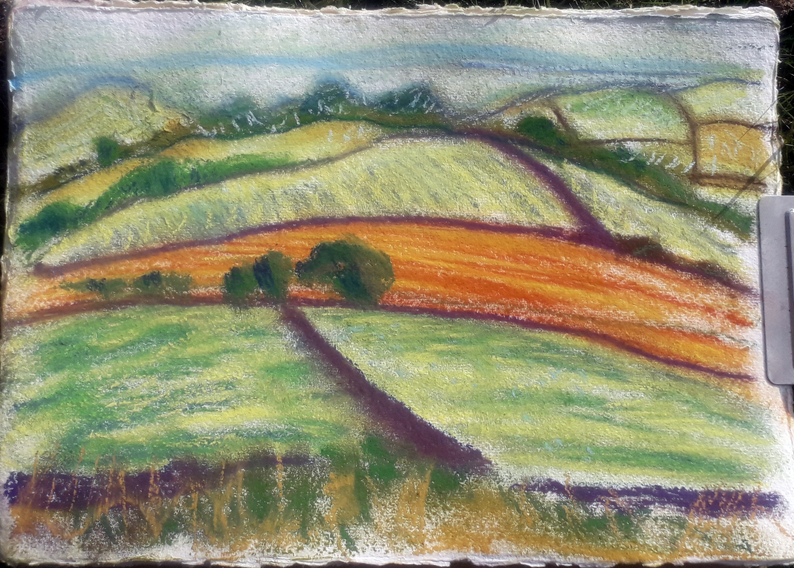
Here’s my pastel drawing, using Daler Rowney Artists Pastels onto Khadi handmade paper. I stopped to sketch on a walk across Birkrigg Common.
This is me with my young nephew who has been helped enormously by LATCH: The Children’s Cancer Charity over the past 3 years. We’ve got together to raise funds for LATCH, which is a small independent charity. Please click on the link below to find out more. Thanks xxx
LATCH, The Children’s Cancer Charity, Painting Fundraiser
I’ve been painting these ‘fakes’ with Ed Sumner’s Cheese and Wine Painting Club on Facebook since lockdown started in Spring 2020. I’m selling some of them to raise funds for this lovely charity which has given so much support to my young relative over the past few years.
If you would like to see the paintings and maybe buy one, please click on the boats picture to visit the page. Thanks xxx
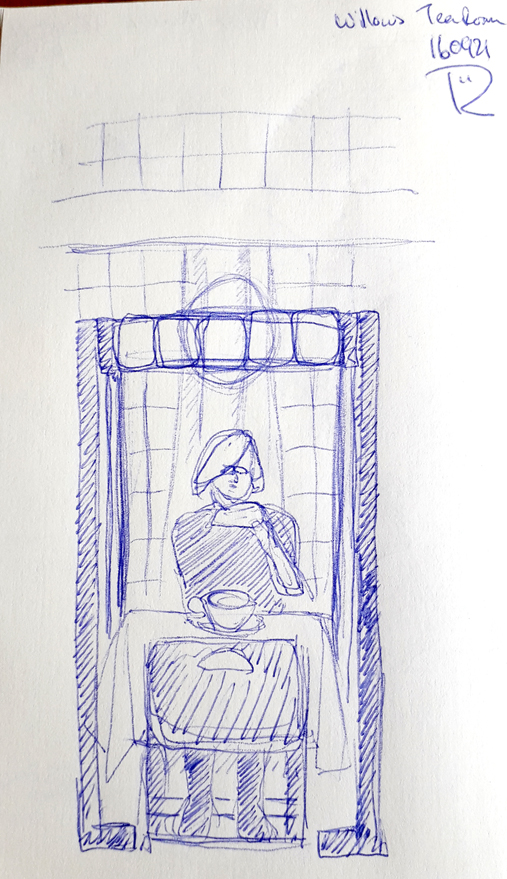
Husb and I went to Glasgow last week, for the first time. What a fabulous city. I loved it. We did the touristy bit, visiting the Kelvingrove Art Gallery and Museum (fabulous), the Necropolis (fabulous) and lunching at the famous Willows Tearooms (fabulous). We only had two days there but just enough to convince us both to go back and explore the graffiti and the vibrant rap and music scene. I did this scribble in the Willow, in ballpoint pen into my little A6 sketchbook. The food there was lovely and the surroundings gorgeous.
This is me with my young nephew who has been helped enormously by LATCH: The Children’s Cancer Charity over the past 3 years. We’ve got together to raise funds for LATCH, which is a small independent charity. Please click on the link below to find out more. Thanks xxx
LATCH, The Children’s Cancer Charity, Painting Fundraiser
I’ve been painting these ‘fakes’ with Ed Sumner’s Cheese and Wine Painting Club on Facebook since lockdown started in Spring 2020. I’m selling some of them to raise funds for this lovely charity which has given so much support to my young relative over the past few years.
If you would like to see the paintings and maybe buy one, please click on the boats picture to visit the page. Thanks xxx
Hiya, Rosie Scribblah here. www.scribblah.co.uk Welcome to my latest podcast. It’s called 10 Paintings – I don’t do long podcasts. Just enough time for a cuppa tea and a biscuit. Or a Welsh cake.
This is about 10 paintings I have copied through lockdown. I’ve been following the Cheese and Wine Painting Club on Facebook. The artist Ed Sumner has been running a free painting class every Friday since lockdown started in March 2020, teaching people to paint by copying great works. I’ve done nearly 60 paintings now and I decided to sell 10 of them throughout September to support a local charity called LATCH, the Children’s Cancer Charity which has given so much help to my young relative and family over the past few years. So have a listen and if you fancy having a look at the paintings, I’ll tell you how at the end.
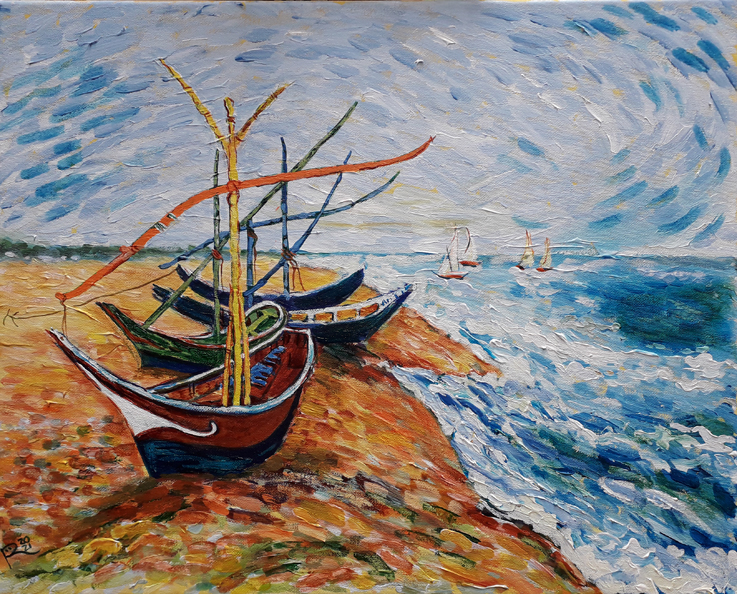
1. Vincent van Gogh, “Fishing Boats on the Beach at Les Saintes-Maries-de-la-Mer“
This was painted when Vincent was living in Arles in the south of France and had a trip to the seaside for a week in 1888 to help with his mental health. He was so excited to be at this little fishing village because he’d always wanted to paint by the sea, and he did loads of drawings and paintings. This particular painting was based on drawings he did, because the fishermen put out to sea so early each day that there was no time to paint the boats on the spot.
The little village is named after three saints called Mary; Marie Madeleine, Marie Salomé and Marie de Cléophas. They were closely linked to Jesus, the first witnesses to his Resurrection. There is a medieval tradition that afterwards they escaped persecution in Palestine in a boat and landed here and lived in the area for the rest of their lives.
This painting, like most of Vincent’s later work, is bright and colourful and full of dynamic brushstrokes. I have used Liquitex Heavy Body acrylic paint onto a stretched canvas for all of these, it’s great for using brushes and palette knives, which is how I created the choppy layers of paint in this one.
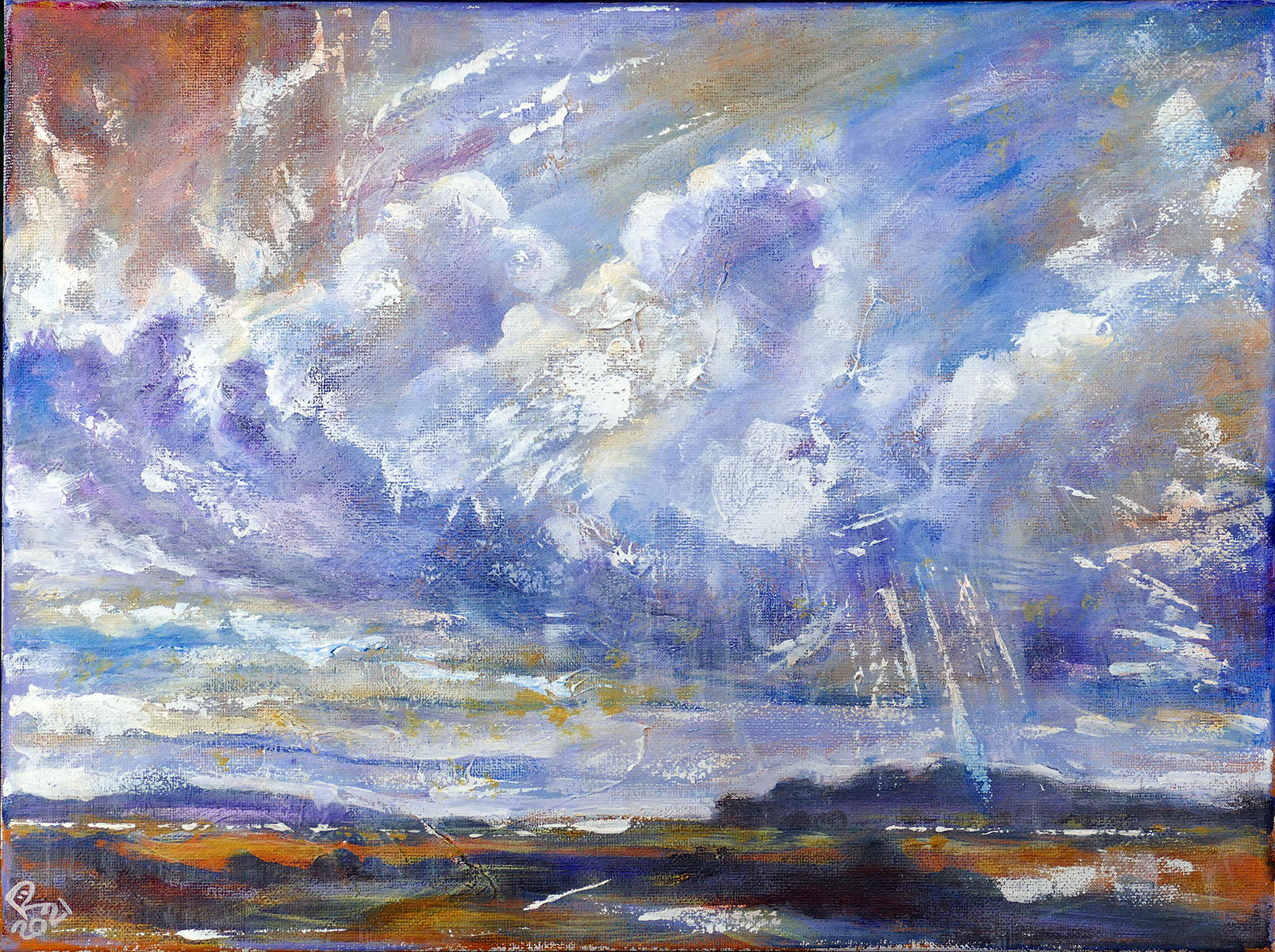
2. John Constable “Cloud Study”
I was never much of a fan of this bloke. He was an 18th / 19th century British landscape painter and I grew up in a time when his work was popular on biscuit tins and chocolate boxes, you know The Hay Wain and Flatford Mill and I guess that familiarity breeds contempt. So copying this cloud study was a real eye-opener. Constable made about 50 spectacular oil sketches of clouds in 1821 – 1822. He was very scientific in his approach and wrote notes on the back of the paintings about the conditions, the light and time of day; he was influenced by the pioneering “Father of Meteorology”, Luke Howard.
I started the painting on a textured canvas. I don’t like to waste anything so when I have some paint left over at the end of a session I scrape it onto a spare canvas and over the weeks it builds up layers of colour and texture. When I want to use it, I paint over it with some white acrylic or whatever colour is going to be the base coat of the painting. It gives me a head start on a heavily textured work like this one …. and I recycle paint I would otherwise have thrown away.
This cloud study reminds me of the atmospheric paintings of William Turner, who was around at the same time, but until I saw this I’d never ever thought about them being similar in any way. Constable was 60 when he died and had a pretty successful and influential career.
3. Andre Derain “Charing Cross Bridge”
The French artist Derain was probably most famous for being one of Les Fauves – Wild Beasts – a group of painters who developed this style in the first decade of the 20th century. As well as Derain, there was Henri Matisse and a few others as well, but these two are generally recognised as the leaders. This is one of 30 paintings that Derain did when he was young and lived in London, around 1906, and is full of joyous colour and dynamic brushstrokes. He loved living in London and when he went back to Paris, he picked up a few fashion tips and was regarded as quite a dandy in the English style.
But that didn’t last. As he grew older he left his wildness behind and his later art, after World War One, is very sober and classical; well, you can understand that, after living through the Great War.
I loved painting this. Apart from the juicy colours, the composition reminds me of photographs from around this time. They’d have been in black and white, but the wider angle shots of those primitive cameras have a strange distorted perspective that you can see in this painting, especially in the moving vehicles. It fascinates me that both photography and cars were reasonably new things, this was painted at the start of our modern world, saturated in unrealistic colours and warped by new technology. Strangely, after being there in the early years of moving vehicles, and painting them, he died in his seventies when he was run over.
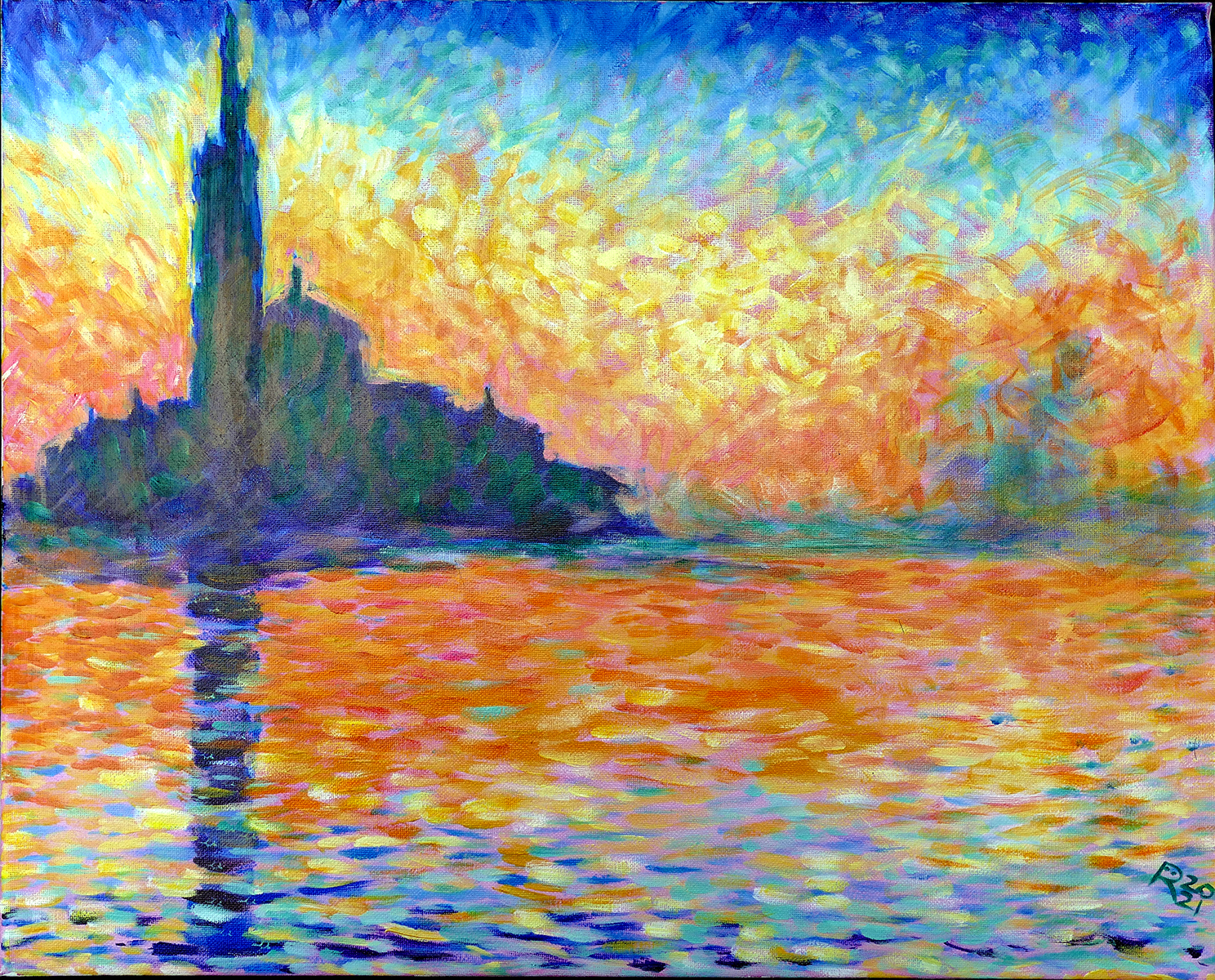
4. Claude Monet “San Giorgio Maggiore At Dusk
Monet was a French Impressionist and this painting is alive with tiny flecks of pure colours. The original is here in Cardiff at the National Museum of Wales. He painted it in the first few years of the 20th Century, when he was getting on a bit. He loved the sunsets in Venice but by this stage of his life, he didn’t complete them outside “en plein air” like he did when he was young. He started his paintings in Venice and then took them back to his home in Giverny to finish them. There’s this one in the National Museum but he also painted another version, I think it’s even brighter than this, and it’s in Tokyo.
So, how did this painting get into the National Museum of Wales? It was donated by Gwendoline Davies who, with her sister Margaret, was fabulously rich. They were heiresses of their grandfather’s fortune – he was an industrialist – and they were both mad keen to collect art and started in the early years of the 20th century, collecting Impressionist and Post Impressionist artists at first, then they went on to collect modern artists up until the 1950s. They bequeathed their collection of 260 artworks – worth a fortune – to the National Museum where they form the nucleus of their international collection. I’ve been there many times, it’s fantastic.
This composition is quite simple so I was able to get absorbed in applying the paint. Monet used many layers of colours, overlaid in dashes, and I found that once I got stuck in, the paint went on fairly quickly.
5. Camille Pissarro, “Bridge at Montefoucaute”.
The is by the Danish / French Impressionist artist Camille Pissarro, “Bridge at Montfoucaut”.
Now, Pissarro was a bit older than most of the Impressionist artists in France and he was a bit of a father figure to them. Like the other Impressionists he was frustrated with conventional academic art so he worked outside “en plein air” as they say in France, painting what was in front of him and finishing his paintings in one sitting. It made them look realistic but the art establishment thought they were vulgar. Imagine it would be like an artist nowadays painting street scenes with litter bins overflowing with rubbish and seagulls fighting over fast food in the gutter. But that’s the way it is. So when he met the younger Impressionists, he fitted right in.
This painting, “Bridge at Montfoucaut” is from about when he got involved with the Impressionists and it’s very typical, a fairly simple composition build up with many dashes and layers of paint. I didn’t like it when I started copying it, but it grew on me. It shows a person in a park with a pond and lots of trees and shrubs, very simple, but the colours are stunning, really beautiful and I really got into building up all those intense colourful layers.
What happened to Pissarro? Well, he became a Neo-Impressionist – or Pointillist – but that’s another story and he lived to a ripe old age, fathering a dynasty of painters who are still working today.
6. Vladimir Tretchikoff “The Green Lady”
Now Vlad the Russian was self-taught but despite this went on to become one of the wealthiest artists of the 20th century. I grew up with this painting, so many people had a print of this on their living room walls during the 1960s and 1970s – it was one of the best-selling art prints of the last century. Vlad painted it in 1952 when the model, South African Monika Sing Lee was about 17. She had never thought of herself as beautiful because of the racist remarks she had to put up with – South Africa was riddled with Apartheid back then. Scandalously, she never benefitted from the sale of millions of prints of this painting. She earned just £6 for sitting for the portrait.
Vlad’s work was incredibly popular with the public which earned him the title “The King Of Kitsch” from the art establishment, snooty lot. But he sold so many reproductions of his works that he was reckoned to be the second richest artist of his time after Pablo Picasso. So he was laughing all the way to the bank, wasn’t he?
I found this one of the easier “fakes” over the past 18 months, the composition is fairly simple and the brushwork isn’t complex, unlike some of the other painters I’ve studied. The colours in her face are beautiful, such a range of tones and hues. I used a copper metallic paint in places to give her skin an iridescent sheen, the first time I’ve tried out a metallic paint and I like it. The embroidery on her gown was a bit of a faff, to be honest, but really good practise for me.
7. Joseph Mallord William Turner “Storm At Sea”
Turner. One of Britain’s most famous artists and a notorious cheapskate. It’s true, he was stingy. He often used cheap paints and sometimes they were so cheap that buyers returned the work months later because they had faded so much! He loved the juicy red called cochineal, made from South American beetles. But despite knowing that the colour just wouldn’t last, he carried on using it and we have no idea now after a couple of centuries just how brilliantly coloured his original works were.
Turner was well known for not caring about his finished work and left a lot of paintings in terrible conditions. He even ripped a tear in one painting to make a flap for his seven Manx cats. He was such a passionate, spontaneous artist that he wanted the reddest red or the bluest blue at the moment he was painting and didn’t think of anything else.
This copy I’ve painted is built up of many, many textured layers of paint. His work is so complex, with so many things going on and I’ve learnt a lot by studying him. And unlike old Turner, I’ve used excellent paint, Liquitex Heavy Body acrylic, so it won’t fade.
8. Vincent van Gogh “Irises”
Vincent van Gogh painted lots of flowers, tons of them and I’ve included one of irises in my 10 paintings. Like all the others, I copied this during The Cheese and Wine Painting Club on Facebook. Ed Sumner, who runs the club, taught us to paint these by doing a sort of swirl in one stroke with a big brush and dark purpley blue acrylic paint and then add the lighter bits and details when it had dried. It was fun, to be honest, doing a canvas full of these great big purpley swirls.
The first time I saw one of Vincent’s paintings was when I went to Amsterdam way back in my youth. I went on a motorbike with a load of other bikers and we stopped over for a few days on our way to the Dutch TT races. My mate and I really wanted to go to the van Gogh museum so off we went. Well, we’d been on the road and camping for a few days so we were proper minging, to be honest, and as we went around we noticed that wherever we stood to look at one of his fabulous paintings, the crowds quickly moved away. Result. I remember this one, I was absolutely blown away by it.
9. Vincent van Gogh “Scene in Montmartre”
This painting is a copy I have done of one of van Gogh’s scenes of Montmartre. Vincent was living with his brother Theo in 1886 when he painted this, when the area was still very rural. It’s not like that anymore, although there’s a windmill, the infamous Moulin Rouge, and a few vineyards. But back when Vincent and Theo lived there, it was a largely unspoilt pastoral district and Vincent painted a series of scenes in this suburb. These studies still have the sombre feel of his earlier paintings from The Netherlands and Belgium. But within a year or so, his style had developed into the brightly coloured post-Impressionism most of us are familiar with.
The windmill here, “Moulin da la Galette”, built in 1622, is apparently still standing, just around the corner from the apartment the two brothers shared. Although this is an early work, his style of painting is just as complex as his later ones, with hundreds, maybe thousands, of brushstrokes overlaid and overlaid to build up rich textures and well as glorious depths of colour. It took me AGES to do all those sticks!!!!! I visited Montmartre a few years back and stood outside the house the brothers shared. It was quite upsetting because just a few short years later, they would both be dead.
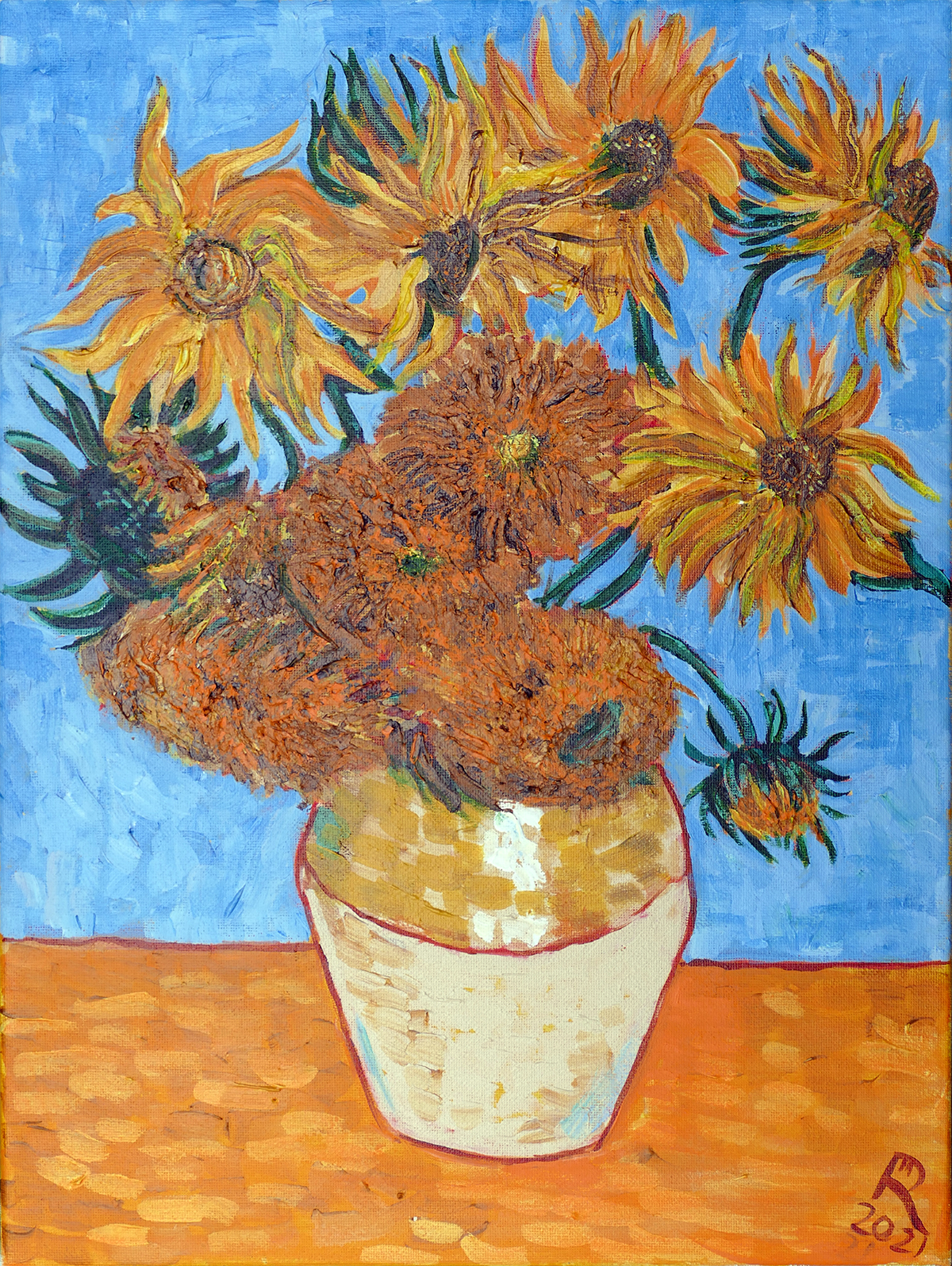
10. Vincent van Gogh “Sunflowers”
And the final one on my list of 10 is one of Vincent’s Sunflowers. It is said that his many, many paintings of sunflowers were originally much brighter, but he often could only afford cheaper paints and the yellows in particular are supposed to have changed over the years, becoming darker and more browny.
Copying a painting teaches you so much about the technique of the original artist. I’ve learnt that van Gogh built up the paintings in many, many layers, more than I had imagined. Those weird sunflowers at the bottom of the vase in particular, are painted so thickly that the paint is sticking up in little spikes. I’ve often thought it would be great to travel back in a time machine and see them as they were created, in all their colours. My favourite episode of Doctor Who is the one where they do exactly that, go and visit Vincent in Arles.
Right. That’s another Tea Break Podcast over. If you want to see these paintings please visit my blog www.scribblah.co.uk and click on the photo of van Gogh’s boats on the right hand side.
Next time – back to my series about different colours and it’ll be all about brown – and some of it will be quite revolting. Hwyl fawr, bye…..
Husb and I had a few days away last week, cautiously enjoying the relaxation in lockdown rules. We spent some time in the Lake District and I did a bit of scribbling out walking on the glorious Birkrigg Common. I used Daler Rowney Artist’s Pastels onto hand made Khadi paper. I’m facing North West in this photo, a few hundred metres behind me is the double stone circle known as The Druid’s Circle. It’s very rare – only 15 of the 250 stone circles in England are concentric so it’s protected as an Ancient Monument.
This is me with my young nephew who has been helped enormously by LATCH: The Children’s Cancer Charity over the past 3 years. We’ve got together to raise funds for LATCH, which is a small independent charity. Please click on the link below to find out more. Thanks xxx
LATCH, The Children’s Cancer Charity, Painting Fundraiser
I’ve been painting these ‘fakes’ with Ed Sumner’s Cheese and Wine Painting Club on Facebook since lockdown started in Spring 2020. I’m selling some of them to raise funds for this lovely charity which has given so much support to my young relative over the past few years.
If you would like to see the paintings and maybe buy one, please click on the boats picture to visit the page. Thanks xxx
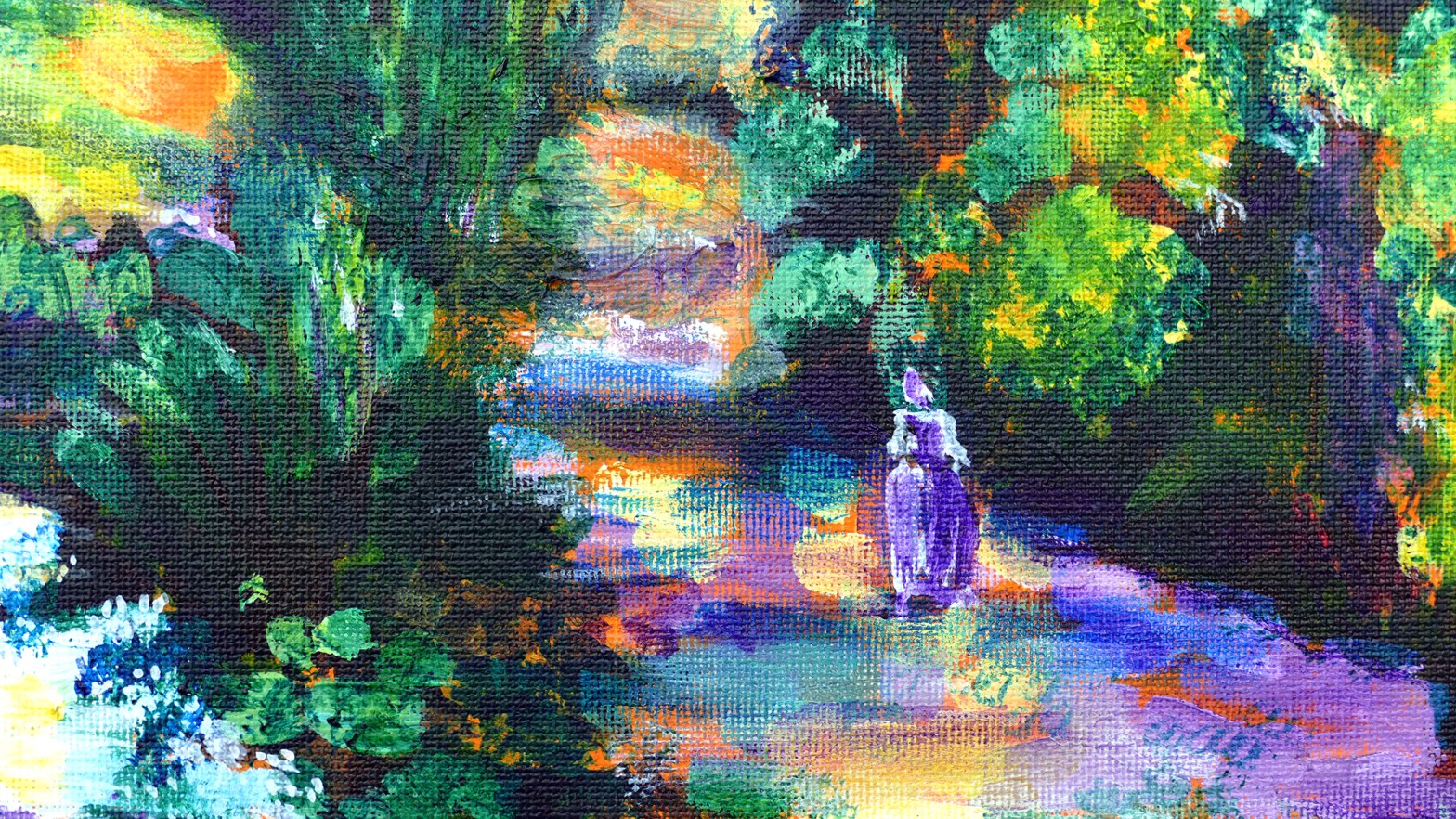
Camille Pissarro was slightly older than most of the Impressionist artists in France and he was a bit of a father figure to them. Like the other Impressionists he was frustrated with conventional academic art so he worked outside “en plein air”, painting what was in front of him and finishing his paintings in one sitting. It made them look realistic but the art establishment thought they were vulgar. I imagine it would be like an artist nowadays painting street scenes with litter bins overflowing with rubbish and seagulls fighting over fast food in the gutter. So when he met the younger Impressionists, he fitted right in.
This painting, “Bridge at Montfoucaut” is from about the time when he got involved with the Impressionists and it’s typical, a fairly straightforward composition built up with many dashes and layers of paint. I didn’t like it when I started copying it, but it grew on me. It shows a person in a park with a pond and lots of trees and shrubs, very simple, but the colours are stunning, really beautiful and I really got into building up all those intense colourful layers. What happened to Pissarro? Well, he became a Neo-Impressionist – or Pointillist – but that’s another story and he lived to a ripe old age, fathering a dynasty of painters who are still working today.
LATCH, The Children’s Cancer Charity, Painting Fundraiser
I’ve been painting these ‘fakes’ with Ed Sumner’s Cheese and Wine Painting Club on Facebook since lockdown started in Spring 2020. I’m selling some of them to raise funds for this lovely charity which has given so much support to my young relative over the past few years.
If you would like to see the paintings and maybe buy one, please click on the boats picture to visit the page. Thanks xxx
This is my painted copy of an original painting that’s here in Wales. It’s French Impressionist Claude Monet’s “San Giorgio Maggiore At Dusk“. He painted it in the first few years of the 20th Century, when he was quite elderly. He loved the sunsets in Venice and started his paintings there, but took them back to his home in Giverny to finish them. The original was donated to the National Museum of Wales in Cardiff by Gwendoline Davies. Claude also painted another version, I think it’s even brighter than this, and it’s in Tokyo.
Gwendoline and her sister Margaret were properly rich, heiresses of their industrialist grandfather’s fortune and they were both mad keen to collect art and started in the early years of the 20th century, collecting Impressionist and Post Impressionist artists as well as modern artists up until the 1950s. They bequeathed their collection of 260 artworks to Cardiff’s National Museum where they form the nucleus of the Museum’s famed international collection. I’ve been there many times, it’s fabulous. This composition is quite simple so I was able to get absorbed in applying the paint. Claude used many layers of colours, overlaid in dashes, but I found that once I got stuck in, the paint went on fairly quickly. As always, I used Liquitex Heavy Body acrylic paint onto a stretched canvas. It is one of the paintings I have offered for sale during September to raise funds for LATCH Wales, the Children’s Cancer Charity – please click on the photo below to find out more xx 🙂
LATCH, The Children’s Cancer Charity, Painting Fundraiser
I’ve been painting these ‘fakes’ with Ed Sumner’s Cheese and Wine Painting Club on Facebook since lockdown started in Spring 2020. I’m selling some of them to raise funds for this lovely charity which has given so much support to my young relative over the past few years.
If you would like to see the paintings and maybe buy one, please click on the boats picture to visit the page. Thanks xxx
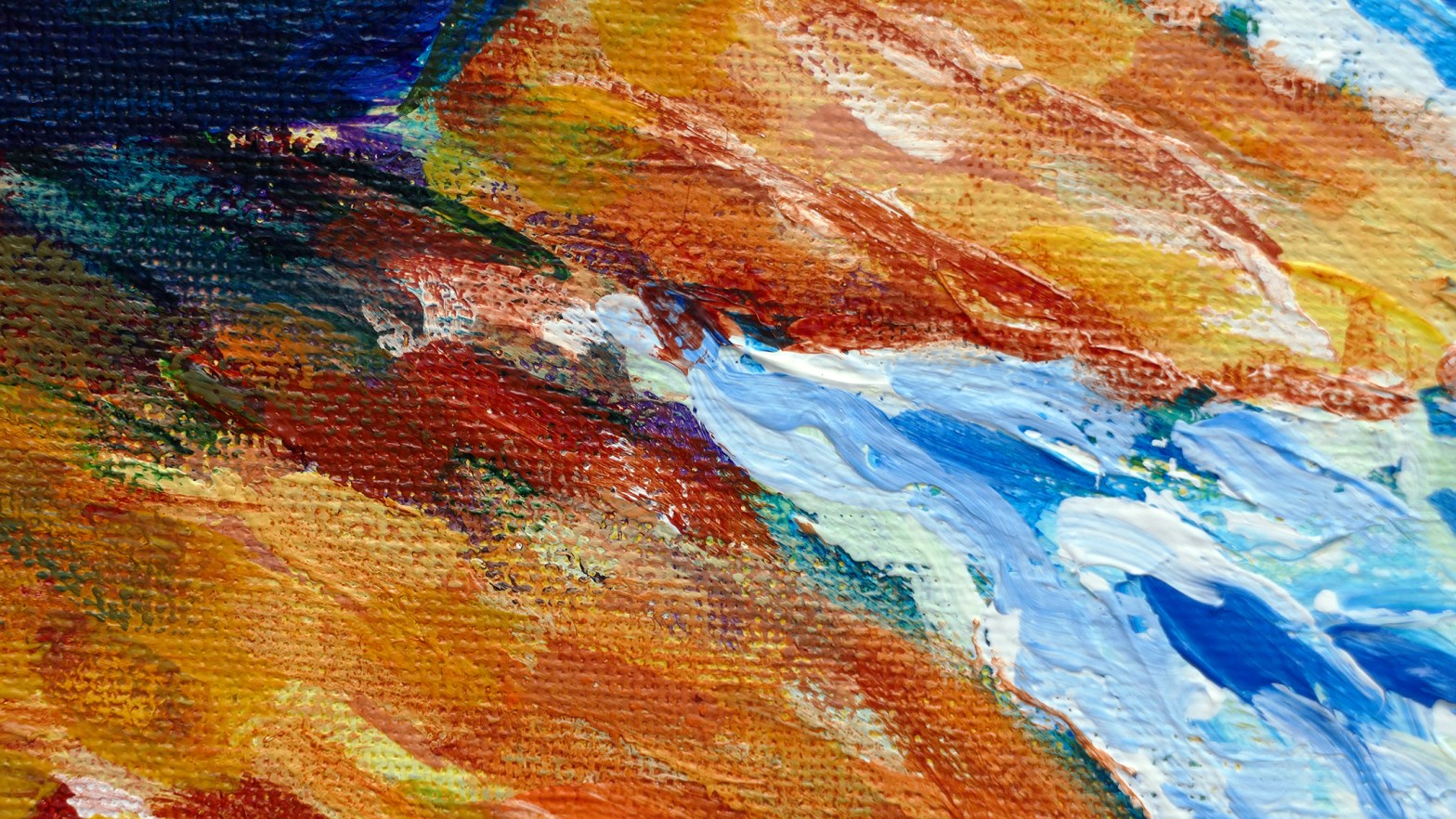
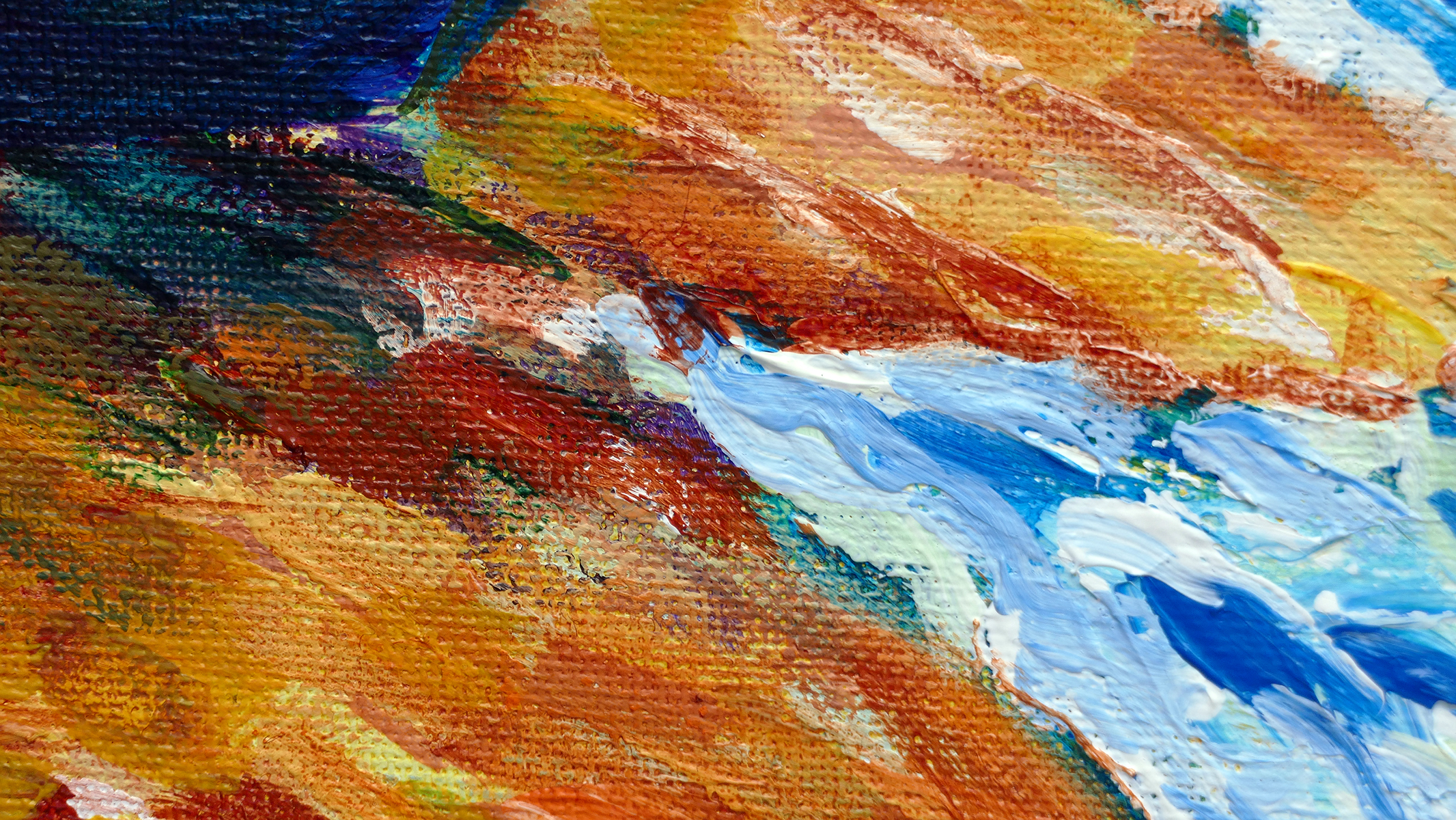
These dynamic brushstrokes are from a “fake” I did of a painting by Vincent van Gogh, “Fishing Boats on the Beach at Les Saintes-Maries-de-la-Mer“, which was painted when Vincent was living in Arles in the south of France and had a trip to the seaside for a week in 1888 to help with his health. He was so excited to be at this little fishing village and did loads of drawings and paintings. This painting was based on drawings he did, because the fishermen put out to sea so early each day that there was no time to paint the boats on the spot.
The little village is named after three saints called Mary; Marie Madeleine, Marie Salomé and Marie de Cléophas. They were closely linked to Jesus, the first witnesses to his Resurrection. There is a medieval tradition that afterwards they escaped persecution in Palestine in a boat and landed here and lived in the area for the rest of their lives. I painted this in Liquitex Heavy Body acrylic paint onto a stretched canvas, using brushes and palette knives to create the choppy layers of paint that van Gogh is so famous for. It is one of the paintings I have offered for sale during September to raise funds for LATCH Wales, the Children’s Cancer Charity – please click on the photo below to find out more 🙂 xx
LATCH, The Children’s Cancer Charity, Painting Fundraiser
I’ve been painting these ‘fakes’ with Ed Sumner’s Cheese and Wine Painting Club on Facebook since lockdown started in Spring 2020. I’m selling some of them to raise funds for this lovely charity which has given so much support to my young relative over the past few years.
If you would like to see the paintings and maybe buy one, please click on the boats picture to visit the page. Thanks xxx













 scribblah