S’Up In May And June?

What am I up to?

I’m working through a load of art events that I’ve been preparing for ages.

I’ve done TRANSITION, a public art event on May 20th and 21st 2016 in Swansea’s Creative Bubble Artspace with the 15 Hundred Lives art collective.

The 15 Hundred Lives art collective

And then May 28th I was in Fringe Arts Bath’s “A FAB Intervention” as part of The Plebeian Scribblers, a public access street-based drawing event.

A FAB Intervention in Bath

And then June 1st to 24th I am part of the Swansea Print Workshop collective exhibiting and running events at The Welfare, Ystradgynlais during the “Arts in the Tawe Valley (AitTV)” festival.

The Welfare, Ystradgynlais

And in the middle of all that, from June 17th, I will be exhibiting a large drawing as part of a group show in the ‘Divided By The Meltwater’ exhibition in Swansea’s Dynefor Centre.

Photograph by Tim Kelly
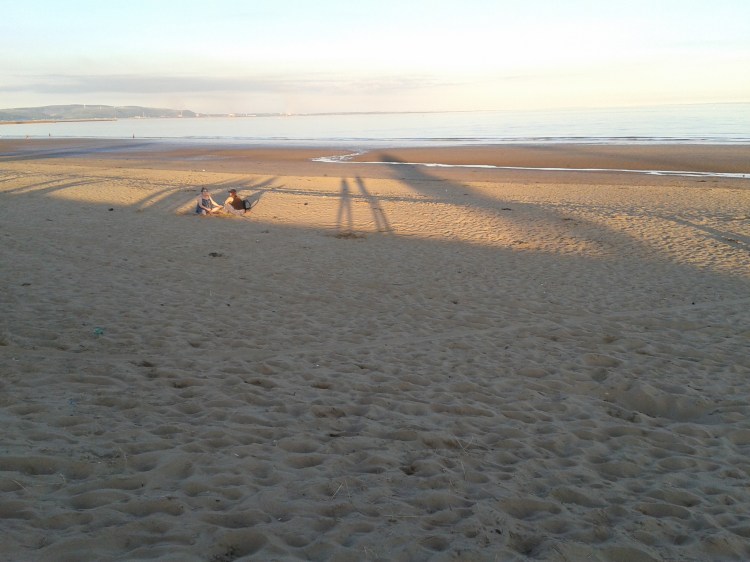
The Meltwater between Swansea and North Devon. Photograph by Tim Kelly

Throughout September I will have a solo show at the fabulous Workers Gallery in Ynyshir, Rhondda, showing the work I am developing on the ancient ancestral stones of South Wales.


The Hunt Rose Davies poster

I am part of the “Leftovers VI” International Print exchange which is a touring group exhibition of miniature prints from international printmakers. It’s just been exhibited in Boise, Idaho , USA and is destined for Reno, Nevada USA in October. Moves are afoot to bring it to Wales after Reno – watch this space!

And finally I will be running short courses in printmaking at Swansea Print Workshop over the coming months. Check out details here.

My courses at Swansea Print Workshop


If you would like to see some of my other artworks, please click here.

Rhubarb At The Castle

17-rhubarb
Rhubarb in pen and graphite

Too warm for me today, temperature around 21 Celsius, so Husb and I didn’t get down to the allotment until about 4pm, when it was staring to cool off a bit and I could do a load of digging without flaking out. Our allotment is on a site sandwiched between two woodland glades and right behind the 12th century Oystermouth Castle in Mumbles. It’s an idyllic setting but the soil is poor, a heavy clay and very hard to cultivate. But it’s good exercise and we generally harvest a good crop of fruits. Most veg need a lighter soil so we’ve built some raised beds and we’ve had moderate success with leeks, chard, rocket, potatoes, runner beans and broad beans. I’m trying out some beetroot and peas this year. Brassicas are a non-starter; as well as the poor soil, everything eats them.

oystermouth castle
Oystermouth Castle at twilight


If you would like to see some of my other artworks, please click here.

Copper And Stone

The first proof off the new etching plate

I etched two plates at the recent course at Swansea Print Workshop with Andrew Baldwin of Trefeglwys Print Studio, one aluminium, one copper. I’ve just done a first proof from the copper plate. I used a hardground and the traditional technique of drawing into it with an etching needle than adding aquatint. Andrew demonstrated how to do aquatint using his non-toxic B.I.G. process which involved putting the grounded plate through the etching press with a piece of emery paper face down on top of the ground. This cuts tiny holes into the ground which will etch as an aquatint. I did several dips into Ferric Chloride, ‘stopping’ out areas as I went along to develop the different tones.


Then I cleaned the B.I.G. ground off the plate, dried it and inked it up to take the first proof. It’s paler than I wanted it, possibly I needed to etch it for longer, possibly it’s a result of using a very soft ‘drypoint’ ink with a soft Somerset paper. I need to try another proof with a heavier, stiffer ink to see if it makes a difference, otherwise I’m going to have to do some work on the plate.

Andrew Baldwin’s new book comes out in October in conjunction with the opening of the ‘BIG Exhibition’. The book will give step by step guides to all the processes that can be used with BIG. The call for entries for the exhibition is open from 1st June and is open to all who have made prints using BIG. All entries should first be sent to Andrew via atb@aber.ac.uk. The exhibition will open at The School of Art in October and then travel to other galleries in UK before going over to USA.

The subject is the King’s Quoit stone monument at Manorbier in Pembrokeshire. I’m travelling around South West Wales with archaeologist Dewi Bowen who is researching his new book on Neolithic / Bronze Age monuments. His previous book on the stones of Ancient Siluria (South East Wales) can be found here. Accompanying us is film maker Melvyn Williams who is recording a documentary about our experiences. Some of Melvyn’s short films can be seen here. I’m currently working on a series of expressive drawings of ancestral sites and if you want to see some of my other artworks, please click here.


An Older Model

Mari May 2

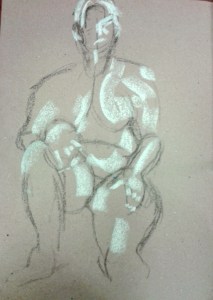
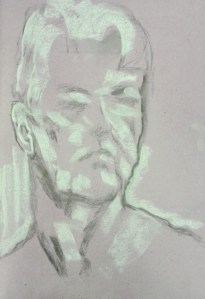
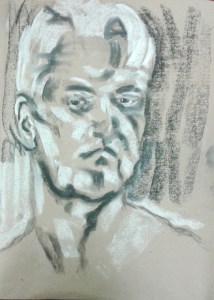
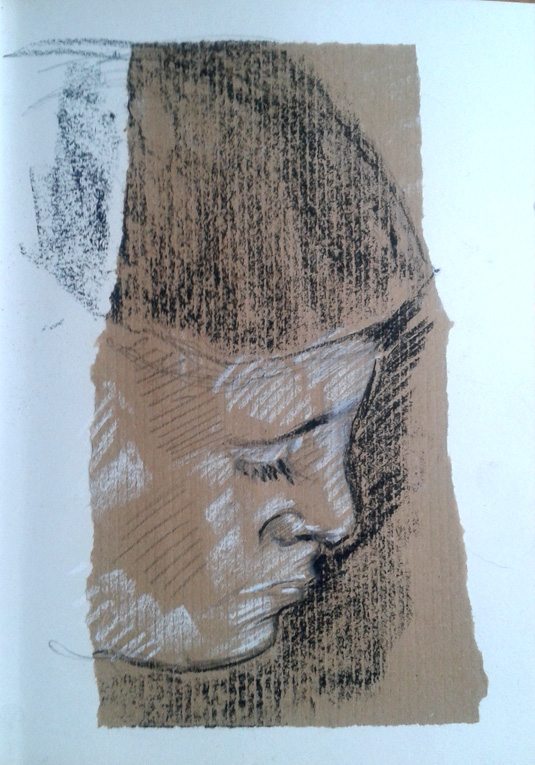
Life drawing at Swansea Print Workshop last night and I did a quick warm-up sketch then concentrated on a portrait drawing, working with an older model, a retired teacher. I worked with black and white conte crayon into an A2 brown paper sketchbook.

Mari May 1


Please click here if you would like to see more of my artworks.

The First Proof!

First proof

I spent this afternoon at an Open Access session at Swansea Print Workshop, ready to take a first proof from my coffee-lift-spit-bite aluminium etching plate, developed at last weekend’s BIG Etching course with Andrew Baldwin. I chose a soft textured Somerset paper from St. Cuthbert’s Mill and Intaglio Printmaker’s Drypoint Shop Mix etching ink. It’s softer than the usual etching ink, specially designed for delicate drypoint plates, but I fancied using it on this because I like its soft smudginess.


I’m very pleased with this first proof of one of the standing stones I have been drawing over the past 2 months. The coffee lift technique is wonderfully free and suits my drawing style – I did most of the drawing onto the aluminium plate with a dip pen and a reed pen. I like the splashes and dribbles, so much more spontaneous than traditional copper plate etching with a hard ground.

Andrew Baldwin’s new book comes out in October in conjunction with the opening of the ‘BIG Exhibition’. The book will give step by step guides to all the processes that can be used with BIG. The call for entries for the exhibition is open from 1st June and is open to all who have made prints using BIG. All entries should first be sent to Andrew via atb@aber.ac.uk. The exhibition will open at The School of Art in October and then travel to other galleries in UK before going over to USA.

I’m travelling around South West Wales with archaeologist Dewi Bowen who is researching his new book on Neolithic / Bronze Age monuments. His previous book on the stones of Ancient Siluria (South East Wales) can be found here. Accompanying us is film maker Melvyn Williams who is recording a documentary about our experiences. Some of Melvyn’s short films can be seen here. I’m currently working on a series of expressive drawings of ancestral sites and if you want to see some of my other artworks, please click here.


Coffee And Spit Bite

The plate ready to print

More geeky printmaking stuff from last weekend’s B.I.G. Etching course with Andrew Baldwin at Swansea Print Workshop. The aluminium plate was degreased with whiting and soy sauce to get it ready for drawing on with instant coffee solution. I forgot to take a photo of mine being drawn, but Andrew Baldwin has kindly lent me a photo from his forthcoming book (below). Once I finished the coffee drawing I gave it a quick flash in the oven to dry it and then rolled over a layer of Andrew’s B.I.G. etching ground. I baked it for 6 minutes and then bathed it in warm water, which lifted off the areas that had been drawn with the liquid coffee, revealing the areas to take an aquatint and spit bite, which will be the darker areas of the print. Then a quick dunk in copper sulphate solution to etch a light grey aquatint, giving the metal a bit of a ‘tooth’.


The copper sulphate does some chemistry and reacts with the aluminium, effervescing a red residue. Once that happens, the etching process stops and the residue washed off to reveal the lightly aquatinted surface beneath. Once it dried, I added layers of localised etching using a brush and concentrated copper sulphate solution to darken the selected areas. Then I scrubbed off the B.I.G. ground with non-toxic paint stripper and a stiff scrubbing brush. Now it’s ready to take a first proof, which I will do at an Open Access session at Swansea Print Workshop tomorrow.


The image is of a standing stone I drew recently on one of my adventures through South Wales hunting the wild megalith. Please click here if you would like to see more of my artworks.

BIG And Greasy


I spent a happy but exhausting weekend at Swansea Print Workshop on a specialist course in the ‘BIG’ non-toxic etching technique, pioneered and taught by Andrew Baldwin of Trefeglwys Print Studio. Andrew has invented a new etching ‘ground’ and has also experimented with a range of household materials to take the place of some of the toxic chemicals used in traditional etching. We started by degreasing some plates with whiting powder (powdered chalk) and soy sauce. It makes a terrific degreaser and is far safer than the ammonia I remember using in art college, back at the end of the 1970s. Once the grease had been cleaned off, we rolled the red ‘BIG’ ground onto the copper plate, keeping the aluminium plate for a coffee lift and spit bite. More about that tomorrow…….


Please click here if you would like to see more of my artworks.

Developing The Drawing


During last week’s life drawing session at Swansea Print Workshop, I took photos of the development of my portrait head of our model. It shows the drawing in different stages of development. I used conté crayon in white, sanguine and black into an A2 brown paper sketchbook.


Please click here if you would like to see more of my artworks.

Drawing The Environment

circle

The second stone circle at Y Pigwyn on Mynydd Bach Trecastell is a lot more complete than the first, with almost all its stones still in place, although they’re not very big. We took young Nephew with us, he’s a country lad and used to the rough terrain, he found a sheep’s skull, a ram’s horn and balanced on one leg on one of the stones in the circle. I drew quickly because it was cold and we weren’t sure how long the sunny interval after the gales and hail would last. I became aware how much this series of drawings has been influenced by the environmental conditions surrounding me. Many of them have had to be done quickly and the materials I have used to draw them have had to function in some pretty severe weather. I might produce something different if I return to these sites in the summer.

sky 4

The views from Y Pigwyn are spectacular, even in the appalling weather. It’s fascinating watching the weather systems churning across the vast landscape.

wall

There was a lovely old stone wall at the bottom of the field with sheep and newborn lambs behind the wire fence.


I’m travelling around South West Wales with archaeologist Dewi Bowen who is researching his new book on Neolithic / Bronze Age monuments. His previous book on the stones of Ancient Siluria (South East Wales) can be found here. Accompanying us is film maker Melvyn Williams who is recording a documentary about our experiences. Some of Melvyn’s short films can be seen here. I’m currently working on a series of expressive drawings of ancestral sites and if you want to see some of my other artworks, please click here.


The Mountain’s Challenge

Sky 1

Friday saw another excursion into the bleaker parts of South Wales hunting the wild megalith. The weather forecast predicted sunshine with the occasional shower so I had high hopes for this visit to Mynydd Trecastell / Mynydd Bach to the site called Y Pigwyn which has two Neolithic stone circles and the remains of a Roman camp. The car wouldn’t have made it up the rough track (a four-wheel drive would be fine) so we parked at the cattle grid, had our packed lunch and then set off in the crisp sunshine. Within a few yards along the, possibly, Roman road the weather completely turned, bombarding us with snow, hail, gale force winds and a drastic drop in temperature. We were kitted out for it as even late April can see sudden changes in the weather around here but even so, it took all our resolve to carry on struggling against the vicious headwind for the mile or so to the circles.

quadrant

About halfway along we had to stop and turn our backs to the fierce gale and we discussed turning back but the wind dropped slightly and the wave of heavy hail moved over us and on into the distance so we carried on. I wondered how I would be able to draw as my hands were desperately cold but as we reached the circles, the last of the hail disappeared, the sun came out and warmed us up. The first ‘circle’ we came to is incomplete, with only four remaining standing stones but a number of postholes are still very obvious. There are paths criss-crossing the rough grass, possibly made by people but more likely sheep and two intersected the circle neatly. It was still cold so I had to work quickly.

sky 2

Dewi the archaeologist commented that the mountain had challenged us and we had passed the test. It certainly felt that way.


I’m travelling around South West Wales with archaeologist Dewi Bowen who is researching his new book on Neolithic / Bronze Age monuments. His previous book on the stones of Ancient Siluria (South East Wales) can be found here. Accompanying us is film maker Melvyn Williams who is recording a documentary about our experiences. Some of Melvyn’s short films can be seen here. I’m currently working on a series of expressive drawings of ancestral sites and if you want to see some of my other artworks, please click here.