Cutting The Stones

Vinyl drawn and ready to cut

I do a lot of drawings and many of them become the basis of prints. I’ve selected 9 of my recent drawings of ancient Neolithic stone monuments to develop into linocuts. Well, I’m using soft cut vinyl instead of lino but the final print will look the same. The vinyl is very easy to cut so my cutting tools go through them with little resistance. I started off by dividing my 30 x 30 cms vinyl block into 9 squares and then redrawing my stones in reverse using a white conte crayon.


Vinyl - first cut
Vinyl – first cut

Then I cut into them with my Flexcut tools, using the Flexistrop to keep the tools sharp. I’ve kept the cutting minimal at this stage; I’ll check out the image by taking a rubbing with tissue paper and a block of graphite to check what’s there and cut into them some more if I need to. It’s better to cut too little rather than too much – you can always cut out a bit more, but you can’t put any back.

The Offerings

Arthur's Stone / Maen Ceti
Arthur’s Stone / Maen Ceti

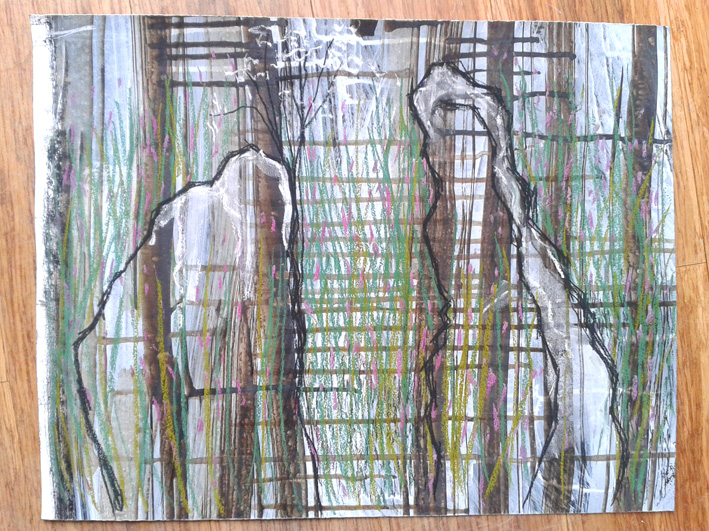
This is the third and final drawing I did at Arthur’s Stone on the Gower Peninsular on Tuesday. It’s the fastest and perhaps the most abstracted of the three. I loved the brushstrokes of the home-made walnut ink so much that I didn’t want to cover them so I kept the linear drawing of the stones very simple to allow the background to show through. There are legends associated with Arthur’s Stone, one of the oddest is that the stone travels over Cefn Bryn at dawn to drink from a local stream. There’s a similar story about the Maen Llia stone near Ystradfellte.

The monument is a Neolithic burial chamber, one of the first sites to be protected under the Ancient Monuments Act (1882) and it’s long association with the dead is reflected in the offerings that are often placed on it or nearby. This week I found a memorial around a small stone on the periphery of the site, simple wooden crosses with regimental badges and some flowers. We found another offering, or maybe a shrine, up at Llyn Fawr in the Cynon Valley a couple of weeks ago. A hoard of ancient votive offerings, including bronze cauldrons and arrow heads, have been found in the lake and it’s a popular place for anglers. Somebody had carefully set up this little chap nearby, perhaps to encourage the local water spirits to look favourably on their fishing. The tradition of acknowledging the importance of these places continues through the millenia ……

Follow The Bear

I circled Arthur’s Stone yesterday, making three drawings of this Neolithic monument. Although the popular English name links it to King Arthur (its Welsh name is Maen Ceti), it is far older than the Arthurian legend, which was written down in the 12th Century C.E. It is thought that the story of Arthur might refer to a warrior king or leader around the 6th Century C.E. when the Britons were fighting the invading Saxons. Either way, the monument is ancient, around 4,500 years and counting.

Arthurs Stone
Arthurs Stone

I did a sparse drawing, trying to tap into the feelings the place inspired in me rather than slavishly copying what was in front of my eyes. I had prepared the paper with washes of my home-made walnut ink and I wanted to keep a lot of it intact – the surface of the ink is thick and satiny, it holds the shapes traced by the brushstrokes beautifully and I didn’t want to lose too much of that because it adds a lushness to the work. Here’s a previous blog on how to make walnut husk ink here.

There’s a theory that the name Arthur comes from the ancient British word ‘arto’ meaning bear (‘arth’ in Welsh) and ‘ursa’, the Latin for bear. The battles between the Britons and Saxons happened in the century or two after the Roman withdrawal from Britain and a mixture of the British and Latin would have been very possible at that time.

The Pebble In Arthur’s Boot

Arthur's Stone, Cefn Bryn
Arthur’s Stone, Cefn Bryn

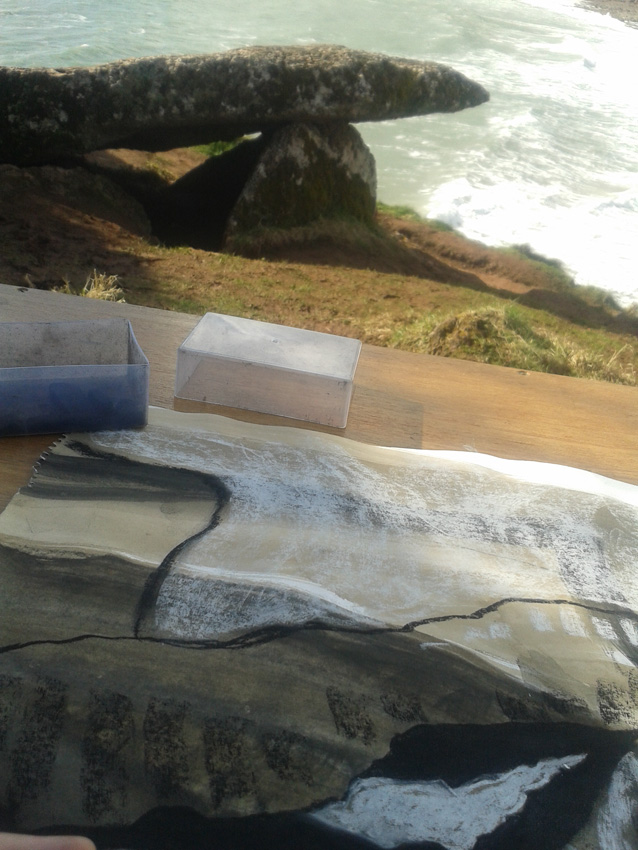
Today we visited Arthur’s Stone at Cefn Bryn on the Gower Peninsular, a Neolithic tomb about four and a half thousand years old. It’s a very popular destination for primary school day trips in this area and there is always a steady stream of visitors as it’s quite accessible from the road. Legend has it that King Arthur stopped across the estuary and removed a stone from his boot, throwing it right across the river where it landed in its present position and grew to a mighty size. In the late seventeenth century, a large chunk of over 10 tons fell off and still lies where it fell.

I’m still using up the recycled Fabriano Accademica paper that I had previously drawn on with my home-made walnut ink, ripping it into drawing-board sized pieces and drawing with carbon and white conte crayon. I’m keeping the drawing very simple, I don’t want to get into representational detail, I’m trying to get a feeling from the places I’m visiting and putting that down on paper, if that makes sense?

People Watching


I tend to go through phases when I make prints, making a sequence instead of random one-offs. This helps me to focus on subject matter, developing a theme and also lets me explore the technique. I did this series a couple of years back, combining transfer prints with drawing. I have hundreds, maybe thousands of sketches in my sketchbooks and I had been wondering how I might use them. I like all my drawings of ordinary people getting on with their lives, not knowing that I’m recording them for posterity.

elderly dude
The elderly dude

I also have lots of digital photos so I printed some of them onto ordinary printing paper from an inkjet printer and took a transfer print using nail varnish remover to embed the image into Bockingford paper. When each transfer was dry, I drew on top, using my sketchbook scribbles as source material. I spent a lot of time matching up the drawings to the transfer prints, it wasn’t done at random. Each drawing reflected the transfer print in some way. You can read a bit more about the technique here.

These prints are available for sale from my Artfinder site.

Boy And Spear

Parc le breos 2

Yesterday I went to a local ancient site, Parc le Breos on the Gower Peninsula with Husb and one of our young nephews. There was a day of ancient events going on, showing how people lived many of thousands of years ago. We saw a flint knapper who made a stone axe-head in about 20 minutes from a few pieces of rock; wild wheat being ground between two stones then baked into flatbreads on a stone over the fire; a Neolithic stew made from bits of cow, some dried peas and wild garlic; pots were being made and fired and cooked in; clothes fashioned from deer skin; and spears thrown.

Young nephew loved the spear throwing. One end of the spear (the feathered end) was slotted into an atlatl (spear thrower) which uses leverage to greatly increase the speed of spear throwing. They have been used until at least the Upper Paleolithic, around 30,000 years ago, and still exist with some hunter gatherers today. Did a few scribbles of the nephew into my sketchbook, this is the one I liked best. I did a quick drawing with a graphite stick and then inked it with a Faber Castell Pitt drawing pen.

Birds And Burial Chamber

Carn Llechart chambered tomb

The final drawing from Thursday’s field trip visiting some of the many ancient stones of South Wales. I hadn’t realised how many there are across the country. Our ancestors left a huge amount of monuments across the Neolithic and Bronze Age landscape. This is the Carn Llechart chambered tomb, just a hundred yards or so North West of the Carn Llechart cairn circle. The capstones are huge and probably deposited there by a glacier before people modified them into a chambered grave. The weather was fine and bright, a bit chilly and the views spectacular; larks hovered above us singing their hearts out. Truly beautiful.


I’m travelling around South West Wales with archaeologist Dewi Bowen who is researching his new book on Neolithic / Bronze Age monuments. His previous book on the standing stones of Ancient Siluria (South East Wales) can be found here. Accompanying us is film maker Melvyn Williams who is recording a documentary about our experiences. Some of Melvyn’s short films can be seen here. I’m working on a series of expressive drawings of ancestral sites and if you want to see some of my other artworks, please click here.
Sleeping Giant, Black Stones

Tafarn y Garreg 1
Maen Fawr (Big Stone) near Tafarn Y Garreg

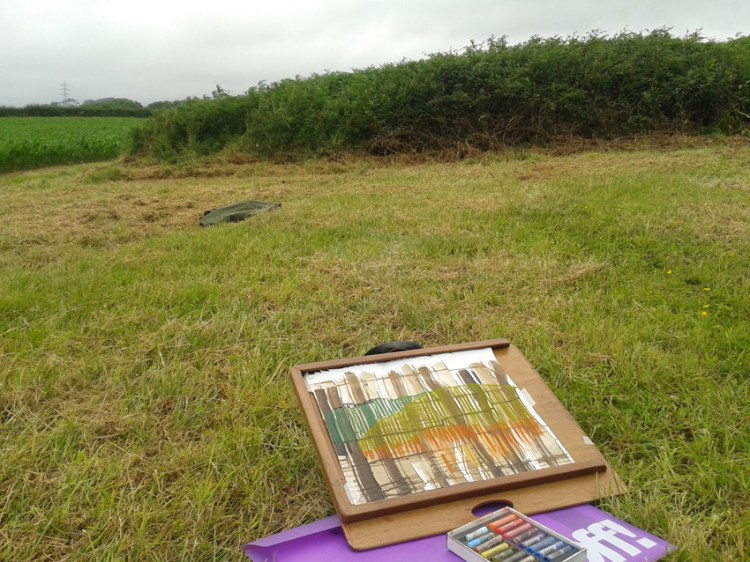
Here’s another drawing I did yesterday on my journey around sites of ancestral stones in South Wales, using carbon and white conte crayon onto Fabriano Accademica paper prepared with homemade walnut husk ink. We travelled up the Swansea Valley, past Ystradgynlais and on to Abercrave where we stopped for a few minutes to show the Sleeping Giant to my young nephew who was out with us for the day. You can see him slumbering up on top of the hill (below).

sleeping giant
The Sleeping Giant of Abercrave

Then another few miles up the valley towards Tafarn Y Garreg, where we scrambled across a stream strewn with slippery, slime-covered rocks and up a steep slope to Maen Fawr (Big Stone) and the Cerrig Duon (Black Stones) circle.

Tafarn y Garreg 2

It’s a fairly large site with not only a circle but also two outlier stones marking a row with Maen Fawr and an avenue, although the stones used for this are so small and overgrown with tussocks of rough grass that it’s hard to find them

Owain

As a boy, archaeologist Dewi Bowen used to scramble on top of Maen Fawr and now, almost 55 years later, my young nephew has done the same.

I’m travelling around South West Wales with archaeologist Dewi Bowen who is researching his new book on Neolithic / Bronze Age monuments. His previous book on the standing stones of Ancient Siluria (South East Wales) can be found here. Accompanying us is film maker Melvyn Williams who is recording a documentary about our experiences. Some of Melvyn’s short films can be seen here. I’m working on a series of expressive drawings of ancestral sites and if you want to see some of my other artworks, please click here.
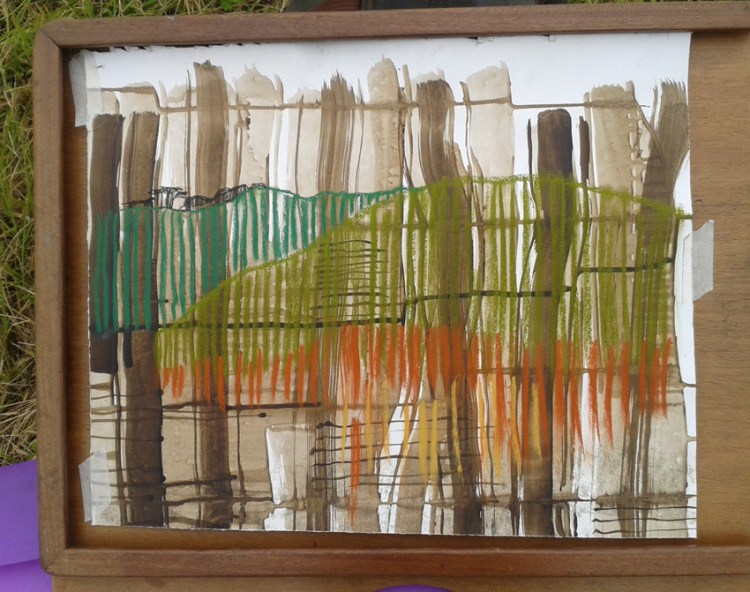
Stone Circle And Lark Song

Back to the ancestral stones today with a brisk walk up Mynydd Llechart above Pontardawe to the Carn Llechart cairn circle. It’s been a gorgeous day, quite warm and very bright and sunny, deep blue skies with no clouds. The larks hovered and sang all around us and we met some jolly dog walkers, despite being miles away from anywhere.

Carn Llechart circle

It’s a simple circle, quite small stones but with a terrific view across the expansive land. I drew onto Fabriano Accademica paper that I had prepared with my home-made walnut ink and some white acrylic paint. I drew with carbon and white conte crayon. I just sketched in the shapes quite roughly and concentrated instead on making marks, getting into the physicality and pure pleasure of drawing with the sun on my face, surrounded by some of the best scenery in the world.

Facing north at Mynydd Llechart

I’m travelling around South West Wales with archaeologist Dewi Bowen who is researching his new book on Neolithic / Bronze Age monuments. His previous book on the standing stones of Ancient Siluria (South East Wales) can be found here. Accompanying us is film maker Melvyn Williams who is recording a documentary about our experiences. Some of Melvyn’s short films can be seen here. I’m working on a series of expressive drawings of ancestral sites and if you want to see some of my other artworks, please click here.
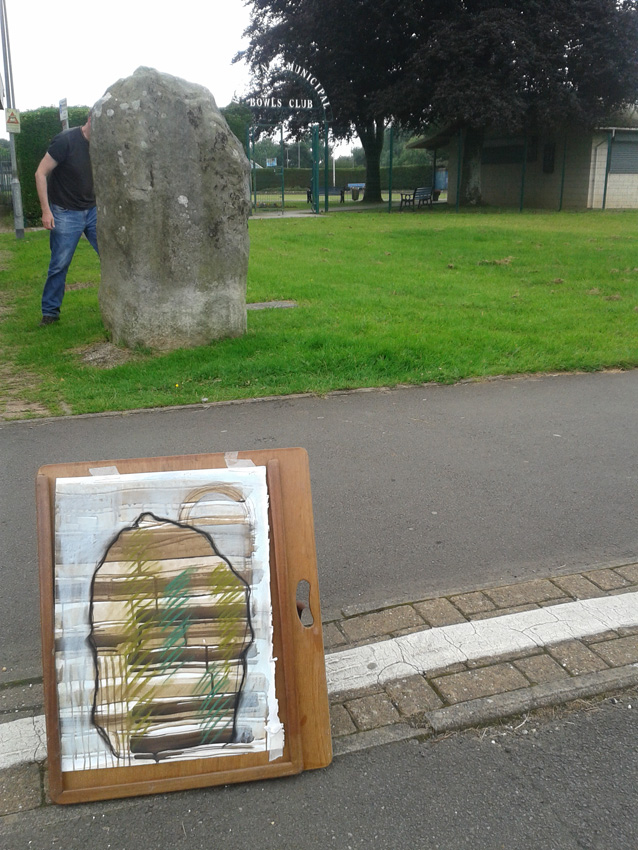
Looking south at Mynydd Llechart

Build It And They Will Come


Psychobagpuss Bagpuss Window

Back in September 2015, my artist chum Melanie Ezra and I ripped up filthy old carpet, bleached what needed bleaching, filled the window of a semi-derelict dirty old shop with art and artefacts,  set up an event page on Facebook, opened the doors and developed our artwork in the premises during daylight hours. Over the next three and a half weeks, The Bagpuss Window, earmarked for demolition in Swansea’s High Street, brought forth an outpouring of visual and performing art and was experienced by around 200 people, artists and the public alike.

What happened?

They came, they saw, they did art.

Local charity Circus Eruption lent us some iconic chairs, copies of the classic Arne Jacobsen design so we started a photo project, asking artists who visited to have their photo taken ‘Being Christine Keeler’.

Puppeteer and musician David Pitt sat in the doorway and ‘gonged’ the street, sometimes with sunpan player, Sharon Edlington Douglas.

The Window held an ever-changing array of artistic tableaux with artists bringing in and collecting work every few days.

Tableaux

And then there was Man Arkin (Jonathan Green), whose silent performance overlooked the run-down street one afternoon.

Sylvie Evans psychedelically collaged the changing rooms…

sylvie

Hannah Lawson took over a darkened derelict space out the back for her light paintings.

Archaeologist Dewi Bowen created a Cretan Labyrinth on the floor for people to walk and contemplate.

Melanie Ezra worked on her delicate assemblages each day but also found time to paint the walls.

Rhys Trimble performed his spontaneous poetry into the street….

We did some etching

Dai Melv at Bagpuss

I did some drawing…..

And Melvyn Williams filmed it …….