Staying In

1414357684722

After helping out with painting walls at the new Workers’ Gallery in Ynyshir yesterday, today was much more restful. The clocks went back last night so we had a rare lie-in this morning and a lazy day, clearing the last of the runner beans off the allotment – we picked a carrier bag full! Guess what we’ll be eating all week? I also picked kale, chard, rocket, French sorrel and a few straggly carrots.

This slideshow requires JavaScript.

So this evening we are cwtched in front of the TV, in our pajamas and I have Sparta Puss on my lap, conveniently placed for a bit of a scribble on my Samsung Galaxy Tablet Note 8 with the free Markers app.

Up The Workers

Workers 1

I spent a happy day in the Rhondda village of Ynyshir, helping to paint the walls of the village’s new artspace, The Workers’ Gallery. Artists Gayle Rogers and Chris Williams are renovating the village’s old library and will be opening Wales’ newest art gallery next month.

DSC08078

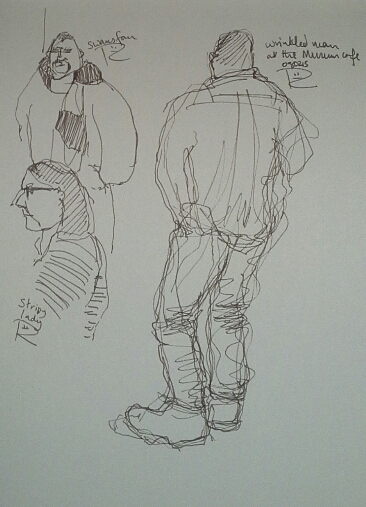
I nipped outside and stood in the drizzle, having a scribble, looking down the grey stone and slate street at the fiery bracken on the mountain opposite. And I had a bit of a scribble inside too.

DSC08079

I drew into my A5 leatherbound Steampunk sketchbook with a variety of graphite blocks and Faber Castell Pitt drawing pens. The village name, Ynyshir, is Welsh and translates as Long Island. Ynys is an ancient word, similar to the Irish and Scottish words for island, Ennis and Inish.

A Head In Lines

1414095921344

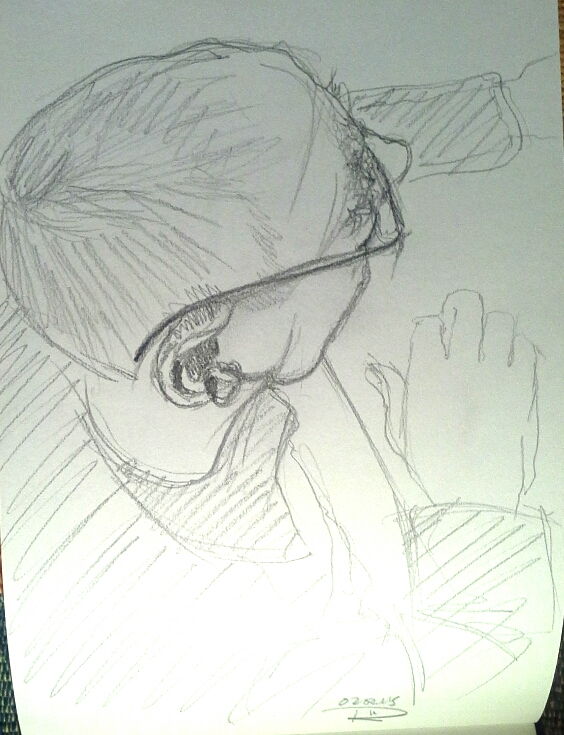
Here’s another digital study I did at this week’s life drawing at Swansea Print Workshop. I took a different approach with this one and concentrated on line rather than tone. I did this on my Samsung Galaxy Tablet Note 8 using the free Markers app and drew with the smart stylus.

This slideshow requires JavaScript.

Smudgy Finger

1414096848729

Just back from life drawing at Swansea Print Workshop. I concentrated on portraiture this evening. I used my Samsung Galaxy Tablet Note 8 with the free Markers app and used my finger for this study rather than the stylus. It gives a much softer and smudgier effect. I built the drawing by overlaying tones onto a mid grey background.

This slideshow requires JavaScript.

In The Beginning

DSC08065


I’ve been invited to take part in a collaboration between artists in Swansea and across the meltwater in North Devon. I’m starting to plan a new piece of work for it, probably an installation in cyanotype if it works out. I’m beginning with some sketching en plein air so today I took a walk up a local hill to do some drawings and photos of some very specific places that will be relevant to the final artwork. I used Faber Castell Pitt drawing pens in sepia, sizes S, F and B and spent just a few minutes on each. I drew into my A5 leatherbound steampunk sketchbook.

DSC08064

When I got back home, I put on some tonal washes with the walnut ink I made this week. It’s great stuff to use, very silky and thick, it flows nicely off the brush. It settles out in the jar so I dipped into the top to do the pale wash and then pushed the brush into the thick sediment to do the darker tones. This is where the final artwork begins. I have to work quickly from now on as it has to be finished for exhibiting in January.

Ethereal Ghosts

DSC08042 small

This is the last of the four monotypes I made on one day last week. The effort nearly killed me! I’m not young anymore. Anyway, this is the one I’m least happy with. I think it’s because I thought too much about it and tried to do too much detail. I was much freer with the other 3 monotypes and I think they worked better. It’s useful to know.

This slideshow requires JavaScript.

The process starts with printing the yellow plate, then overprinting that with the magenta, then finally the cyan, which gives a full colour range because the inks are translucent. The plate and paper are put through the press a second time at each stage to give a second, ‘ghost’, monotype. Some of the Impressionists used to work over their ghost monotypes with oil pastels, notably Degas and Monet, although I generally leave them, I like their ethereal quality.

Walnut Husk Ink Revisited

UPDATE:

It’s been about a year since I wrote this post when I made a batch of walnut ink. I’ve been using it regularly and it’s delicious, silky, smooth and rich. It seems to be lightfast, no signs of fading on any of the pieces, although I’ve been careful to use best quality acid-free paper like Fabriano and Saunders.

20160306_145501

Here’s the most recent drawing, in carbon and white conte crayon overlaid onto a background of walnut ink.

DSC08063

So today I finally finished the walnut ink I started a couple of weeks ago. A friend gave me 4 fresh walnuts (juglans regia) in their husks. I peeled them and left the husks to stand in a basin of water for about a week and a half. They went very black and mushy. I put the basin, covered with tin foil,  into a slow cooker with hot water coming up to half way and left it on the lowest setting overnight, letting it cool completely for another day and night.

This slideshow requires JavaScript.

Then I strained it through a ‘J’ cloth into a large jar and tested its strength on a bit of cartridge paper. It was quite pale so I boiled it on the stove and reduced it, checking occasionally until it was a decent sepia colour. There wasn’t much to bottle, about a quarter of a tea mug. The recipes I’ve looked at online suggest adding up to 20% surgical spirit (rubbing alcohol) as a preservative, but there’s so little that I think I’ll use it up pretty quickly. I’ll do some drawings with it and leave them in the light until this time next year. If they haven’t faded, I’ll see if  I can get hold of a larger amount of husks and make some more.


The story so far

Reblogging this spoof of  political life in Wales. If you haven’t read it before,  here’s a chance to catch up. Very funny weekly blog.


The story so far.

It’s Physical

DSC08051 small

Carrying on with the small full-colour monotypes that I did a few days ago. It was hard work being on my feet for hours on end. The lightbox is too high to sit down to work into the plates and I prefer to stand anyway; it’s a physical thing and I think my mark-making is better when I’m standing. Something to do with posture maybe? I’m working in sweeping gestures with rags and scrim (tarlatan) onto the inked perspex plate. I’m trying to get an expressionistic feel to my landscape studies from Pakistan, quite different to the anatomical details of my nudes.

This slideshow requires JavaScript.

The slides show the first pressing from the yellow plate, the second with magenta overlaid and the final full colour print after the cyan plate has been printed, giving a range of colours from very dark blues, purples and greens to pale pinks, yellows and oranges. You have to know your colour theory to work with this medium. There is more detail about the method on my website here.

More Of The Same

DSC08048 small

I had a marathon monotype session at Swansea Print Workshop yesterday and produced 4 full colour monotypes and 4 ‘ghost’ monotypes which is a record for me. I was corpsed at the end of it though. I drew the yellow and red plates in broad strokes with cotton rags and scrim (tarlatan). On the final, blue, plate I worked with tiny strokes and stabs with the scrim, covering the surface of the ink with tiny, tiny marks. When this was printed over the other two colours, it gave a soft twilight effect.


This slideshow requires JavaScript.

The slides show the prints taken from, firstly, the yellow plate, then the red overprinted onto the yellow, then the blue printed over the yellow/red. Finally, the ghost is produced by putting the plate through the press a second time to pick up the faint remaining ink, resulting in a ghostly image. I used Caligo ‘Safewash’ oil-based litho/relief inks, which give lovely intense colours with the added advantage of being easily cleaned in warm soapy water. Takes ages off the cleaning process. You can read more about the process here.