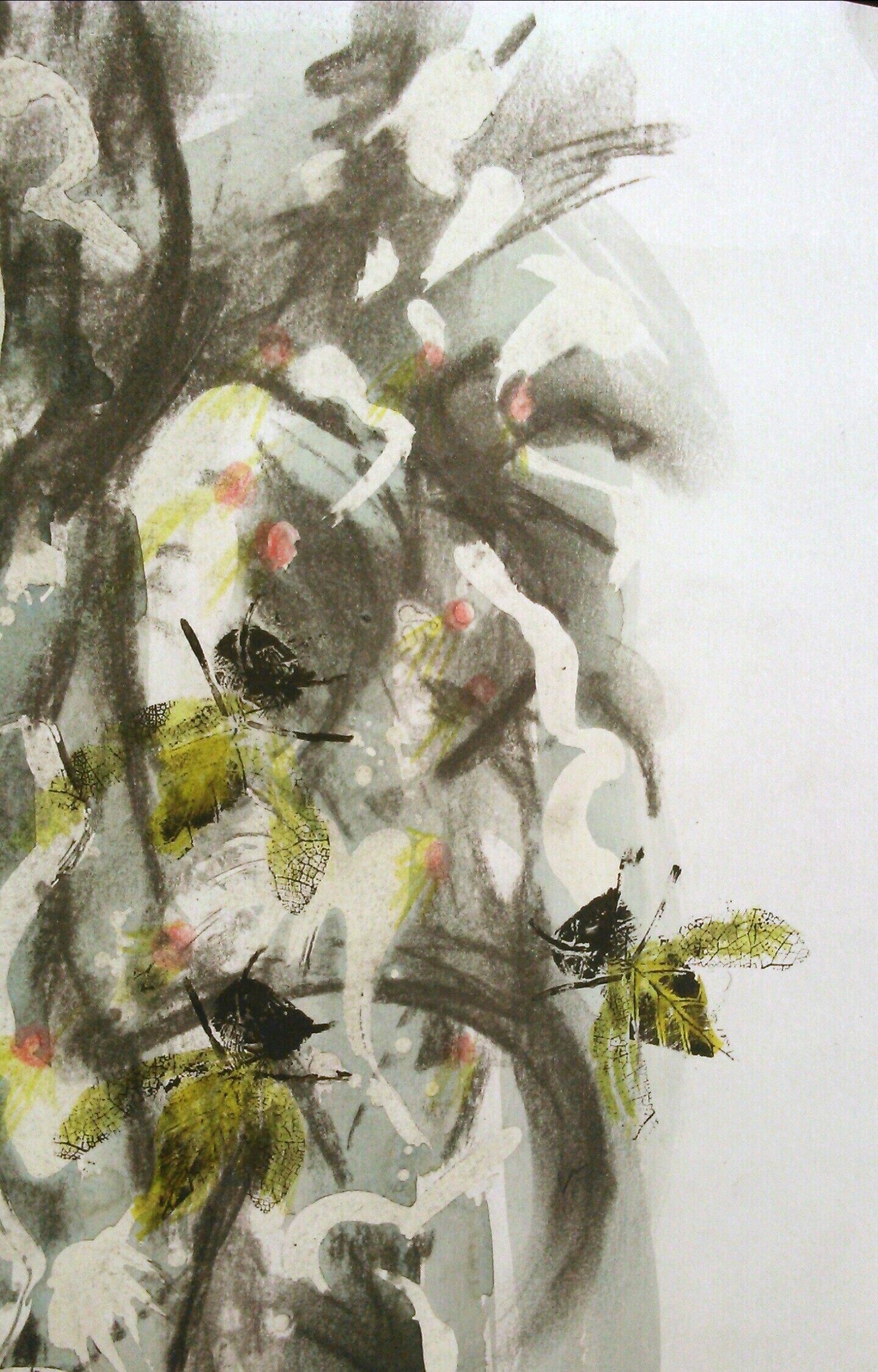
A short video showing the process of printing a drypoint with a recycled pasta making machine. It’s easy. The video is just over 4 minutes long and features my cat as well.
Please try it, it’s very easy and convenient 🙂

I’m really getting into doing these 10 minute practice studies from photos of elderly women. It’s a big departure for me to work from photos as I love drawing from life so much. I can develop a different style with these drawings though as it isn’t imperative for me to get an absolute likeness, so I can improvise and experiment and really let go. It’s like a musician jamming I guess.
I’m working on an A4 size, into a hardbacked sketchbook prepared with randomly ripped brown wrapping paper stuck in with Pritt (it’s the best I find). I sketch roughly in a light graphite stick then pick out the highlights and lowlights with white and black conté crayon and finally scribble over the ‘detail’ lines with a dark graphite stick.
I really appreciate the beauty in these faces, they have lived a life and tell a story, yet are largely invisible in our culture. What a shame.

I’m getting really enthused with these 10 minute sketches from Googled images of elderly women. I started just as a quick bit of practice but after 4 or 5 I find myself really getting into it. There are so many beautiful older faces to choose from and it dawned on me that for me this is a feminist issue, this is an age group that is usually invisible, ignored, marginalised in our youth obsessed culture. So I’m going to carry on drawing them. I don’t know who they are, there is rarely any information about the people in the photos but it doesn’t matter; I think the important thing for me is to focus on them and draw them and make them visible through my art. I might not do one every day because I am working on other art projects as well, but I think I’ll make this a long term thing.
I’m drawing into my A4 hardbound sketchbook, prepared with brown wrapping paper, ripped and stuck randomly, to give me a midtone to work on top of, with graphite and conté crayon. This woman had an extraordinarily lined face, covered in patterns from her life’s experiences. As I was drawing, the scribbly markmaking became quite psychedelic. I want to fill the whole sketchbook with these elder women and then maybe do something with them digitally, because otherwise it’s just about impossible to display a sketchbook without taking it apart.

I’m really enjoying the 10 minute head sketches from photos I’ve been doing recently. As well as helping me to practice accurate speed sketching, my chosen subject, elderly women, is fascinating. I look forward each evening to exploring the heads I find on Google, they are so full of character and experience. This elder woman has extraordinary eyes, so full of life. She is beautiful.
I drew her with graphite, white and black conté crayon into my hardbacked A4 sketchbook that I prepared with ripped brown parcel paper, stuck in with Pritt stick. I always use Pritt because it doesn’t buckle the paper and it stays stuck. Cheaper versions don’t. The brown paper gives me a mid-tone ground over which I apply highlights and lowlights which is quite dramatic. It also gives a good texture when I rub my conté over it.
Carrying on with the quick head sketches, I Googled another photo of an elderly woman and did a 10 minute timed sketch. I drew into my A4 hardbound sketchbook with a graphite stick and white conte crayon. I had prepared a lot of the sketchbook’s pages with brown wrapping paper stuck in with Pritt stick. As we age, the difference in looks between men and women becomes less obvious. I love to draw older people, their faces reflect the experience of a lifetime. I hate the way our culture is so obsessed with youth that many people have their faces stretched with cosmetic surgery, deleting the story of their life. Such a shame.
We have a terrific art gallery in Swansea, Galerie Simpson, which not only shows fabulous art exhibitions but also hosts excellent events. Husb and I went to one today, a talk and Q&A session by Welsh punk musician and author, Rhys Mwyn. Fascinating stuff. I had a quick scribble, as I always do. It’s hard to draw a moving person and Rhys was very animated. I find that I have to get the first few critical lines down as quickly as possible, the forehead and nose and then wait until the person moves back into that position and sketch in a bit more. And again. And again. Eventually I end up with an approximation of the person. It isn’t exact but I think it captures essence and movement in a way that a formal pose never would.
Sometimes it’s getting late and I haven’t done any drawing so I look around for something quick to do. I try to draw every day because that’s what underpins my practice as an artist, rather like a singer practicing their scales every day. If I’m stuck, I turn to the Internet and google images of people, choose one and time myself- a strict 6 minutes to scribble a reasonable drawing. I like to choose elders because their faces are so interesting, so expressive. They have history and stories flickering across their faces. I drew this with a graphite stick into my A5 black hardbound sketchbook.
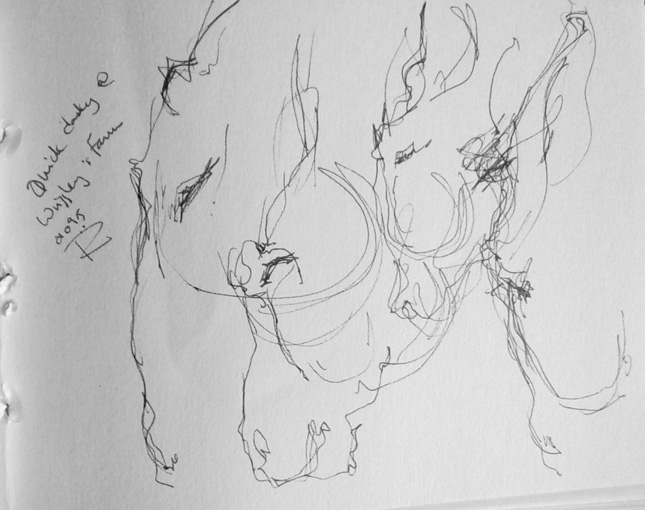
We have one of our young nephews on a sleepover and I scribbled him as he watched a film. He’s at that in betweeny age, just leaving boyhood but not quite adolescent, so he has this little skinny, gangly, Bambi body with a large head wobbling on top. His face is starting to fill out too. Very hard to draw though, I’ve only just started to get used to little children’s alien faces and this is half way between a kid and an adult. Weird.

The tabletop pasta maker had it’s first trial as a mobile printing press today. RESULT!!!!! It worked beautifully. It’s taken ages to renovate because we had stored it in a really damp cupboard and it was badly rusted, but WD40, patience and elbow grease did the job.
First, I cut a piece of Intaglio Printmaker’s paper drypoint etching plate and then I redrew a little drawing of a hare onto it, from one of my sketchbooks, using a Faber Castell Pitt drawing pen, size S. Thirdly, I scratched over the linework with my drypoint tool, just breaking the surface of the plastic coating. Then I cut and soaked some small pieces of Bockingford before removing the pen drawing with a very lightly dampened piece of cotton wool. Finally I cut some pieces of felted wool to be used as tiny blankets for the pasta press.
I put a blob of Intaglio Printmaker’s Drypoint Mix oil–based etching ink onto my inking block (a recycled bit of marble from an old fireplace) and picked some up with a mini rubber squeegee. I squeegeed the ink across the little drypoint plate then removed the excess, firstly with the edge of an old business card and then with a piece of tissue paper, taking care not to take too much off. Finally I wiped the edges with a rag, cleaned my hands and blotted a piece of the soaked Bockingford paper.
On top of one of the first blanket I laid a clean piece of tissue paper, then the blotted Bockingford and then placed the drypoint plate, inky side down, then another layer of tissue and finally the second blanket.
I picked up the blanket sandwich very carefully and firmly, making sure none of the layers slipped and rested the bottom edge onto the rollers in the pasta press. I turned the handle with one hand while keeping a tight grip on the blanket sandwich with the other. Once it was through, I peeled away the layers and voila! A teeny little etching.
These paper drypoint plates make an edition of 10 or so etchings before wearing out. I think I might try some hand colouring on these little hares, with my Winsor & Newton Artist’s Watercolours.
There’s a new exhibition coming up at The British Museum this Autumn – drawings in metalpoint. These are drawings made with silver or gold onto specially prepared paper, a technique used before the invention of graphite pencils. I did some work in Silverpoint a while back (above), drawing directly from a life model.
The tool is a smooth barrel of wood like an etching needle but the point is a piece of silver wire, 99% pure. It can be used flat or as a very sharp point, but you have to be accurate because it can’t be rubbed out. Renaissance artists didn’t use the technique for quick scribbling, it was for careful studies. The paper has to be coated with a special Silverpoint Medium; I don’t know what’s in the modern version, but back in the day it was made from finely ground bone mixed with animal glue. When it’s dry, you draw the fine silver point across the paper and the bone drags molecules of the metal off and in a few seconds it tarnishes. This means that you can’t see the line you’ve drawn until the tarnish appears.

The British Museum is just up the road from my all time favourite artist suppliers, Cornelissen & Son, so I could combine a visit to the exhibition with a shopping trip to Cornelissen to buy silverpoint materials. Now that sounds like a plan 😀