Tea And A Pop Up

Back in April 2014 I travelled to Pakistan with another Swansea Printmaker to do a residency at the Zaira Zaka Print Studio near Rawalpindi. It was an amazing, exhausting and inspiring experience!

Rose Davies invitation

My fellow printmaker, Hannah Lawson and I are bringing our experiences back home in a four-day pop-up studio at Swansea Print Workshop, from Friday October the 23rd to Monday October the 26th. 

taxila rose
At Taxila, a UNESCO World Heritage site.

We’re kicking off with a family-friendly Welsh – Pakistani tea from 4.30 – 7pm on Friday the 23rd, with Welsh Cakes and Bara Brith, Pink Chai and Builder’s Brew, Pakoras and Samosas and home made chutneys and jams. So if you’re in the area, please pop in.

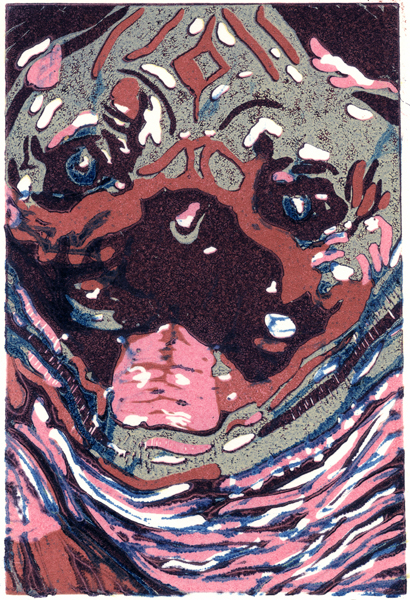
rose davies paisley breakout
‘Paisley Breakout’, a full-colour monotype inspired by a shopping mall in Islamabad

And we’re having an open-studio from Saturday 24th to Monday 26th, 10.30 – 5.00 each day where you can pop in and see our new work developing and have a look around our lovely print workshop.

The Blue Stones

pentre ifan

I’ve been thinking about how to develop the drawings I did last weekend in North Pembrokeshire. I have seven drawings from four different Neolithic sites and I thought that one or two of them might look good as cyanotypes.

Cyanotype is an archaic form of photography invented in early Victorian times by Sir John Herschel which results in a blue image. The original charcoal and carbon drawing onto marbled paper was done in the field at the enigmatic ancient burial tomb of Pentre Ifan in the Presceli Mountains in Pembrokeshire, Wales. This striking Neolithic dolmen is almost 6 thousand years old. It is a lasting reminder of Celtic ancestors and the site is inspirational. I worked quickly in the late afternoon Autumn sunshine to catch it before the sun went down.

I turned the original drawing into a negative and coated a sheet of Bockingford paper with the cyanotype chemicals. I put the negative onto the paper and put a sheet of glass over it. I exposed it for three hours in the weak Autumn daylight, as the Victorians would have done. It was then washed in cold water to develop it.

Here’s a lovely video from Cadw, the Welsh Government’s historic environment service, showing how Pentre Ifan might have looked when it was originally built.


This artwork is for sale through Artfinder


The Last Of The Stones

marbled drawing

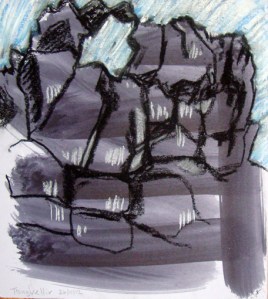
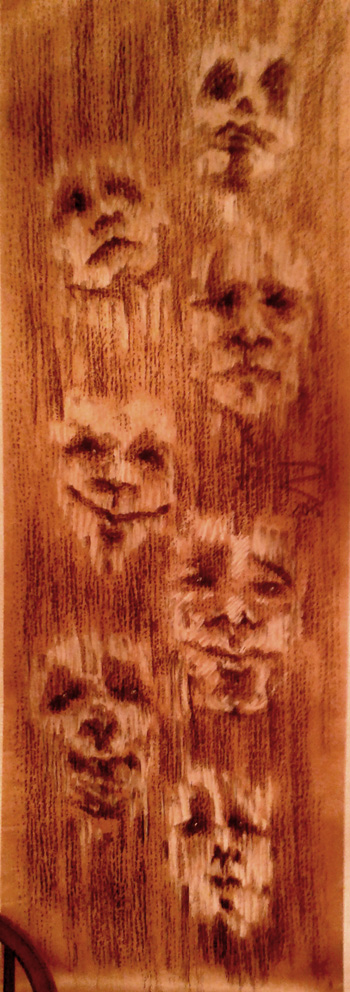
Here are the last couple of drawings from my weekend sketching ancient burial chambers in North Pembrokeshire. This one at Pentre Ifan is drawn in charcoal, carbon and white conte crayon onto Fabriano Accademica that I had marbled with black oil paint mixed with turpentine.

This slideshow requires JavaScript.


stones 2
The Pentre Ifan dolmen, Nevern, Pembrokeshire


Pentre Ifan
Pentre Ifan

Here’s the dolmen drawn over a previous drawing of Maltese catacombs in home-made walnut ink. What next? Well, I’m doing some experiments with cyanotype. Hopefully, if they’re successful, I’ll blog them tomorrow.

PINK CHAI AND WELSH CAKES

The next printmaking event at Swansea Print Workshop – please pop by if you’re in the area 😀


Source: PINK CHAI AND WELSH CAKES

Win a Glenys Cour painting …

A beautiful original painting by Glenys Cour, a fundraiser for Swansea Print Workshop


Source: Win a Glenys Cour painting …

Scribbling Sacred Stones

Carreg Samson drawing

Here’s the fourth ancient burial site I drew over the weekend on my visit to ancestral graves in North Pembrokeshire. It’s a beautiful little chambered tomb called Carreg Samson, near Abercastle. The dolmen looks out across The Irish Sea from a farmer’s clifftop field in a glorious setting. It’s around 5,000 years old and is the site of over 1,000 burials and more recently a shelter for sheep.


stones

I forgot to take a drawing board with me so I scrabbled around on my hands and knees, drawing on the grass. I drew very quickly because it was cold, blustery and uncomfortable. I drew with a piece of Daler Rowney carbon onto a piece of Fabriano Accademica paper (200 gsm) that I had marbled with oil paint mixed with English Turpentine. I like the effect that the marbling gives to these Neolithic stones.

stone and drawing

When I got up off my knees, I realised that the field had been recently occupied by cattle. The evidence was on my leggings. I suffer for my art 😡


The Three Tombs

drawing

Trekking around North Pembrokeshire yesterday, hunting ancient burial sites, took us to Goodwick near Fishguard (what are the fish guarding?) and a bit of a trek along the cliff path towards Strumble Head, through a housing estate and along an overgrown path between back gardens and a barbed wire fence keeping goats at bay to the three prehistoric chambered tombs known as the Garn Wen burial chambers. They’re quite different to the other sites we visited, they are very low, the uprights mostly submerged and the capstones barely above ground. They’re hardly visible amongst the bracken. The other sites are beautifully manicured but this one has been left largely unvisited, going by the state of the hardly used, overgrown path.

goats
Little goats followed us all over the site, nuzzling our bags for something to snack on

I’d forgotten to take along a drawing board but there was a conveniently placed notice board on the small site so I taped a piece of marbled Fabriano Accademica to it and drew quickly with a piece of carbon. We were up above the cliff and the wind was gusting, very chilly for drawing. When I marbled the paper some months ago, I used black oil paint mixed with a little turpentine. It was very smelly so I put it into the garden to dry, forgot about it and found the paper next day covered in holes nibbled by snails. I like the effect of the rough drawing of the rough cromlech on the rough paper.

drawing carn

Experiments At Pentre Ifan

khadi

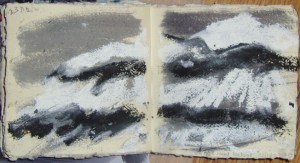
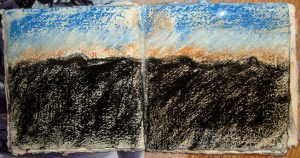
I spend a couple of days in Pembrokeshire drawing dolmens. I managed to get to 4 sites and did some sketching in the field, not easy as I forgot to take my drawing board so I was drawing on grass or even the stones themselves. I tried out some different techniques. These first two drawings at Pentre Ifan are drawn into my small Khadi handmade paper sketchbook that I had pre-coloured with a dark ink wash sploshed on randomly with a sponge. I drew with my Daler Rowney artist’s oil pastels, using white, pale blue and two tones of green. I filled in the negative spaces with the pastels – the dark stones are the ink-washed paper.

PI a
Pentre Ifan burial chamber, Nevern, Pembrokeshire, Wales


catacomb

Then I tried experimenting with a piece of Fabriano Accademica paper that I had already drawn on some months ago. I visited St. Paul’s catacombs in Malta last Winter and when I came back, I developed some of my sketches into larger drawings with my home-made walnut ink. I didn’t much care for most of them and I’ve been planning on re-using them and this is my first attempt, drawn with carbon and oil pastels, both by Daler Rowney. I like the idea of overlaying an ancient burial chamber onto an ancient burial site, but I’m not sure what I think of the drawing itself. I’ll sleep on it.

Drawing Dolmen

Carreg Coetan
Carreg Coetan

I’m drawing dolmen in Pembrokeshire. I used compressed  charcoal onto marbled Fabriano paper.

Newport, Pembrokeshire

Continue reading “Drawing Dolmen”

The Curate’s Egg

October

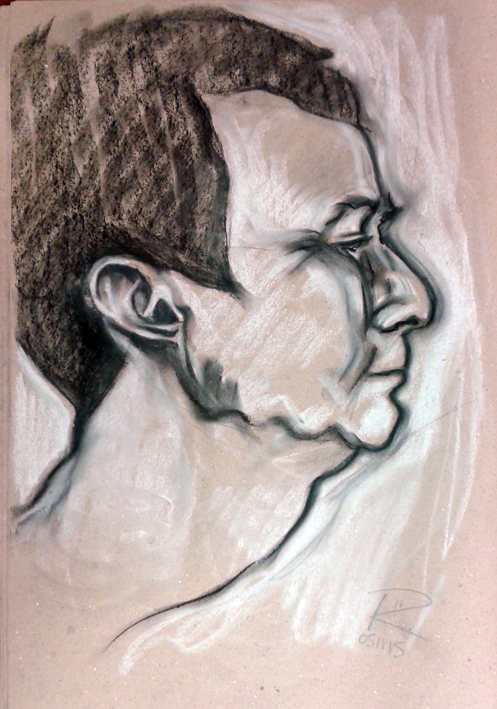
Tonight’s life drawing is like the Curate’s egg – good in parts. I had the most horrific foreshortening on the left hand. no matter how many times I measured it, the darn thing looked badly drawn. I used Winsor & Newton’s willow charcoal and white conte crayon onto a piece of Fabriano Accademica that I had marbled with oil paint and turpentine.

It’s late. I’m going to bed. Goodnight 😀