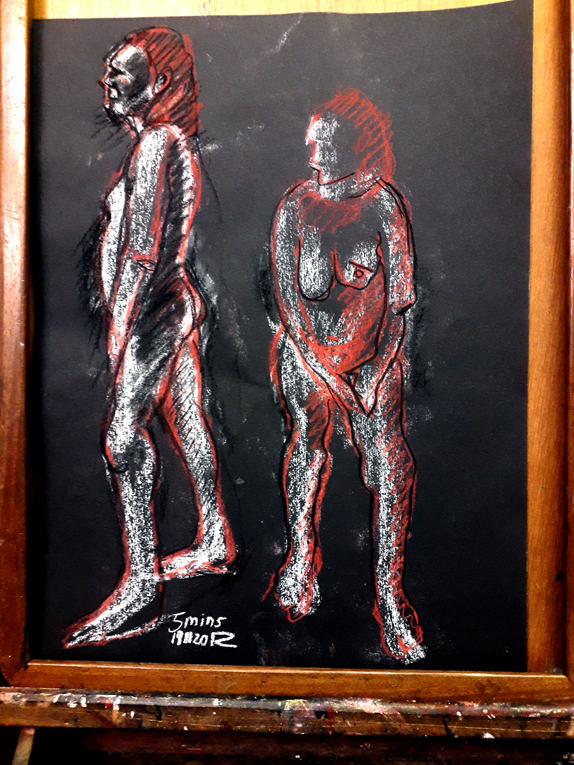

Just back from life drawing at Swansea Print Worksop and I’m shattered. So I’m off to bed. I used black, white and sanguine conté crayons onto black paper.
Just back from life drawing at Swansea Print Worksop and I’m shattered. So I’m off to bed. I used black, white and sanguine conté crayons onto black paper.
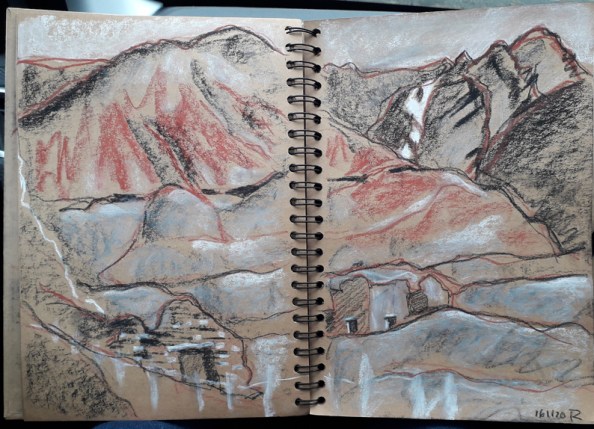
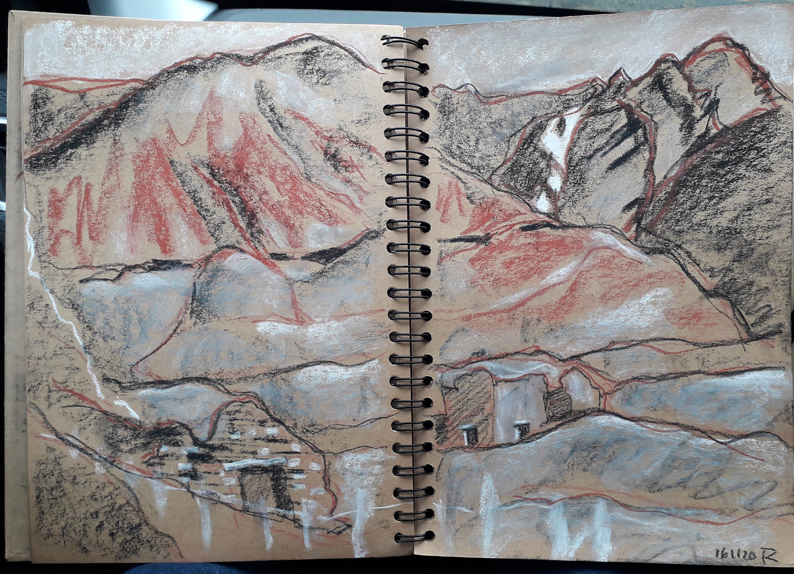
I did this sketch a few days ago while Husb and I were driving back from Devil’s Bridge, via the mountain road to Rhayader. We stopped for a while at these old mines going back to the Bronze Age, near Cwmystwyth. The earliest miners about 4,000 years ago extracted copper, but from Roman times the hills have been mined for lead.
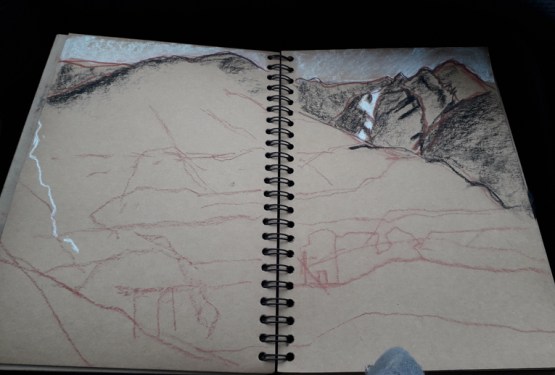
I drew quickly into my A3 spiral bound brown paper sketchbook from Seawhites of Brighton, with conté crayons in white, sanguine and black. The weather was terrible, cold, wet and blowing a gale so I stayed in the car. There’s only so much suffering I’m going to do for my art lol 😀
I have some small screenprints for sale, inspired by my drawings of the taxidermy collection at Swansea Museum. I have given these antique artifacts a modern twist by combining them with images of rubbish – old fruit nets, bubble wrap and plastic – highlighting the problem of human pollution and how it affects wildlife.
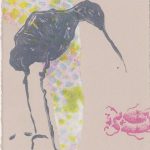 To buy my work on the Swansea Print Workshop site please click the image to the left and to see the complete image.
Inspired by drawings of the taxidermy collection at Swansea Museum. I have given these antique artefacts a modern twist by combining them with images of rubbish – old fruit nets, bubble wrap and plastic – highlighting the problem of human pollution and how it affects wildlife.
20 percent of the cost of each screenprint sold goes to support Swansea Print Workshop, which receives no public funding.
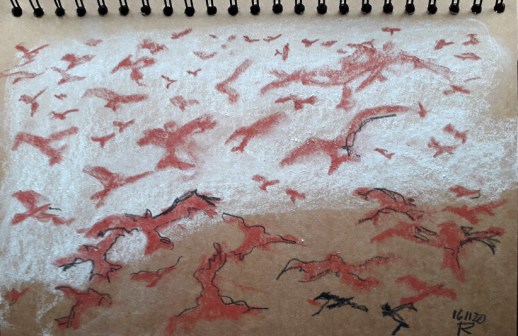
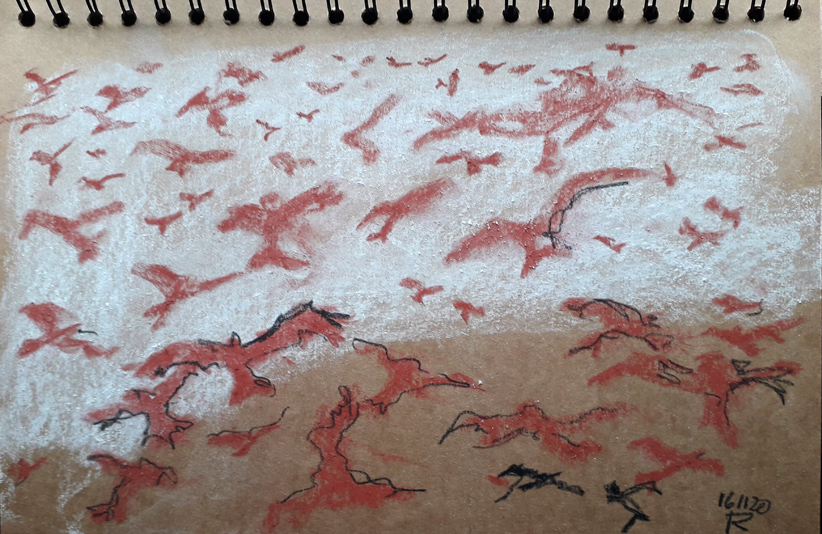
Husb and I went to Ceredigion for an overnighter, just to get out of the city. We haven’t escaped the area since lockdown started in March so it was a relief to get away, even for such a short time. We called in to the Red Kite Feeding Centre, near Rhayader. Barcud is the Welsh word for red kite, milvus milvus in Latin. They’re amazing birds. We hired a hide because it was raining and I wanted to draw and Husb wanted to film.

It wasn’t easy drawing so many moving creatures – they’re really fast! And there were hundreds of them. They’re beautiful and it’s great to see so many; not so long ago they were almost extinct in Wales. I drew quickly, just aiming to get impressions of their flight rather than details. I used white and sanguine conté crayons with a touch of black into a brown paper sketchbook. Here’s a short video of these lovelies in flight.
I have some small screenprints for sale, inspired by my drawings of the taxidermy collection at Swansea Museum. I have given these antique artifacts a modern twist by combining them with images of rubbish – old fruit nets, bubble wrap and plastic – highlighting the problem of human pollution and how it affects wildlife.
To buy my work on the Swansea Print Workshop site please click the image to the left and to see the complete image.Inspired by drawings of the taxidermy collection at Swansea Museum. I have given these antique artefacts a modern twist by combining them with images of rubbish – old fruit nets, bubble wrap and plastic – highlighting the problem of human pollution and how it affects wildlife.
20 percent of the cost of each screenprint sold goes to support Swansea Print Workshop, which receives no public funding.

We’ve been in lockdown for what seems like forever so Husb booked us an evening away at the Hafod Hotel at Devil’s Bridge – Pont ar Fynach – in Ceredigion, for a bit of a break. It’s a very atmospheric part of the world and features a lot in the Cymru Noir crime drama TV series “Hinterland“.
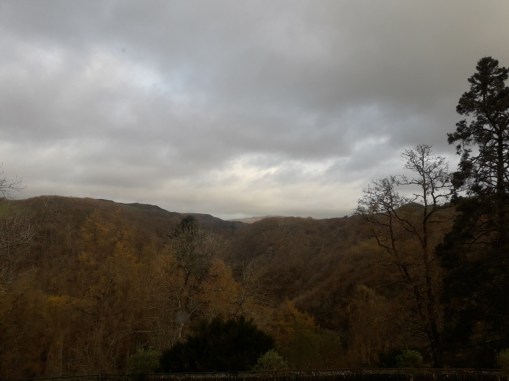
Dusk was already drawing in on a gloomy afternoon when we checked in and we had a lovely room with a spectacular view along the chasm – the Devil’s Bridge is at the bottom of it. I grabbed some conté crayons and scribbled the view quickly into my brown paper sketchbook before it became too dark.

I have some small screenprints for sale, inspired by my drawings of the taxidermy collection at Swansea Museum. I have given these antique artifacts a modern twist by combining them with images of rubbish – old fruit nets, bubble wrap and plastic – highlighting the problem of human pollution and how it affects wildlife.
To buy my work on the Swansea Print Workshop site please click the image to the left and to see the complete image.Inspired by drawings of the taxidermy collection at Swansea Museum. I have given these antique artefacts a modern twist by combining them with images of rubbish – old fruit nets, bubble wrap and plastic – highlighting the problem of human pollution and how it affects wildlife.
20 percent of the cost of each screenprint sold goes to support Swansea Print Workshop, which receives no public funding.
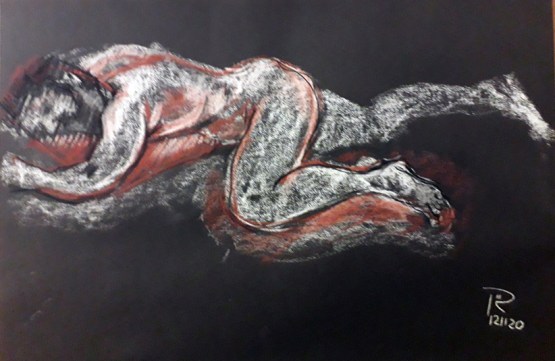
Here’s a 20 minute pose I did during the latest life drawing session at Swansea Print Workshop. I didn’t particularly like the angle but with the Covid19 restrictions, we can’t move around the drawing studio to find another vantage point, like we used to – we have fixed workstations now – so I had to do my best.


I like to draw reclining figures with foreshortening, even though it’s much harder.
I have some small screenprints for sale, inspired by my drawings of the taxidermy collection at Swansea Museum. I have given these antique artifacts a modern twist by combining them with images of rubbish – old fruit nets, bubble wrap and plastic – highlighting the problem of human pollution and how it affects wildlife.
To buy my work on the Swansea Print Workshop site please click the image to the left and to see the complete image.Inspired by drawings of the taxidermy collection at Swansea Museum. I have given these antique artefacts a modern twist by combining them with images of rubbish – old fruit nets, bubble wrap and plastic – highlighting the problem of human pollution and how it affects wildlife.
20 percent of the cost of each screenprint sold goes to support Swansea Print Workshop, which receives no public funding.
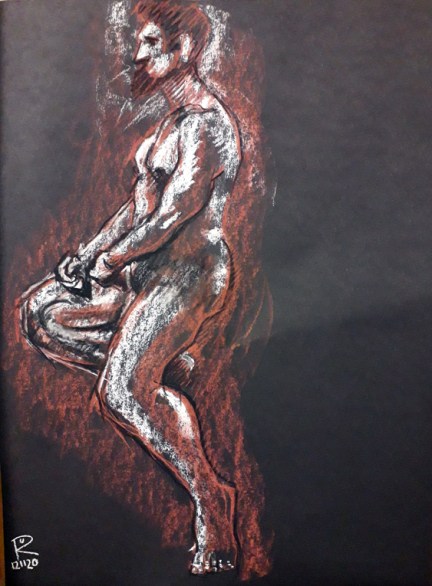
Here’s another of my life drawings from Thursday evening at Swansea Print Workshop. Our model is really good, he’s been working with us for over a decade now, since his late teens. He’s available for modelling work on- and offline – please message me for his contact details if you want to work with him.


This is a 25 minute pose and I used conté crayons in white, sanguine and black onto black paper, size A2. I started by roughly blocking in the highlights using the flat side of the white, then some blocking and linework in sanguine before working on the details.
I have some small screenprints for sale, inspired by my drawings of the taxidermy collection at Swansea Museum. I have given these antique artifacts a modern twist by combining them with images of rubbish – old fruit nets, bubble wrap and plastic – highlighting the problem of human pollution and how it affects wildlife.
To buy my work on the Swansea Print Workshop site please click the image to the left and to see the complete image.Inspired by drawings of the taxidermy collection at Swansea Museum. I have given these antique artefacts a modern twist by combining them with images of rubbish – old fruit nets, bubble wrap and plastic – highlighting the problem of human pollution and how it affects wildlife.
20 percent of the cost of each screenprint sold goes to support Swansea Print Workshop, which receives no public funding.

The subject of today’s Cheese And Wine Painting Club on Facebook was “The Mandrill” by the French post-Impressionist painter Henri Rousseau. I really like his work, it is naive yet strong with a good dash of humour. I reckon there’s about another couple of hours work to do on this before it’s finished. I’m using Liquitex Heavy Body acrylic paints.


Our tutor, the painter Ed Sumner really makes the sessions come alive and I’m learning a lot about painting, and I’m especially enjoying using paint for the initial sketching on the canvas. As well as the Friday sessions which are free or a donation if you can afford to, Ed also runs prepaid online tutorial groups for up to 10 participants. The next Friday faking session features a Matisse. Check it out here.
I have some small screenprints for sale, inspired by my drawings of the taxidermy collection at Swansea Museum. I have given these antique artifacts a modern twist by combining them with images of rubbish – old fruit nets, bubble wrap and plastic – highlighting the problem of human pollution and how it affects wildlife.
To buy my work on the Swansea Print Workshop site please click the image to the left and to see the complete image.Inspired by drawings of the taxidermy collection at Swansea Museum. I have given these antique artefacts a modern twist by combining them with images of rubbish – old fruit nets, bubble wrap and plastic – highlighting the problem of human pollution and how it affects wildlife.
20 percent of the cost of each screenprint sold goes to support Swansea Print Workshop, which receives no public funding.
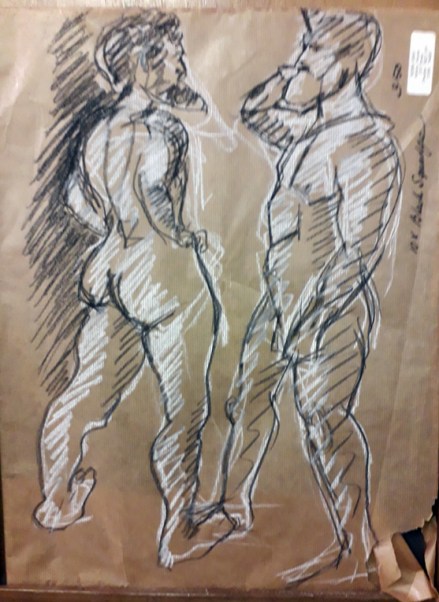
Just back from life drawing at Swansea Print Workshop this evening – we had a 2 week break during the “firebreak” lockdown in Wales. I didn’t take enough paper with me so I used this brown wrapping paper for the two 5 minute poses, with black and white conté crayons. Anyway, it’s getting late and it’s been a long day. Nos da. Good night 😀

I’ve been smearing leftover paints onto nice papers over the past few months, building up a store of collage papers to experiment with. I recently started thinking about the Hafod tip in Swansea which was opposite my bedroom window for much of my childhood. And looming above it in the distance was the equally black and ruined Kilvey Hill. It took many years to remove the tip and bring life back to the hill, but they’re unrecognisable now.
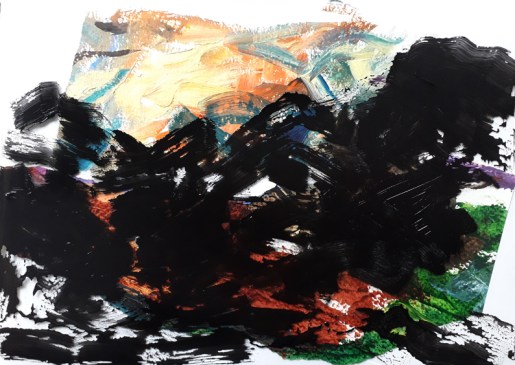
I thought I’d start ripping up fragments of the collage papers to stick into my sketchbook and then cover them with a sheet of cellophane and paint it with black acrylic paint. That way I can try things out without putting the black paint over the collage papers. Once the acrylic paint is dry, I can scrape into it, rub sections away, play with it to reveal some of the background colours and textures. Early days yet though.

Oh and I baked my Xmas cake. And made the last rhubarb crumble of the year.
I have some small screenprints for sale, inspired by my drawings of the taxidermy collection at Swansea Museum. I have given these antique artifacts a modern twist by combining them with images of rubbish – old fruit nets, bubble wrap and plastic – highlighting the problem of human pollution and how it affects wildlife.
To buy my work on the Swansea Print Workshop site please click the image to the left and to see the complete image.Inspired by drawings of the taxidermy collection at Swansea Museum. I have given these antique artefacts a modern twist by combining them with images of rubbish – old fruit nets, bubble wrap and plastic – highlighting the problem of human pollution and how it affects wildlife.
20 percent of the cost of each screenprint sold goes to support Swansea Print Workshop, which receives no public funding.
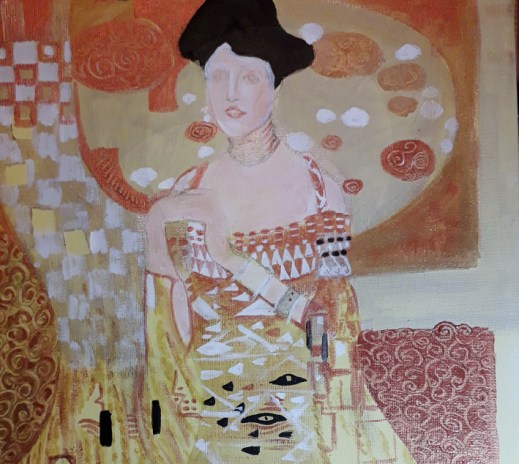
I’ll be working on this fake Klimt for ages. It’s so detailed. The composition is more or less ok and I’ll leave the finer points of the portrait until the end, so now I’m doing loads and loads of patterns. It’s nice though, I just relax and get in the zone. I’m learning so much as well about how to handle paint and brushes. It’s such good practice to study a painting in depth, analysing how the artist did it. This is one of the paintings I’ve done with the Cheese and Wine Painting Club on Facebook on Fridays. Next Friday is a Rousseau.
I have some small screenprints for sale, inspired by my drawings of the taxidermy collection at Swansea Museum. I have given these antique artifacts a modern twist by combining them with images of rubbish – old fruit nets, bubble wrap and plastic – highlighting the problem of human pollution and how it affects wildlife.
 To buy my work on the Swansea Print Workshop site please click the image to the left and to see the complete image.
Inspired by drawings of the taxidermy collection at Swansea Museum. I have given these antique artefacts a modern twist by combining them with images of rubbish – old fruit nets, bubble wrap and plastic – highlighting the problem of human pollution and how it affects wildlife.
20 percent of the cost of each screenprint sold goes to support Swansea Print Workshop, which receives no public funding.


 scribblah