The Sentinel

Sentinel

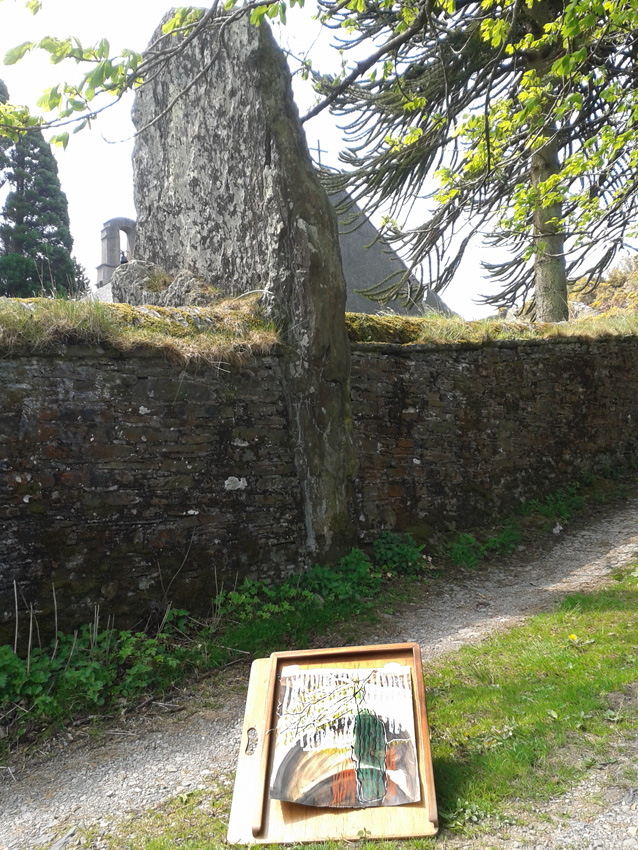
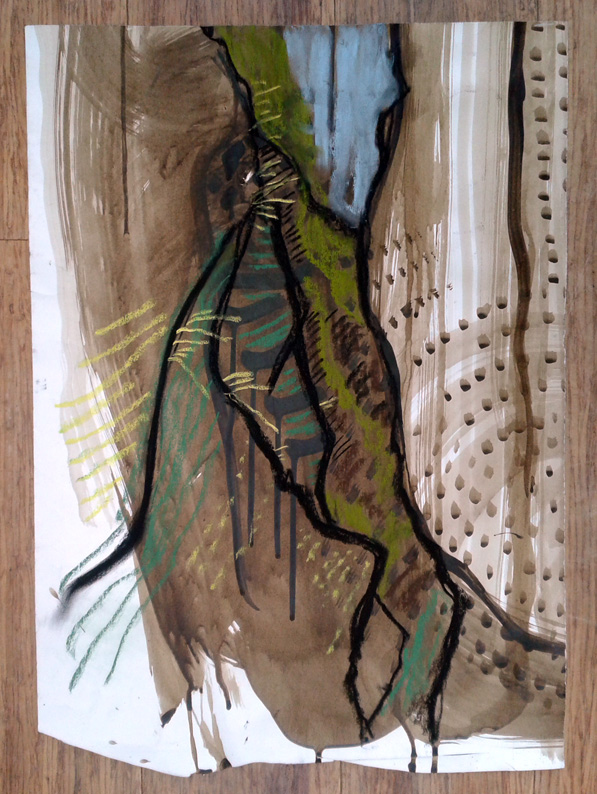
The Sentinel is a massive quartzite standing stone, the first ancient monument we met as we walked up Mynydd Llangyndeyrn, which translates from the Welsh as the Mountain of the Church of Saint Cyndeyrn. The stone was flat on the ground until 1976, when its socket was found and it was re-erected. Nobody is sure what the stone signifies although it may have been a way-marker and some think there may have been another opposite, forming a portal to the Bronze Age landscape of the Mynydd. As I circled the stone, looking for the right angle to draw it, I noticed the coastline in the distance. I was on the mountain with archaeologist Dewi Bowen and film maker Melvyn Williams and Dewi told me that the coastline was North Devon, around the Bideford area. Coincidentally I had some Bideford Black in my bag and so decided to use it to draw with. It’s a strange oily black pigment, a bit like coal, that used to be mined commercially in Bideford until the late 1960s. Local artists still dig it out and use it and I was lucky enough to be sent some back last year. It’s very possible that Bideford Black might have been traded and used many thousands of years ago.

Click here to find Dewi Bowen’s book about standing stones. Click here to see some of Melvyn Williams’ films. Click here to see my art for sale.

Grumble In The Jumble

capstone 2 b

What influences a drawing? Lots of things; the subject, the artist’s reactions to the subject; the drawing materials; the weather. That’s right, the weather. I was so cold by the time I reached this sub-Megalithic burial chamber on Mynydd Llangynderyn that I couldn’t be bothered to faff about with my carrying tube of paper and my drawing board. So I reached into my bag for my Daler Rowney Ebony sketchbook and a piece of white conte crayon and spent a few minutes sketching this, the fourth of the ancient monuments on the mountain. It was a long but steady walk up the mountain to the highest point and then a scramble over the ridge to reach the two dolmen, side by side. Unfortunately we had to cross an area of bog to get to them and that was dire. And cold. So by the time I got to this I was pretty fed up. And hungry. And grumbling.

capstone 2 a

The chamber is in amongst a jumble of rocks, mostly fallen from the ridge above. It was very common for these earlier monuments to be constructed at the site of natural rock formations so sometimes it’s difficult to differentiate them from what nature put there. The materials and the quickness of my drawing lent itself to representing the mishmash of rocks on the site.

Stones, Slurry, Sun

20160225_151026

This morning was bright, sunny and cold and I took off with archaeologist Dewi Bowen and film maker Melvyn Williams for a second day  following the trail of Bronze Age monuments across West Wales. We had a trek up Mynydd Llangyndeyrn, between the villages of Pontyberem and Crwbin to see a magnificent standing stone; a stone circle at the top of the mountain, with an extraordinary 360 degree vista; and a hike through liquid slurry (think The Bog of Eternal Stench) for two sub-Megalithic burial chambers. It was very rugged and very cold but I did 5 drawings en plein air.

And now I’m cwtched at home under a blanket with a purring Sparta Puss on my lap, a hot dinner and lashings of tea. More drawings tomorrow.

Up The Workers (with added cat)!

e

I have a permanent exhibition at The Workers Gallery in Ynyshir where I am one of the gallery artists. Started by Gayle Rogers and Chris Williams just over a year ago, The Workers has developed into a major cultural force in The Rhondda Valley. Originally the village library, Gayle and Chris took it over after it was closed down due to massive government cutbacks that have blighted so many deprived areas.

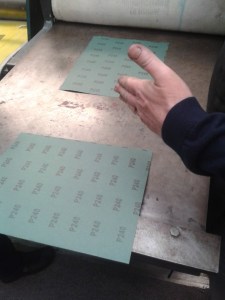
The stages of a block print: cutting, inking first colour, inking second colour, final print
The stages of a block print: cutting, inking colour 1, inking colour 2, final print

As well as a warm and welcoming place to visit, The Workers provides studio and workshop space for artists Gayle and Chris, has a main gallery space hosting an excellent programme of contemporary art, and another exhibition space for its gallery artists. At the moment, I am exhibiting a suite of eight block prints, inspired by a visit to Berlin’s Holocaust Memorial in the snow a few winters ago. There will be a major new exhibition of work by the gallery artists opening in mid-March – more news on that to come.

Printing the first colour on the antique Columbian Press at Swansea Print Workshop

I’ve used vinyl ‘soft cut’ blocks from Intaglio Printmaker in London and their litho / relief ink. The prints are two-colour reduction relief prints: I cut away the areas to be left white and printed a mid grey, then cut away the areas to be left grey and printed black. This is often called the ‘suicide’ method by printmakers because it destroys the block and there’s no turning back!

cat and cut

Here’s my cat, Sparta Puss, ‘helping’ with the cutting. A dangerous business, she has no concept of ‘Elfin Safety!

Myrddin’s Quoits

I’m continuing to work on a series of drawings done in the field, quite literally, of ancient stone monuments in West Wales, linked with the legends of the Mabinogion.

Merlins Quoits 2

This is Myrddin’s Quoits. Myrddin is the Welsh version of Merlin, who is a major figure in Welsh / ancient British mythology. I visited these stones, possibly part of a Neolithic cromlech and estimated around 5,000 years old, when I was out and about drawing in Carmarthenshire last week with archaeologist Dewi Bowen and film maker Melvyn Williams. They are on the edge of the village of Llangain, one is a few feet into a very muddy field and the other is in the hedge. It was really wet, after months of torrential rain, the ground was completely waterlogged but I gamely pulled out a piece of carbon and a sheet of vintage British paper and scribbled away on top of my portable drawing board. I took this photo in my garden, the hellebores are in full bloom.

Merlins Quoits 1

Here are Myrddin’s Quoits in a muddy field. We’re planning another drawing trip this week. I’m hoping the few days of sunshine we’ve had recently will dry the fields out a bit.

Little Lovely Leftovers

leftovers

Just finished stitching a set of 15 little prints for the Leftovers VI international print exchange organised by the irrepressible Amy Nack at Wingtip Press in Boise, Idaho, USA. The premise of Leftovers is to use up some of those scraps of beautiful printmaking papers that are often left over from our projects. I have put together an edition of 15 little rubber stamp prints that I developed from an original screenprint. I printed them onto fragments of Japanese Shiohara paper and then stitched them onto leftover pieces of Somerset, using my antique Singer sewing machine. Artists from all over the world participate in this each year and Amy puts together a touring exhibition of each year’s Leftovers that travels the globe. If you’re quick, there’s still time to enter.

Ropes And Buckets

cbj2

I caught up with an artist chum from way back when recently. Chris Bird-Jones and I were in Swansea Art College in the 1970s when the world was a very different place.  Chris recently came back from an artist residency at the University of Hawai’i where she had an exhibition of the art she created there. She works mainly with glass, from monumental and architectural to tiny hand-held pieces.

She has just installed a new exhibition at the Volcano Theatre Gallery on Swansea’s High Street based on buckets, lots of small buckets made from mirror glass; she is fascinated by the potential of the mirror bucket for collecting, visually, whatever you want to put in it. Chris had a public ‘Call Out’ for ropes to hang her mirror buckets on, I was one of the artists who responded and I made a simple rope from plaited tissue paper that I had decorated with golden graphite rubbings from a woodcut block.

cbj1

I visited just after she’d finished and loved the diversity of ropes that different people had brought along, from simple rubber bands to complex sculpted pieces. The pieces were tied together visually by the two-dimensional glass buckets that hung from each piece of rope, twinkling and reflecting their surroundings.

Next Saturday Chris will be doing a talk at Volcano, sharing her experiences in Hawai’i, the work from her residency and how her practice has developed and she will introduce the work she is developing for her upcoming residency at Ruthin Craft Centre next month.

CHRIS BIRD-JONES | Glass Artist | Creative Wales Ambassador 2015.

Saturday 27th February, doors open at 3:30pm and the talk will begin at 4pm. Volcano Theatre Gallery, High Street, Swansea.

The Greyhound’s Kennel

Twlc Y Filiast

This is the first of the ancient stone monuments I drew a couple of days ago when I was trekking around muddy Carmarthenshire with an archaeologist and a film maker. The Welsh name is Twlc Y Filiast which translates as the Kennel of the (female) Greyhound, but the monument is also known as Arthur’s Table or Ebenezer’s Table. It’s a Neolithic chambered tomb. There are a number of ancient burial sites associated with greyhounds. In Welsh, greyhound is milgi (female is miliast) and means a thousand dogs (or a thousand bitches) as a greyhound was considered to be as valuable as a thousand ordinary dogs because of it’s hunting ability, absolutely vital in ancient societies.

The setting is strange and ethereal. I’m used to seeing dolmen out in the open, often overlooking the sea or set on top of a hill and it was odd seeing this in a shadowy hollow by a stream just behind the now closed* village school in Llangynog. It’s well hidden and easily missed and the route was treacherous after the many weeks of torrential rain and awful weather.

Llangynnog 1

I had almost finished the drawing when I noticed the stone face in profile, looking towards the stream and the woods on the opposite side. I drew with willow charcoal onto a vintage British paper. I had a range of drawing materials but I instinctively reached for the willow charcoal; when I reflected on my choice later I realised that I had gone for an organic, natural material that had itself come from the woods and would have been used by ancient peoples.

*Many village schools have been closed by the Welsh Government, depriving rural communities of an important resource. A national disgrace in my opinion.

The Vastness Of Time

Carreg Jack

I was out and about with archaeologist Dewi Bowen (left) and film maker Melvyn Williams (middle) yesterday, following a Bronze Age route to visit 4 sites of ancient stones. I was planning on drawing them all but this one turned out to be a bit on the short side and I couldn’t get any inspiration from it, to be honest and as it was so cold I didn’t want to stick around and draw it. Sometimes you just don’t find a connection with the subject matter.

Carreg Jack 2

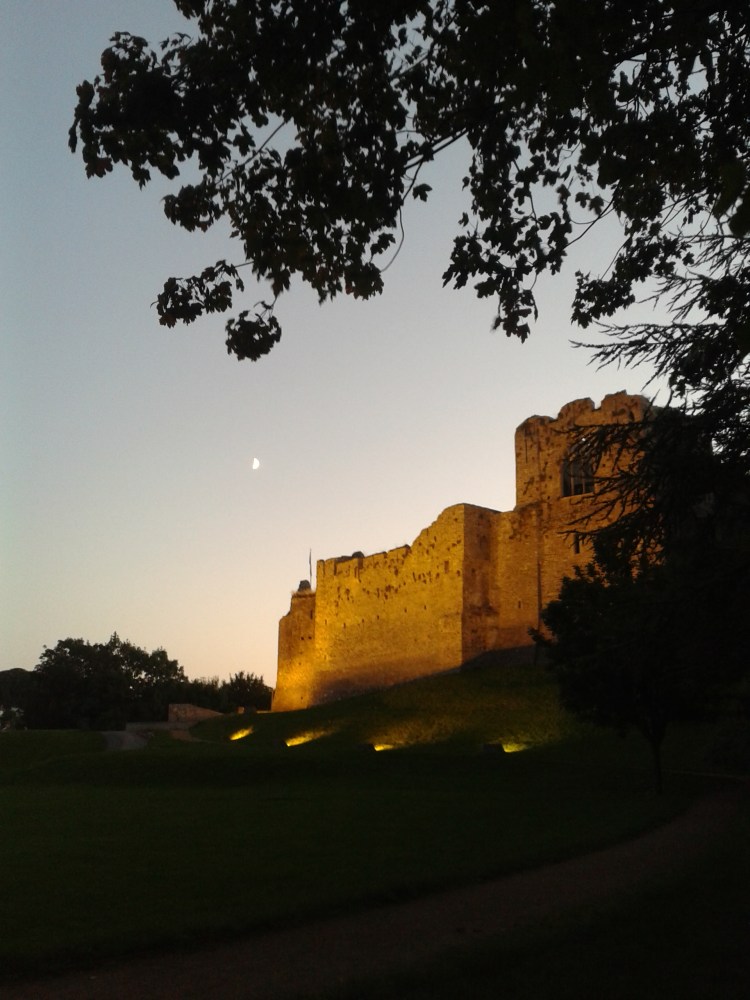
Then I turned round and saw this! The spectacular Llansteffan Castle at the top of the hill. Glorious. So then I started thinking about combining the two images sometime. But not in the cold on the beach in the wind. It’s a sofa job with Adobe Photoshop.

This standing stone is ‘Carreg Fawr Nant Jack‘, which translates from the Welsh as ‘The Big Stone at Jack’s Ford’. Although it looks small now, there’s a lot of it under the sand and in the past it stood on pasture land where it would have been much taller. There’s a huge timescale captured in these two photos. The castle is almost a thousand years old, but was built on the site of a much older Iron Age fort, about another thousand years earlier, and the Bronze Age ‘Carreg Fawr Nant Jack’ could be a couple of thousand years older again.

MUD!!!

Maen I Llwydion 3

A great day out today, scrambling across the West Wales countryside with irrepressible archaeologist Dewi Bowen and inquisitive film maker Melvyn Williams, finding ancient burial sites and standing stones and drawing in the mud. This site is called Meini Llwydion (Grey Stones) and it’s near Llangynog in Carmarthenshire. After almost 4 months of rain, the ground was absolutely sodden, despite the bright, dry, sunny weather today. The mud put my new walking boots through their paces and the mud won.

Maen I Llwydion 2

People often assume that artists have an easy time of it, sitting around dabbing a bit of paint in warmth and comfort, but here’s the reality – wrestling with a drawing board in a quagmire! The acres of liquid slurry finally got the better of me and I gave up on the drawing board and loose sheets and I drew into my Daler Rowney ‘Ebony’ sketchbook with a white conte crayon. We’ll be continuing this journey across Bronze Age South Wales intermittently in coming months, as Dewi researches for his new book, Melvyn makes his documentary film and I draw inspiration from my ancestors marks on the environment.